
Finance
How much money would we need to win in the lottery to be able to stop working in Spain?
It depends on your age and where you live but you'd likely need a few winning 'El Gordo' jackpot tickets in the famous Christmas draw


Madrid
Let's imagine that on 22 December we win the Spanish Christmas lottery jackpot prize, known as 'El Gordo', and we appear on all the news channels explaining what we are going to do with the prize money while our family and friends jump for joy, bottle of cava in hand.
With the 400,000 euros from the first prize - 328,000 after taxes - you could do many things: pay off the mortgage, save for retirement, renovate the house, go on a trip with the whole family, buy a new car (or several)... That's all well and good, but could we consider giving up work? Most winners cannot. "'El Gordo can give us a good deal of money, but it doesn't guarantee a lifetime of not having to go back to work," admits Marta Pinedo, director of the savings platform Raisin España.
So how much money would we have to earn before we would never have to work again? "To talk about financial freedom, where our savings generate enough income to cover our standard of living, you need a lot more than the first prize in the Christmas lottery," says the financial expert. According to a study conducted by Raisin, a middle-aged person would need to win at least four lottery tickets to be able to live decently without having a monthly income.
One million or two
However, this figure is not the same for everyone because financial needs depend on factors such as age, income level, place of residence and even gender. Clearly, the amount of money a 20-year-old needs to be able to live the rest of their life without working is not the same as if their parents won. "The budget required to achieve financial freedom evolves with each stage of life," the financial platform points out.
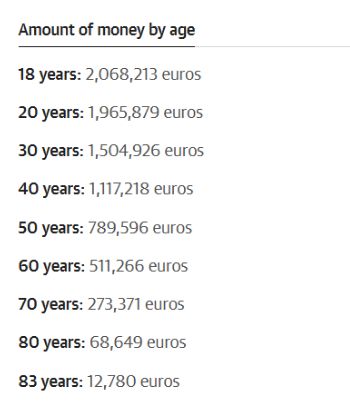
The study estimates that an 18-year-old needs just over two million euros to be able to get by without depending on a salary. As the years go by, this amount reduces considerably "because it is assumed that we have already passed an important part of our working life and have generated income or have some savings", argues Pinedo. For the parents of this 18-year-old, 789,000 euros would be enough to be able to leave their respective jobs and live off the lottery prize until the end of their lives.
The 'luck' of Basques and Canarians
Another very important factor in calculating what we would have to win on 22 December in order not to have to go back to work is our place of residence. The differences between one region and another from an economic point of view are huge. People in the Basque country would need to win the biggest jackpot - specifically, 2,333,420 euros - to be able to afford the luxury of giving up work, followed by people in Madrid (2,222,636 euros) and Navarra (2,189,529 euros).
"The explanation lies in the high cost of living in these areas, especially in relation to housing, services and day-to-day expenses," argue Raisin. On the other side of the scale are those living on the Canary Islands, who could 'retire' with 1,677,257 euros, the people of La Mancha (1,721,370 euros) and the people of Extremadura (1,732,370 euros).
Gender also plays a role. In fact, the report states that women need an additional 265,000 euros compared to men to achieve the same financial freedom. "The wage gap reduces their ability to save and makes it difficult for them to build up a sufficient cushion to be able to live without depending on a salary," they highlight.
Let's imagine now that we hit the jackpot. It's already clear that we can't give up work, but how should we invest those 320,000 euros to make the most of them? Economist Sara Muñoz gives us the keys: "We can set aside 10 per cent for luxuries, but no more. We should set aside 20 per cent for retirement and the amount we have left can be divided between an emergency fund and small fixed-term investments or real estate".
Seven out of ten prize winners are broke after five years
A study carried out by Spain's Organisation of Consumers and Users (OCU) reveals that seven out of ten people who have won the Christmas jackpot end up broke after five years. Broke and sometimes... even in debt because they didn't know how to manage this sudden injection of money. In order not to be part of that list, but of the remaining 30%, it is "important to invest wisely. What tends to happen in these cases is that, as it is money that is not the result of our effort but of luck, it seems to be spent more happily, as if it costs us less. And this is a big mistake. One of the big problems is that there is very little financial education in general. We are not used to handling so much money and when we see so many zeros in the account we don't know what to do. It is essential to have a well-designed plan for the future because money goes very easily," warns economist Sara Muñoz. The experts' recommendation is to keep calm and take "a time of reflection of at least six months" to analyse our financial situation before deciding what we are going to spend the prize money on. "It is very common for people who win the lottery to get carried away by the excitement of the moment and end up making a bad investment. Joy can turn against you if you don't manage your money well," they agree.
![[]](http://static.vocstatic.com/voc26/latest/assets/images/favicon/surinenglish/apple-touch-icon-57x57.png)