
Taxation
Countdown is on for new 'Big Brother' electronic invoicing system in Spain: What impact will it have?
Accountancy specialists have confirmed the concerns of many small business owners and the self-employed regarding the Verifactu system that will go live in 2026, but tried to give some assurances about how it will work

Malaga
The countdown to the New Year is already under way but, for thousands of self-employed people and small business owners in Malaga province and across Spain, 2026 will bring yet another worry: adapting in time to the new regulation that requires them to use computerised invoicing systems (RRSIF is the acronym, but it is more widely known as Verifactu). This regulation lays out new requirements for electronic invoicing systems used by businesses and professionals, with the aim of preventing and detecting fraudulent practices such as modifying invoices once they have been issued or maintaining two sets of accounts through so-called dual-use software. As of 1 January for companies and 1 July for the self-employed, having software that is not certified by the Spanish tax agency (AEAT) can result in a fine of 50,000 euros for the user. In the case of software manufacturers, the penalties for selling non-certified software can reach 150,000 euros (the sales ban on non-compliant software has been in effect since July this year).
Accounting firms have been working overtime these past few months resolving queries from clients concerned about the impact of this regulation on their business. This concern stems from a lack of information, the barrage of warnings from AEAT, confusion surrounding the e-invoicing regulation (which still does not have a formal start date) and also the half-truths being spread by some companies for their own commercial gain.
Rubén Candela, founder of the financial consultancy company that bears his name, explains: "There's a lot of inaccurate information circulating on social media, which is often self-serving and driven by manufacturers of e-invoicing software. They have been launching alarmist messages with the sole intention of selling their products."
Who is exempt from the new regulations?
One of the rumours circulating about Verifactu is that, once it comes into effect, every business will have to issue an invoice for everything it sells, be it a kilo of apples at the market or a coffee in a bar.
This is not true: as the general council for all professional associations in Spain for financial advisors and consultants (CGCGA) has clarified, Verifactu only affects companies and self-employed workers who are already using computerised invoicing systems (SIF). In other words, the new regulation does not require those not previously obliged to invoice (for example, small retail businesses selling to the end consumer) to start invoicing, nor does it affect those who create their invoices by hand or with simple programs, such as Word or Excel without using macros.
AEAT itself specifies in its FAQ section on its website that the regulation "does not affect those who invoice manually or use programs that are limited to generating and printing invoices without any additional functionalities".
"Imagine a market stall selling fruit, which is not required to issue invoices unless the customer prunes the fruit. That fruit vendor can continue as before: creating the requested invoices by hand, or with a Word or Excel document, but without having an invoicing programme", explains Manuel Méndez, dean of Malaga's association of economists.
However, if the merchant already issues invoices (for instance, to business customers) through their electronic cash register, they will have to change it if it is not adapted to Verifactu.
So, who is subject to Verifactu?
The impact of this regulation will therefore focus on small businesses and the self-employed who already use invoicing software. Those with a turnover exceeding six million euros are already subject to the requirement to submit such information promptly to the tax authorities.
The accounting firms are doing their best to send out reassuring messages: "It's not the end of the world, we simply have to adapt because there are things that used to be done a certain way and now cannot be done", says Rubén Candela, referring to practices that are currently commonplace "that don't necessarily have fraudulent purposes", such as changing the issuer or the date of an invoice after it has been issued. "That can still be done, but only by issuing a revised invoice, so that each change is recorded."
Ana María Feria, senior associate in the tax department of Montero Aramburu & Gómez-Villares Atencia, says: "There's no need to worry, just take action. There are almost two months left for companies and eight months for self-employed individuals, which is enough time to prepare, but let's not rest on our laurels."
"AEAT is bombarding companies with questions and this is generating unease and the feeling that they will be under intense scrutiny, but this really shouldn't be cause for alarm. It is, however, another bureaucratic burden being added to the many others that companies have taken on in recent years: data protection law, time-tracking, anti-harassment protocols, the equality plan...," says Méndez.
How much does it cost to adapt?
Adapting to the new system will not be free, but neither will it be prohibitively expensive. Those using non-compliant software will have to switch providers, and software that has been adapted to Verifactu is taking advantage of this requirement to raise subscription costs. In some cases, this will be compounded by the need to expand cloud storage capacity or replace obsolete IT equipment. "The biggest investment will be time and effort in adapting," says Ana María Feria. "Time is precisely what the self-employed have the least of," is the criticism from Lorena García, president of Malaga's provincial federation business entrepreneurs. She adds: "Companies are better informed because most already use electronic invoicing systems, but there are many self-employed people who still don't know what this is all about and it's going to cost them. There's a significant digital divide."
As for Malaga's business hospitality association (Mahos), spokesperson Ana Pérez Marcos views this regulation as yet another push towards digitalisation and expresses concern about this being "an additional burden" for a sector that "is already facing many challenges with adapting to the latest regulations, the increase in sick leave and wage costs".
Is there a free alternative?
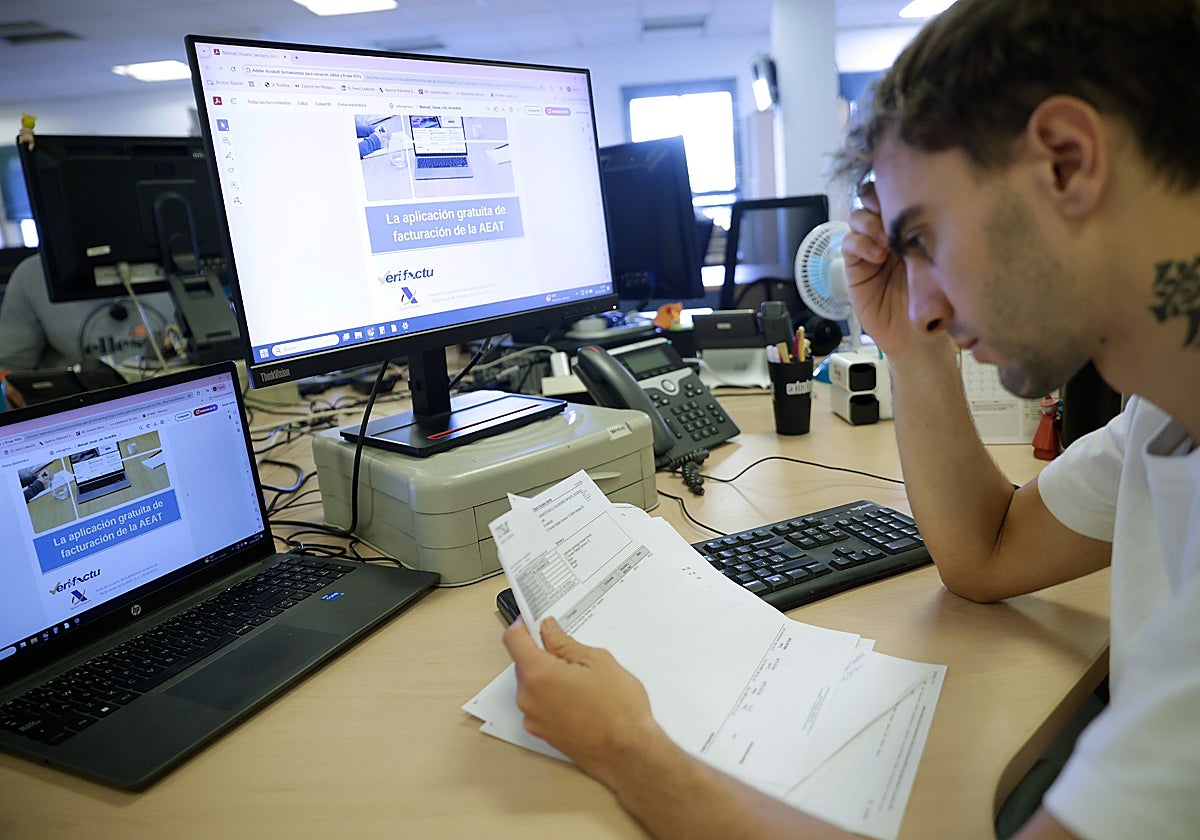
In any case, there is a free alternative to commercial invoicing systems: AEAT has developed an application designed for the self-employed, professionals and small businesses with a low volume of transactions to issue electronic invoices and send them directly to AEAT without needing to purchase or subscribe to proprietary software. It can now be downloaded now from the AEAT website.
What requirements must certified invoicing systems meet?
The new requirements for invoicing software basically consist of generating and saving a summary of the invoice - called an invoice record - at the point when it is issued. This record incorporates a series of security and control measures, such as a digital fingerprint of the data and the inclusion of information from the previous record generated. The goal is to provide evidence of any subsequent alteration to the invoice. They must also include a QR code on each invoice issued to facilitate the transmission of information should the tax authorities require it.
Can AEAT always view my invoicing?
The control capabilities that AEAT gains with Verifactu have led to it being labelled as 'the Big Brother of invoicing'. However, the claim that the tax authorities will have real-time access to all invoices is only a half-truth. In reality, each business can choose between two options: one is called Verifactu, in which the AEAT does indeed have online access to a summary of each invoice, and the other is Non-Verifactu, in which this information is kept by the user and is only sent to the AEAT if requested. Nevertheless, in either case, invoices must include the aforementioned QR code.
In the case of the free application developed by AEAT, the only available mode of use is Verifactu, thereby giving AEAT real-time access to the information.
Which mode of operation is more convenient? "It depends on the client: whether the software they are currently using can be easily adapted, whether it is perhaps the best time to opt for a customised system adapted to their needs, or whether it is a small business with very few operations for which the AEAT app may suffice," says the lawyer from Montero Aramburu & Gómez-Villares Atencia.
AEAT answers questions
What penalties does the law stipulate for the sale and use of unauthorised software?
Two types of penalties are foreseen, both serious:
- For the manufacture, production and marketing of computer systems that do not comply with the new regulation. In this case, the stipulated amount is a fixed 150,000 euros for each tax year in which sales of this type of system have occurred and for each different type of system involved in the infraction.
Similarly, when such computer systems are not certified when required to be so, a penalty of 1,000 euros will be imposed for each computer system marketed without such certification.
- For the possession of computer systems that are not properly certified or where certified devices have been altered or modified, then the fine amount is 50,000 euros per tax year.
- I belong to a business category that is not required to issue invoices. Does the new regulation affect me?
No, as long as no invoices are issued or all invoices are issued manually, meaning without using a computerised invoicing system (SIF). If at any point an invoice is issued using a SIF, then the RRSIF would apply.
- I use Excel or Word to issue invoices. Do I have to stop using them?
The regulation does not apply to you if word processors or spreadsheets are used exclusively to enter invoice data, issue and print invoices and store invoice data. However, you will be subject to the regulation if, in addition to the above functions, you use them to process the invoicing information contained in the program to directly generate IVA tax ledgers, personal income tax ledgers, accounting records or any other output used for voluntary compliance with tax obligations.
AEAT may verify whether the word processors or spreadsheets used for issuing invoices meet the criteria of a SIF.
- A merchant has a scale and a cash register. Is this considered a 'simplified billing system' (SIF)?
In the event that the business owner is required to issue invoices, the fact that they use a computerised invoicing system (SIF) - consisting of a cash register to record sales and print a simplified invoice for each sale - subjects them to the new regulation. Therefore, they must adapt the cash registers (if possible) or acquire suitable software.
As for electronic scales, if it is used only to weigh the product and obtain the amount, which is then entered manually into the cash register to issue the invoice, it would not be considered a SIF, but rather an auxiliary measuring device. However, there are electronic weighing scales with more powerful functionalities that allow for the total amount of each and every weighed product to be tallied up and for a simplified invoice for the entire purchase to be issued. These would be regarded as a SIF.
![[]](http://static.vocstatic.com/voc26/latest/assets/images/favicon/surinenglish/apple-touch-icon-57x57.png)