
Climate change
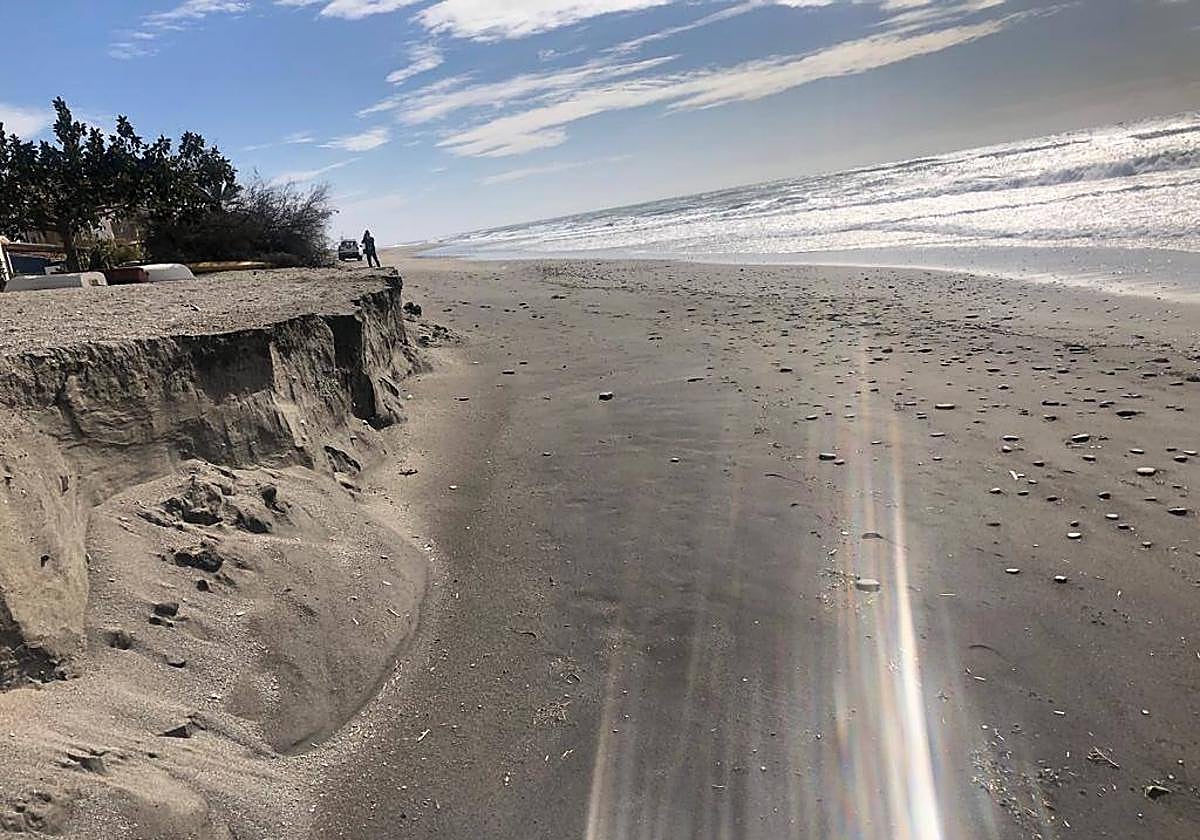
Study projects loss of between 5 and 25 metres of beach on Costa del Sol over the next 25 years
The Junta de Andalucía's ministry of sustainability and environment is developing two reports on the potential impact of climate change on the region's coastline
Europa Press
Malaga
The Junta de Andalucía's regional ministry of sustainability and the environment, within the framework of the Andalusian climate action plan (PAAC), has developed two initiatives to gain in-depth knowledge of the impacts that climate change is having on the region's coastline, estimate its evolution in different scenarios and have tools that will enable preemptive action.
Both studies offer "highly valuable" information on the vulnerability of the coastline to phenomena such as the rise of the sea level, the loss of dry beach area or the processes of coastal erosion and regression, which are already noticeable in different parts of the region, as the Junta has stated.
The first of the actions was the study on the vulnerability of the Andalusian coastline, carried out within the framework of the PIMA-Adapta Costas programme, the results of which were published in 2022.
Among its main contributions is the creation of geo-referenced databases containing detailed information on resources, facilities, land use and activities susceptible to climate change along the entire Andalusian coast.
This work also includes a cartographic viewer and a specific report on coastal risks, as well as a proposal for a climate change adaptation plan applicable to land in the maritime-terrestrial public domain assigned to the region.
The second study, currently underway and pending final validation of results, focuses on the analysis of flooding and erosion in coastal areas under climate change scenarios.
Under the name of 'iccoast', the main objective of this research is to obtain results on the parameters of flooding and coastal erosion along the entire Andalusian coastline, based on the scientific projections published by the intergovernmental panel on climate change (IPCC) and with an analysis horizon up to 2100.
The viewer makes it possible to forecast and visualise coastline changes as the sea level shifts. According to the Junta, this tool shows how the coastline will look in different climate scenarios and makes it possible to determine the erosion that each beach will suffer. It is a "very useful" management tool for anticipating impacts and planning actions more effectively.
According to the scenarios analysed, both in their most optimistic and most unfavourable versions, climate change will have "a significant impact" on the Andalusian coast in the coming decades.
The models project a loss of between 5 and 25 metres of dry beach along the Andalusian coastline between now and 2050, with the Costa del Sol in Malaga being the most affected stretch. As time progresses, depending on the type of beach and its sedimentary composition, this retreat may intensify "notably".
Open, fine-sediment beaches with deeper closure depths will be "particularly affected". In the most extreme cases, they could experience permanent retreat of up to 65 metres by 2100.
Cadiz and Malaga provinces, the most affected
The report highlights that, if the most unfavourable scenario materialises, the rise in the average sea level could lead to the disappearance of up to 33 Andalusian beaches in the coming decades, with a particular impact on the Costa del Sol and the western coast of Cadiz.
General secretary for the environment and climate change María López Sanchís underlined the importance of obtaining this technical data "as a basis for political action and territorial management", adding that the Andalusian coast is "among the most valuable in Europe for its natural wealth and economic importance".
The regional ministry has placed "special emphasis" on the use of this information, not only from an environmental perspective - protecting natural areas, habitats of regional interest or natural and national parks - but also from a socio-economic perspective, taking into account the impact on sectors such as tourism, agriculture or industry located on the coast.
López Sanchís stated that adaptation to climate change "requires solid and up-to-date instruments that allow us to respond effectively to new challenges". Fortunately, Andalucía is equipped with "digital and predictive tools" that place it "in a leading position among the regions" - a position that allows it "to plan solutions".
"Adaptation is a collective task. These studies are not an end point, they are the beginning of a roadmap that will allow us to better protect our coastline and ensure that it continues being an engine of well-being for future generations," she stated.
![[]](http://static.vocstatic.com/voc26/latest/assets/images/favicon/surinenglish/apple-touch-icon-57x57.png)