
Environment
Malaga researchers discover Mediterranean algae capable of stopping spread of invasive Asian species
The discovery opens a new ecological avenue in the fight against the dangerous spread of Rugulopteryx okamurae along the Spanish coast

Malaga
The costly fight against the spread of Asian algae (Rugulopteryx) might have found a much more economical solution with the discovery of a native Mediterranean algae, capable of stopping the proliferation of the former. Rugulopteryx is an invasive species that causes millions in economic losses, especially between Marbella, Estepona and Manilva.
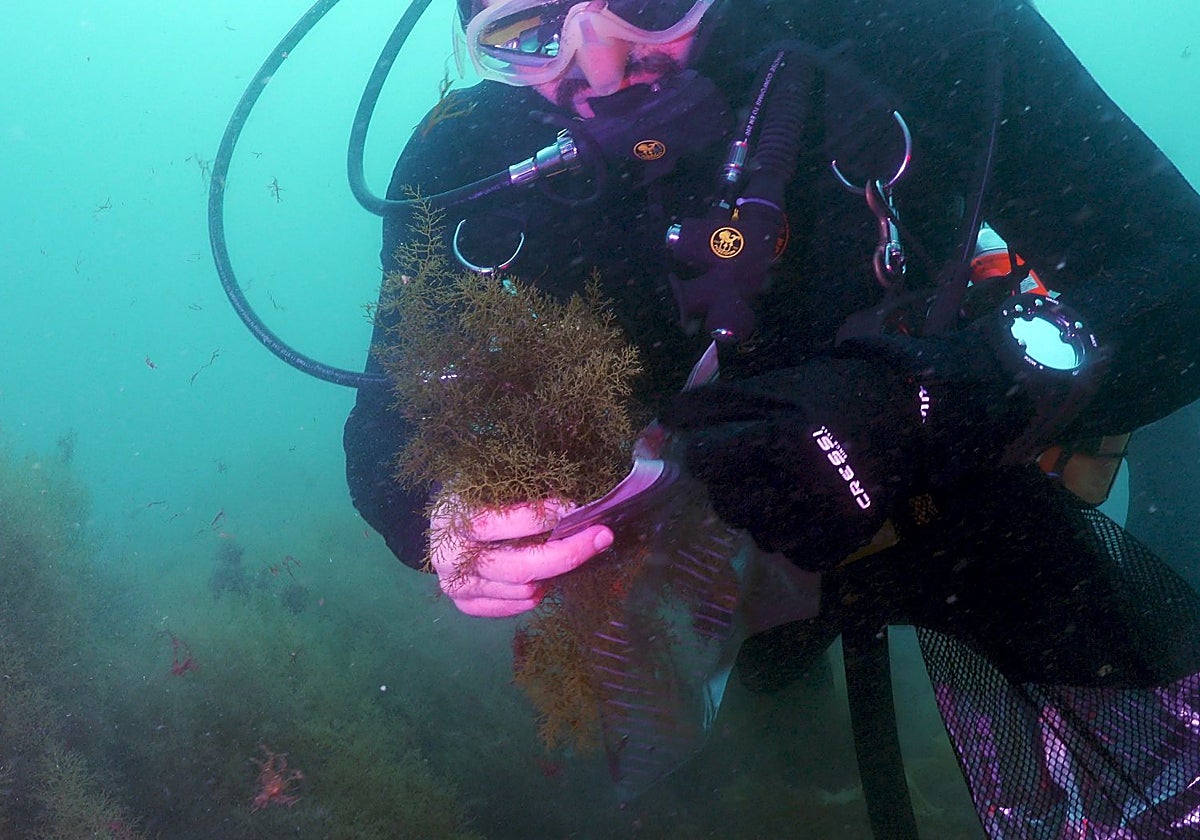
A recent study published in the Plants journal has found that the Gongolaria usneoides algae, native to the Mediterranean, is capable of combating the invader on its own. This means that a potential repopulation of the native species could put an end to a spread that has not been contained by other means in the past ten years.
The research was led by Débora Tomazi and Fernando García Alarcón, who have collaborated with several other scientists. It shows that, in some areas where Gongolaria is present, the biomass of Rugulopteryx is lower or dominated by other red algae that grow on it. The conclusion is that phenolic compounds released into the seawater by Gongolaria affect the ability of the invasive species to grow and develop.
Chemical compounds released by Gongolaria algae affect the ability of the Asian algae to grow and develop
In laboratory tests, Rugulopteryx has showed "a considerable decrease in photosynthesis without recovery after exposure to high concentrations of phenolics". Therefore, "it can be inferred that the presence of G. usneoides in nature and the release of phenolic compounds by this alga could be affecting the invasive alga R. okamurae, which could serve as a natural mechanism to diminish or weaken the invasive species".
According to García Alarcón, who has participated in the diving studies since the beginning, this discovery opens up a new avenue for preserving marine life in the Mediterranean.
The discovery has been possible thanks to the collaboration between the Asociación Equilibrio Marino and the University of Malaga. The next objective is to assess whether this process can be replicated in other areas and develop management and mitigation strategies.
The team has already launched the Invademar project, which seeks funds to continue the research and repopulate an area invaded by the Asian seaweed as a pilot test. "But research of this kind requires resources and the support of institutions for marine conservation. It requires collective commitment," the researcher says.
The most feasible solution would be repopulation with the native algae. "These algae grow at an enormous rate and generate submerged forests, which fill up with fish species that lay their eggs there and come to eat from it; it is the resurgence of the Mediterranean," he states.
Cheaper solution
As well as being beneficial for the ecosystems, this solution would be cheaper. "Imagine how much money the regional government and town halls are spending to remove it," the researchers state, adding that invasive species have negative effects on tourism and fishing. "Until now, no real solution had been found. This measure, based on nature, opens up research opportunities to stop the invasion."
Until now, many of the lines of work have focused on studies on the use of the enormous residual biomass extracted from beaches as garden fertiliser, although this type of action does not contribute to halting the invasion. Nor has the removal of the algae clumps managed to stop its advance, despite investments of millions of euros by town halls such as Marbella and Estepona. Time will tell whether this new biological 'weapon' will finally succeed in restoring the seabed of the Alboran Sea to its original state.
![[]](http://static.vocstatic.com/voc26/latest/assets/images/favicon/surinenglish/apple-touch-icon-57x57.png)