
World Aids Day
Malaga was the Andalusian province with the highest number of HIV diagnoses in 2024
Diagnoses in the province grew by 20.83% to 145 cases last year compared to 120 in 2023, half of them late, thus breaking the downward trend of the last five years
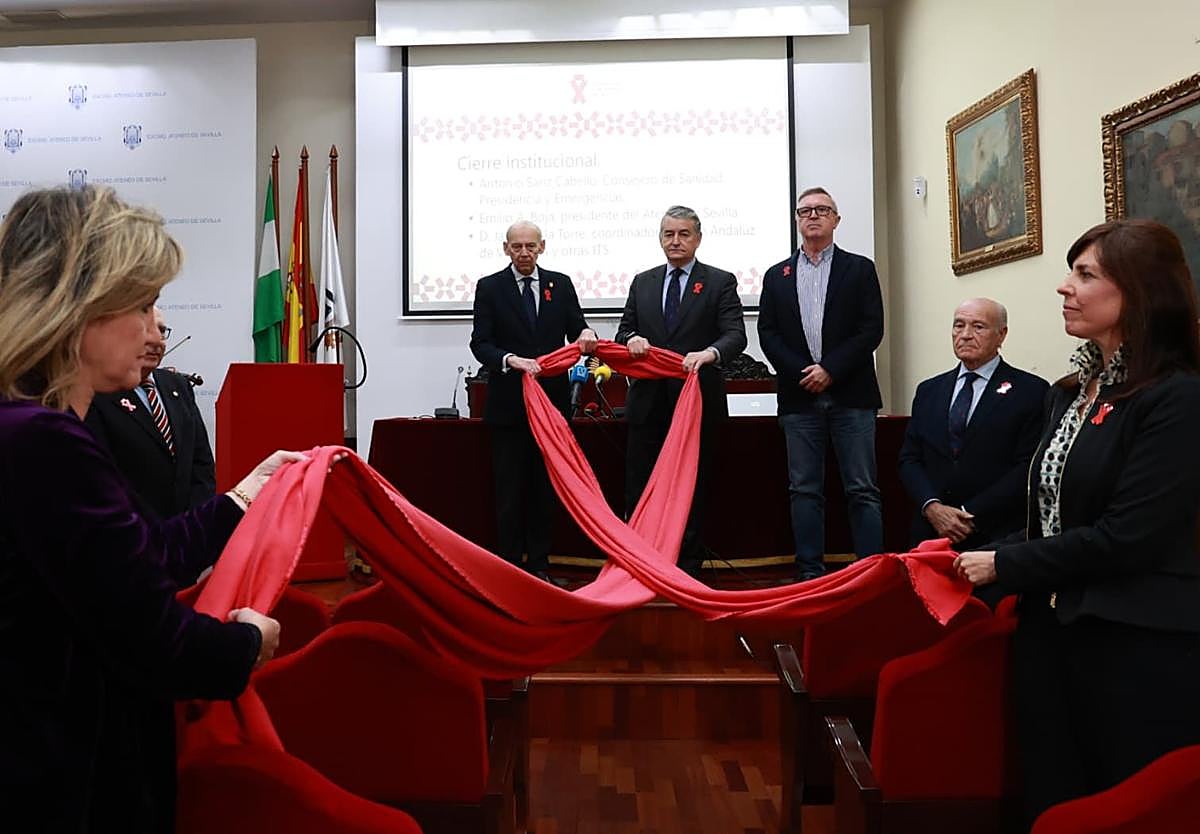

The province of Malaga leads Andalucía in the number of new diagnoses of human immunodeficiency virus (HIV) in 2024, with 145 cases. Moreover, the increase is significant: cases are up 20.83% year-on-year, according to data released on Monday by the regional ministry of health, whose head, Antonio Sanz, closed events for the World HIV/Aids Day organised by his department in Seville.
In 2024, 145 new cases of HIV were diagnosed in Malaga province, of which 120 are men and 25 are women. The rate is 8.17 per 100,000 inhabitants (an increase of 19.2%), higher than the Spanish (6.95) and Andalusian (6.1) average rate. In 2023, 120 new cases were reported, with a rate of 6.85 per 100,000 inhabitants in the province.
In Spain, according to the new diagnoses information system, 3,340 new cases of HIV have been reported and the rate (6.95 per 100,000 inhabitants) is still above the average for European Union (EU) countries.
These numbers break the downward trend in diagnoses of the last five years in the province: in 2019 there were 311 and 146 in 2020, to continue the decline to 120 (117 according to other data series consulted, also from the autonomous region) in 2023.
In absolute values, and in terms of diagnoses, Malaga was followed by Seville (107), Almeria (66), Granada (58), Cordoba (52), Cadiz (49), Huelva (27) and Jaen (23).
In Andalusia, there were 527 new cases, eight more than in 2023. Of the new diagnoses, 53% were late diagnoses (64 at the Aids stage). This figure replicates the Spanish figure and could therefore be similar to the provincial figure, which clearly indicates the need for patients and family and emergency doctors to include another new derivative in the health check-up equation: that of having the test.
In 2024, sex between men was the most frequent transmission mechanism (45.3%), followed by heterosexual sex (23.5%). Increasing early diagnosis and strengthening prevention and sexual health strategies, especially among young people, are key steps.
Call for testing
Councillor Sanz appealed "especially to young people" to definitively close the door on the stigma associated with sexually transmitted infections, especially HIV/Aids. "Stigma and discrimination increase the risk of acquiring HIV, undermine access to services and deepen marginalisation and violence: no one, absolutely no one, should be discriminated against because of their health status.
Sanz pointed out that Andalucía is making progress with new diagnostic circuits and the extension of pre-exposure prophylaxis (PrEP) and recalled that in 2021 the region had already surpassed the 90-90-90 target set by UNAids (knowledge of serostatus, 90.4%; access to treatment for people who know their status, 90.7% and viral suppression among those receiving treatment is already at 91.9%). The aim is to reach the 95-95-95 target set for 2030, he said.
The minister invited the population to get tested for HIV, because "late diagnosis is a serious problem both for the individual and for society in general: screening and early diagnosis can improve people's quality of life and slow the spread of the epidemic".
The health minister said that HIV is a "manageable chronic condition" at present, and advocated looking head-on "at the new realities of sexual health", among which he mentioned chemsex (sex with drugs), which "poses new challenges, not only in sexual health, but also in mental health and addictions".
STIs in Andalucía have grown in the last decade, exceeding the expected values in 2024 with respect to previous years, especially for chlamydia, gonorrhoea and syphilis. The rise in HIV, as well as in these diseases, is due, among other causes, to the greater accessibility of diagnostic tests and the improvement of surveillance systems, but also to the decrease in the perception of risk and the expansion of relationships through digital applications, which has led to the generalisation of STI detection tests among primary care and emergency professionals, in order to know, as soon as possible, the serological status.
Diagnosis as soon as possible
Manuel Castaño, a specialist in Infectious Diseases at the Regional University Hospital of Malaga, has stressed that the infection is "well controlled" in Malaga, that there has been a significant impact on consultations by patients coming from other countries, basically from Latin America or Eastern Europe, and has stressed that he already has patients in follow-up with more than eighty years who have been infected for 30 and 35 years, although "late diagnosis" for three decades continues to be a problem. "This has problems from a personal, care, social and disease transmission point of view, because you know that a person who is diagnosed, treated, controlled, the viral load becomes undetectable and stops transmitting the virus."
He recalls that a diagnostic protocol is being implemented in the emergency department, so that when someone arrives "with a series of illnesses or processes that could lead to suspicion of HIV infection, a serology test is requested, with the patient's prior permission, as always: this is where 'diagnoses' are being hunted," he says. Primary care doctors are also being trained.
The truth is that between 8% and 10% of patients who have HIV do not know it. "People who go to their health centre for a routine check-up, to see how their thyroid hormones are, should ask their doctor for a test, because we have all been exposed or could have been exposed." Not surprisingly, he stresses that "the truth is that the fear of Aids has been completely lost, nobody uses condoms: PreP is used as if it were a chemical condom, so that we understand each other, with which other sexually transmitted infections are emerging in an important way," he says.
"The idea that needs to be conveyed is that, if it is diagnosed, no one dies from it: the key is in the diagnosis." If that happens, mother-to-child transmission (already eradicated in the country) is eliminated.
Advances in antiretrovirals have been huge in the last decade: they are more convenient and have no toxicity. "Today 80% of people are controlled with a pill once a day: they take less medication than someone with high blood pressure." Injectable drugs are already used every two months and, in the not too distant future, current studies will have produced a weekly pill made up of two drugs in combination.
The future, however, lies with long-acting strategies, drugs introduced subcutaneously that could be used every six months. Added to this is pre-exposure prophylaxis, indicated for people who are in high-risk relationships. It is increasingly used.
![[]](http://static.vocstatic.com/voc26/latest/assets/images/favicon/surinenglish/apple-touch-icon-57x57.png)