
Health
Malaga at forefront of organ and tumour laboratory development for testing of new drugs
The provincial biobank research unit has created the first four cultured replicas, grown from patients' tumour tissue, to test radiotherapy treatments for head and neck cancers
-U34285237331upV-1200x840@Diario%20Sur.jpeg)

Malaga
Malaga Biobanco provincial de Málaga, a research support unit that houses an organised collection of human biological samples and associated data to promote scientific study, is currently at the forefront of national research in the generation of so-called organoids, a miniature representation of a human organ (or a tumour or any other pathological tissue, for instance). It is a 3D model replicated in a laboratory from tissue cultures taken from patients, which allows the medical experts to test drugs and treatments or observe how a particular disease develops in that organ.
This type of research is key to the future of precision medicine and organ transplants. The provincial biobank is a multi-site unit located across the province's public hospitals, but mainly housed in three hospitals: the Regional, the Virgen de la Victoria (Clínico) and the Costa del Sol. It is also part of Malaga's biomedical research institute and nanomedicine platform (Ibima-Plataforma Bionand) and the biobank belonging to the Andalucía's SSPA public health system).
"We are currently working on generating a type of 3D culture called an organoid, a miniature representation of a human organ made of wood. This model allows us to test drugs or decipher mechanisms of action that help us to better understand diseases and thus be able to diagnose and treat them more efficiently in personalised medicine. Furthermore, having these models significantly reduces the use of experimental animals," explained Tatiana Díaz Córdoba, a key researcher and regional manager of Malaga's biobank.
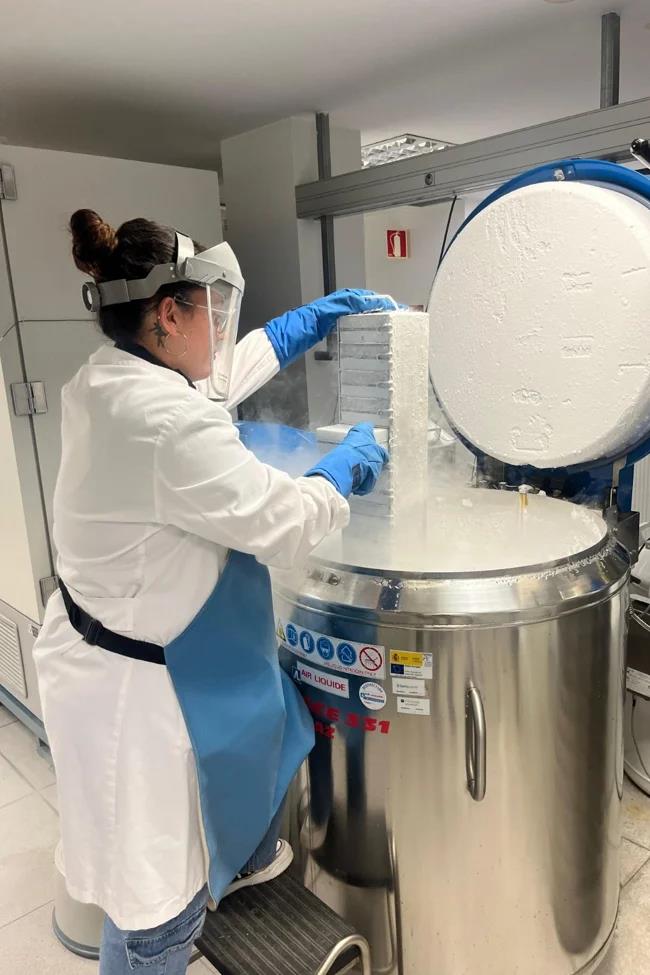
"The goal is to have a raw material that can be used to improve research studies and, in the future, be able to personalise treatments for patients," stated Pedro Emilio Ferro Gallego, head of the cell lines/organoid unit of the Malaga branch of the SSPA's biobank.
"The idea is to replicate a patient's organ in the laboratory, on a small scale, or it could also be some pathological tissue such as a tumour. This allows us to study that person's pathology or the disease itself and discover markers that can help us search for possible treatments or even test different treatments," Pedro Ferro Gallego stated to SUR.
Generation of an organoid
To create an organoid, "a piece of tissue is taken from a biopsy that's been done on a patient. And then there are a series of very specific culture media depending on each organoid. A culture medium would be like a growth liquid, there are compounds that help it grow, then there are a series of specific compounds depending on each tissue. Tumour tissue will have specific additives and a kidney organoid would have others."
For this purpose, the tissue is grown in an "oven, which is an incubator, with a specific temperature and CO2 concentration, usually at 37C, and this allows the organoid to grow and proliferate."
Right now, Ferro explained, they are just getting started. They have developed a line of "head and neck tumours, because there is an oncology group that wants to test the best radiotherapy treatments for this type of tumour." They have launched four organoids. Likewise, "we are trying to collaborate with a group from Sweden, from the Karolinska Institute, because they are interested in skin organoids. There is also an allergy research group here and we want to develop skin organoids for them, plus we are looking at protocols to be able to launch other types. Also for breast cancers. It is a very emerging unit at the moment." But there's more: the urology group wants to develop bladder organoids and the digestive medicine group wants to develop intestinal organoids to study Crohn's disease, added Ferro.
"For example, a person will have a head or neck tumour removed and it is sent to pathology. Part of that tissue is donated to us while the other part is used for diagnosis. We culture it and, as the tumour starts to grow, we have to characterise it visually or histologically - examining and describing in detail the structure and components of a tissue or cell under a microscope. Once the organoid begins to grow, we look at the condition of the structures being generated and whether they are the same as those of the patient's tumour. Then, molecular characterisations and genetic studies and conducted and, from there, it's whatever we want," explained this organoid expert.
A different approach...
What does this mean? Well, if you want to study the development of the disease in vitro, you need to observe how the organoid evolves. "If we want to study possible treatments and we already know of effective treatments for that disease, but they vary depending on the patient, we can test them in vitro and see which one might be most effective for a given type of organoid. This means that we only test one for the patient, the one that worked, and we avoid wasting time looking for an effective treatment," thereby avoiding the consequences of side effects.
"If we want to look for biomarkers, what I do are genetic studies of different organoids with the same pathology and I look for similarities between them, without taking continuous samples from the patients," states Ferro. He sums it up as follows: "Today, there are many waiting lists we rely on for organ donations. With organoids, we could generate organs in vitro and transplant them," including the possibility of creating the organ with the patient's own tissue, reducing the possibility of organ rejection.
Moreover, there would be no need for so many volunteers to test a drug. "It's the future of medicine," declared Ferro.
![[]](http://static.vocstatic.com/voc26/latest/assets/images/favicon/surinenglish/apple-touch-icon-57x57.png)