
World Suicide Prevention Day 2025
Malaga province has failed to reduce its suicide rate post-Covid but people are urged to be alert to the signs to save lives
World Suicide Prevention Day is marked every 10 September and mental health experts have revealed the role that the coronavirus pandemic experience played in the increase


Malaga
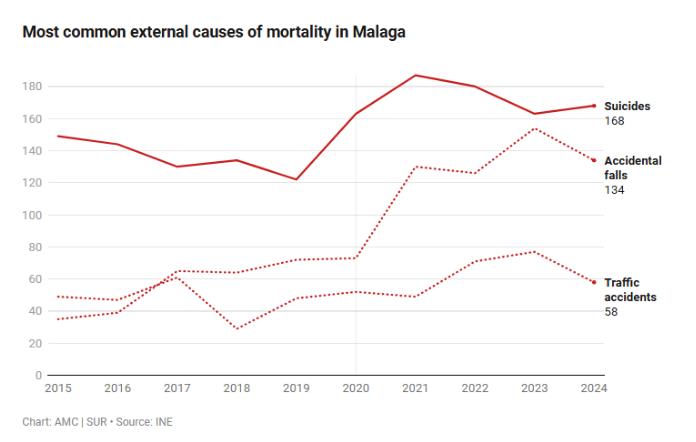
It's a fact that the worldwide Covid-19 pandemic (2020-2022), with the consequent lockdown and other restrictive measures in Spain, caused the suicide rate to soar across Malaga province. Furthermore, it cannot be denied that the effects of that period of alarm and fear are still present in Spanish society, according to data from the INE national statistics institute. In the years prior to this lockdown for a virus, 2017-2019, the number of suicides per year in Malaga province was 130, 134 and 122 respectively. However, things began to escalate in 2020 with 163 suicides, reaching a peak in 2021 of 187 and another high figure in 2022 (180 cases). In the post-pandemic year of 2023, the figure was the same as for 2020, but in 2024, the latest data available, the figure rose again to 168 cases, almost 38% more than in 2019 and nowhere near the much more moderate, pre-pandemic totals.
September 10 is World Suicide Prevention Day and some of the key help and prevention organisations and institutions in Malaga city set up two marquees in Plaza de la Constitución to inform the public that the province is facing a real social and public health problem. Incidentally, Malaga's suicide rate is 9.47 cases per 100,000 inhabitants, which is higher than the nationwide average rate of 7.79. It is the leading cause of unnatural death in the Costa del Sol province, three times higher than traffic accidents and more than 11 times higher than homicides.
"Those who already had a psychiatric problem saw it worsen during the pandemic and suicidal thoughts and actions increased significantly, as did loneliness due to being confined at home. The pandemic did a lot of damage and we are still in the post-pandemic period," says Juan Sánchez, national president of the suicide Teléfono de la Esperanza helpline (telephone of hope). He also stresses that, behind suicide, there is a multifactorial reality. "It can be a health, work or family problem, emotional separation, loneliness, a mental or even physical illness, such as chronic pain. Mental health problems are behind nine out of ten suicidal thoughts or crises", with depression being the most influential pathology. Yet, he adds, it can also be a spur-of-the-moment thing or just creep up on the individual out of the blue.
"It can be a health, work or family problem, emotional separation, loneliness, mental or physical illness. Mental health problems are behind nine out of ten suicide thoughts or crises"
Juan Sánchez
President of NGO, Teléfono de la Esperanza
"When someone is in a situation with tunnel vision and blinkers on, you have to walk beside them, respect them, treat them with dignity and talk. Above all, don't judge them. We try to get them to choose a different future, to convey to them that their story isn't over yet and we try to get them to put off that decision by looking for reasons to go on with life. And, above all, we tell them that their life matters", says Sánchez.
"We shouldn't tell them what to do, as that doesn't help, but we ask them what reasons they have for not living and look for a way for them to rediscover the desire to live"
Noelia Espinosa
Psychologist with the Alhelí association
Silence, Sanchez explains, "can also kill". Nevertheless, a safety plan can be put in place. "If you're thinking about jumping from an open space, step away from all of them, including windows, head down to street level, or call someone, a friend, a therapist, the Teléfono de la Esperanza helpline or 112. I insist, the key moment is to postpone the decision." Sánchez calls for more psychologists and psychiatrists in the public health system and for the state suicide prevention plan to move beyond just being on paper. "Suicide can happen to anyone, it's a social problem," he says.
He expresses concern for adolescents, suggesting that specific strategies must be developed for the digital environment, both via social media and ChatGPT, as many teenagers have developed a dependency for all the 'likes' on social media posts and an obsession with AI. He also gives out some more worrying data: for every suicide resulting in death, there are 20 attempted suicides.
"They want to stop suffering"
Noelia Espinosa, psychologist with Asociación Alhelí (a charitable association that receives support from Malaga's Diputación provincial authority), explains that the pandemic led to "other illnesses such as depression and anxiety, loneliness and fear coming under the spotlight. Also at that time there were very complicated grieving experiences due to sudden deaths, because people saw family members taken away from home and they couldn't say goodbye." Those consequences are still being felt.
This mental health expert refuses to talk about a typical profile for suicidal patients: "there are risk factors, protective factors and precipitating factors. They are personal and social: a person under constant stress, or unemployed, also suffering from money worries, or with an emotional disorder, some dependency or even chronic pain." That said, she asks friends and family to be alert to a series of signs: if the person becomes more isolated or withdrawn, if there is an abrupt change in their personality, or the individual seeks more peace and quiet, even silence, or they become more irritable, if they stop doing things they used to enjoy or start to vocalise that they don't want to continue living. "It can happen to anyone," she adds.
The person, she explains, "wants to stop suffering, doesn't like their life and has no reason to go on." Listening must be active, the loved one or family member must "put themselves in the other person's shoes". "We shouldn't tell them what to do, as that doesn't help, but we ask them what reasons they have for not living and look for a way for them to rediscover the desire to live." She sums it up as follows: "We have to be very aware that active listening saves lives."
"The effects of the pandemic are being felt, it has left its mark on us. It's not that there are more mental illnesses since then, just that we are more aware of them," says Espinosa, adding that unwanted loneliness (perceived as such) is also one of the most common causes.
More psychologists in public healthcare services
On this special day for suicide awareness, the official, professional association for psychologists licensed in eastern Andalucía (COPAO) highlighted the urgent need to address mental health problems from an early age and noted that primary care consultations for anxiety have increased by 60% and suicidal tendencies by 30%, as well as a worrying increase in self-harm among adolescents. For this reason, it criticised the exclusion of psychologists from the assessment process for cognitive impairment.
The Junta emphasises prevention
Andalucía's mental health plan from the regional government mentions its focus on and attention given to older adults in situations of social isolation. Aligned with the International Association for Suicide Prevention (IASP) and its motto "Changing the narrative about suicide", the regional health ministry considers it a priority to "raise awareness and transform how we perceive this complex problem".
"Moving from a culture of silence and lack of understanding to one of openness, empathy and support, with a shared effort between all public administrations (state, regional and local governments) and all sectors of society. The phenomenon of suicide, affected by social, cultural, political and economic determinants, has to be addressed, it transcends mental health and requires a public health perspective, recognising the profound influence of socio-economic factors, disconnection and social isolation as key elements," states the regional ministry.
Those responsible for this mental health plan for Andalucía explain that it is crucial to understand that, while suicide cannot be predicted or eliminated, it can be prevented and avoided through the implementation of evidence-based strategies that have been shown to reduce suicide rates. In this sense, every individual is an agent of suicide prevention and hope is a driving force for change.
Suicide attempts
In 2024, Andalucía's hospitals treated a total of 5,500 suicide attempts, of which 403 applied to under-18s and 5,097 to adults. In 2023, the number of attempted suicides treated in the region's hospitals was 5,374 (of which 393 were minors), while in 2022 there were 5,039 (of which 419 were under 18).
![[]](http://static.vocstatic.com/voc26/latest/assets/images/favicon/surinenglish/apple-touch-icon-57x57.png)