
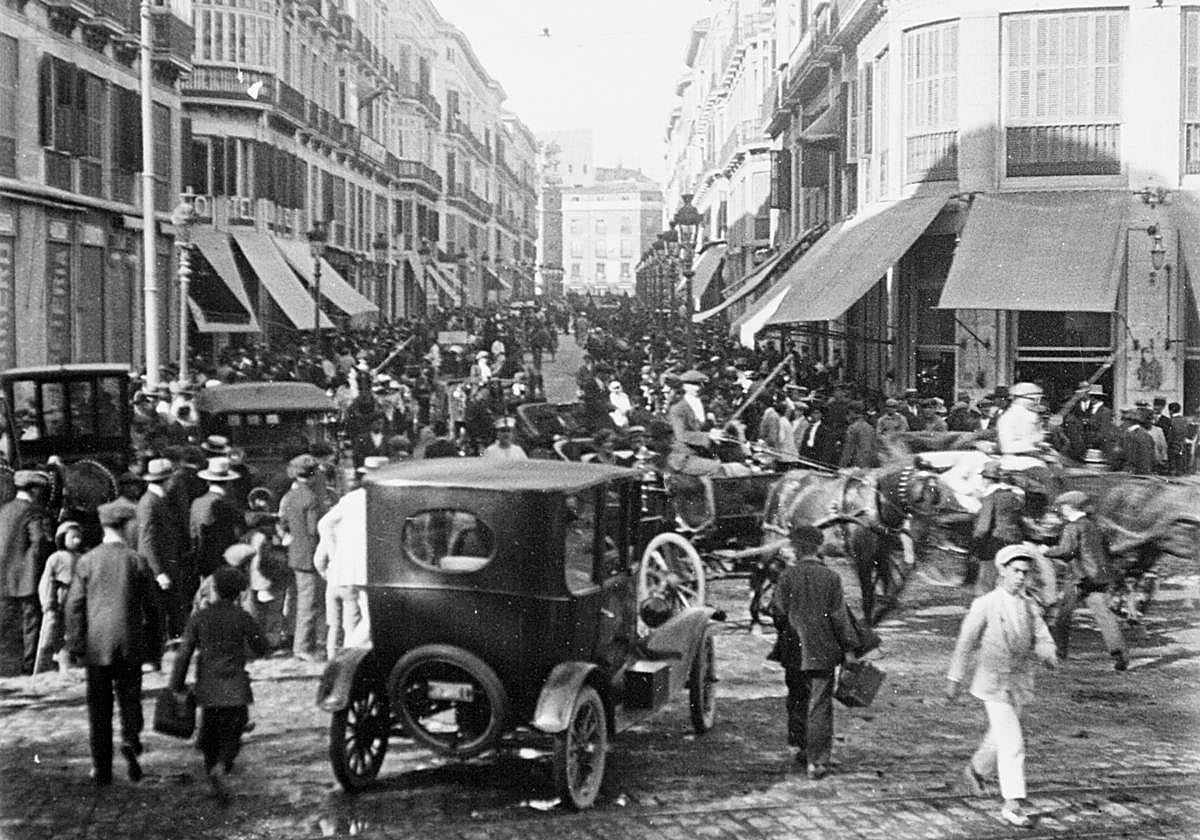
This restored film reveals what Malaga's main Calle Larios shopping street looked like more than a century ago
The frames shot in 1920 show the scene in the city with an abundance of cars, horse-drawn carriages and pedestrians, without much respect shown for each other
Francisco Griñán
Malaga
The charm of Malaga's main Calle Larios shopping thoroughfare, in black-and-white, can now be seen in film stills from the beginning of the 20th century.
With it, the hustle and bustle of a typical Sunday in the city centre is also shown in the frames as the scenes were shot on the day of a bullfight, the main focus of the film, which the photos are from.
A procession which passed through the central Malaga thoroughfare on the way to the bullring caught the filmmaker’s attention. So much so that he devoted more shots than necessary to it.
In addition to the bullfighting tradition with the presence of the legendary Ignacio Sánchez Mejías and Chicuelo, these pioneering silent film images are the oldest frames that are preserved of the main commercial and social artery of Malaga city, and show the traffic chaos that was already happening in this popular street a century ago.
The film named Alternativa de Joseíto en Málaga (1920) has seen the light of day again after the restoration of the original nitrate film by the Filmoteca de Andalucía and Zaragoza. They are now looking for a date to re-release the film in Malaga to coincide with the new bullfighting season.
Although the basic rule of driving on the right-hand side of the road already existed, the frames of Calle Larios shot in the sunny autumn of 1920 in Malaga show that the setting in the city was more like a Wild West scene, with an abundance of cars, horse-drawn carriages and pedestrians, without much respect shown for each other.
The Sunday scene includes a horse hitting a carriage that crosses in front of it without flinching, and a vehicle that has to stop short at the entrance to the street to avoid crashing into an oncoming buggy. The stills also show the Ferretería Guerrero hardware store that operated in the first decades of the last century, the Hotel Londres on the corner of Alarcón Luján and the performance in Malaga at that time of Pastora Imperio herself.
This film was part of a collection of silent films deposited in the Filmoteca de Zaragoza, which has finally been recovered with the help of the Filmoteca de Andalucía and the collaboration of the Filmoteca Española.
"The original film is nitrate, the preservation of which is very difficult, so when we had funding, we got to work on it. We have made a preservation duplicate on 35mm, as well as a digital copy in which the excellent quality of the images a century later can be seen", explained Ramón Benítez, head of the technical department of the Filmoteca de Andalucía. The 15 minutes of recovered work lacks credit titles, so the authorship and production company remain unknown.
What there is no doubt about is the bullfighting content of the film, a genre that was very popular among the Spanish public in the silent era, and the date of filming, 17 October 1920. It featured José Gómez Roca, known at that time as 'Joseíto de Málaga', after quickly made a name for himself as a bullfighter with the nickname, Manteca.
The fans
The film begins with the bullfighter dressing up in his costume at home and then bidding farewell to his family. After the bullfighting procession passes through Calle Larios, the filmmaker devoted a large part of the footage to recording panoramic views of the bullrings full of fans, in which the audience can be perfectly identified. After the paseíllo, the maestro Ignacio Sánchez Mejías gives his first bull to the debutant, to who he hands over the bullfighting equipment. It is interesting to note that the picadors' horses were not yet wearing protective bibs, so that several horses are impaled by the bull, "although the operator does not show these scenes as in other films of the period", Ramón Benítez said.
A month after the shooting, the film was premiered in the city's pioneering cinema, Pascualini. According to the press at the time, the Malaga debutant Joseíto did a great job with the sixth bull and, although he was not awarded the ears, the spectators carried him out on their shoulders, although none of this is shown in the documentary, which closes the following day with images of the numerous friends celebrating with the bullfighter while they read the chronicle of La Unión Mercantil and congratulate Joseíto, a bullfighter who, unfortunately, had a spectacular rise in the ranks and a rapid fall in the following years.
The film premiere did not go unnoticed on the Malaga billboard, which came a month after the filming, at the end of November, with the title Corrida de Toros en Málaga con la alternativa de Manteca (bullfight in Malaga with the alternative of Manteca) in the oldest cinema in the city, the Pascualini.
It is documented that this cinema commissioned the film A Day in Malaga in 1914, which mixed bullfighting with images of numerous locals posing in front of the camera, two elements which are repeated in this 1920 documentary with extensive shots of the bullrings and hundreds of spectators waving or standing in front of the camera as if they were having their photo taken. These shots reveal that this film was probably commissioned by the cinema in what is now Calle Cordoba to attract not only bullfighting fans, but also the hundreds of people and their families who were willing to go to the box office to see themselves and their families on the big screen.
![[]](http://static.vocstatic.com/voc26/latest/assets/images/favicon/surinenglish/apple-touch-icon-57x57.png)