
Infrastructure
Vital reservoir which protects Malaga city from floods 'loses' 40% of its storage capacity
The Junta de Andalucía has formalised a significant decrease in the maximum water level allowed for safety reasons

Malaga
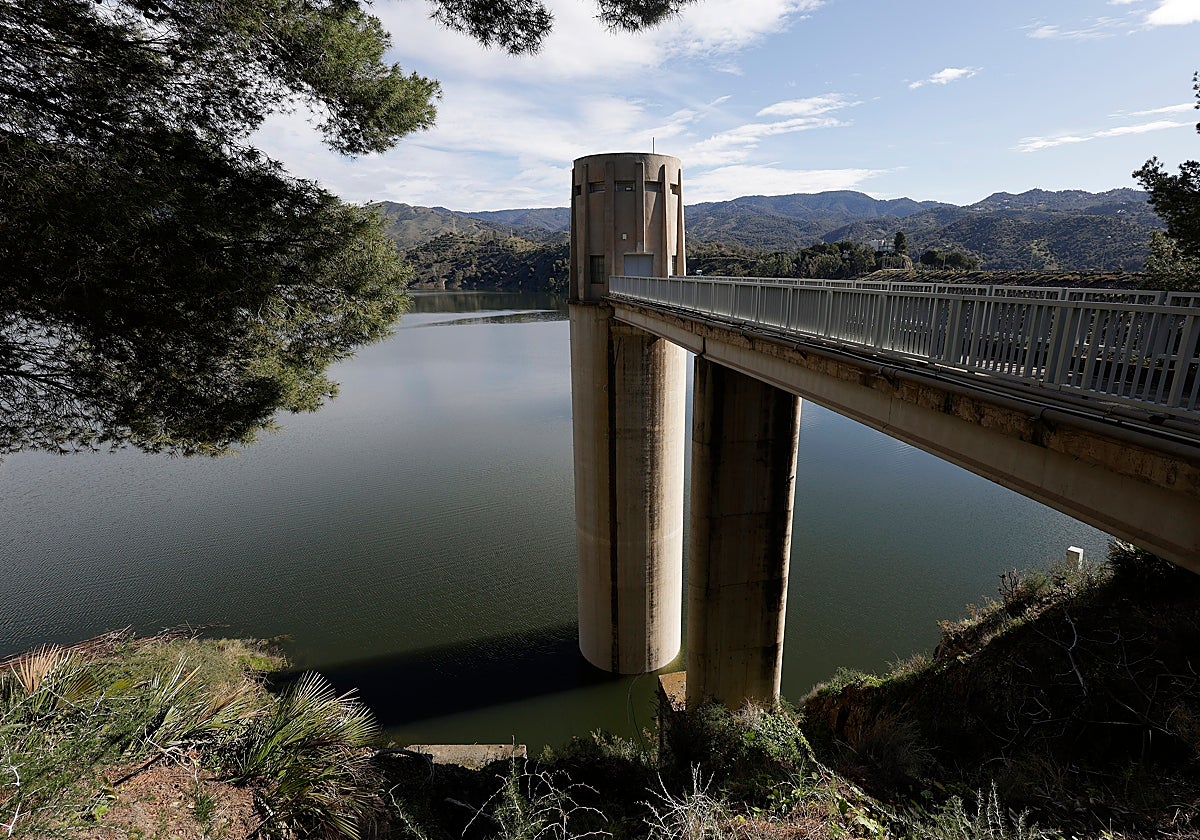
Many reservoirs lose their initial storage capacity over the years. The cause is usually sediment accumulation on the bottom, which is measured by technological processes that study the geography of the riverbed. In the case of the El Limonero reservoir, which has been protecting Malaga city from potential Guadalmedina river floods since 1983, there is another reason. On 1 November this year, the reservoir's capacity dropped from 22.34 million cubic metres to only 14. SUR has challenged the regional Junta de Andalucía government about the change.
The Junta responded that the decision was made with the increase of safety measures in mind. In other words, El Limonero will eventually only store more than 14 million cubic metres during floods. The protective cushion - the reason why the reservoir was constructed in the first place - will be guaranteed by releasing water after every runoff.
"It means a considerable increase in safety," industrial engineer Manuel Olmedo said, adding that drainage channels under the Guadalmedina riverbed can further increase the structure's protective capacity.
Change of rules
The operating rules of El Limonero were updated in 2021, following a hydrological study. This official capacity decrease will now be added to them. In simple terms, the new plan lowers the maximum water level that the reservoir can hold. The spillway (the part that lets water flow out when the reservoir is full) is at 109 meters above sea level.
Before, the water could rise up to 104 metres, which meant the reservoir could store about 21 million cubic metres of water, leaving only a 5-metre safety margin. Now, the maximum level is set at 94 metres, holding around 14 million cubic metres of water.
That means there will always be at least 15 metres of space before the water reaches the spillway, which guarantees three times more safety than before, giving the dam much greater protection against flooding during heavy rain.
A bit of history
El Limonero resulted in the retirement of the Agujero dam, built two kilometres upstream. The Agujero was commissioned in 1908 and construction was supervised by Malaga engineer Manuel Jiménez Lombardo. It stood alone for 75 years, but still lacked safety. Work on El Limonero began in 1979 and finished in 1983. The engineer who designed the dam was Luis de Cossío, who died in 2021.
El Limonero's water treatment plant
The reservoir has its own water treatment plant, which is not usually used for supply and it is rare for it to supply more than 1 million cubic metres per year. Before the El Atabal desalination plant existed, the El Limonero water treatment plant saved Malaga on different occasions. It usually stores quality water and it has its own separate canalisation. It was the reservoir that saved Malaga's water supply during the floods of 1989.
Calculation and safety issues are what weigh most heavily when it comes to proposing solutions for the urban integration of the Guadalmedina riverbed - a project that has been talked about for decades.
The Guadalmedina projects
The most ambitious project since the 1970s has been the 2000 proposal. It included actions for more than 500 million euros and two complex structures designed to divert the riverbed: two tunnels with a significant slope, one leading toward the Viñuela system and the other toward the Peñón del Cuervo area. The plan also included half a dozen peri-urban parks to reforest the surroundings, as well as dams and improvements along the smaller tributaries. However, very little of it was ever carried out and only one of the parks, located in La Virreina, was actually completed.
The plan would have made it possible to dry out the riverbed in order to redevelop the area and there were even plans drawn up for a metro line through it. The project was ultimately discarded around 2006.
Later came the Ciedes foundation's design competition, in which a project by architect José Seguí was chosen as the winner. In summary, his proposal aimed to open the riverbed for public use, improve traffic along its sides and enhance the riverbanks with environmental and landscape treatments.
109
metres is the height at which the spillway is located. Previously, water could rise to 104 metres, which has been reduced to 94 metres
Currently, while the city council is advancing the preliminary project for the 'plaza-bridges', reforestation and renaturation actions are carried out around the river.
The wall of the El Limonero dam is made of rock, not concrete. It was constructed right after the Tous dam disaster in Valencia in October 1982, which is why this type of infrastructure had a bad public image at the time. The incident took the lives of 40 people, while 300,000 people lost their homes. Fortunately, El Limonero is a safe reservoir, providing both a reliable emergency water supply and protection in case the river overflows again.
Build-up in Malaga's reservoirs
Erosion and sediment build-up are common problems in the province and in Spain, in general. It is enough to point out just how long it took the Junta to resolve the clogging issue in another defensive reservoir (Casasola), where sediment had reached a third of its level. After months of arduous work, it was discovered that a large concrete beam was clogging the bottom spillway, which prompted further operations.
14
million-cubic-metre capacity
There is great concern among technicians because build-up, if severe, compromises the useful life of reservoirs. A few days ago, president of the Spanish engineering institute José Trigueros emphasised the consistent maintenance that the country's dam infrastructure needs.
Another reservoir that has suffered clogging issues is the Conde de Guadalhorce. Three years ago, the regional ministry of agriculture was forced to renew its drainage system.
Drainage tasks
In order to keep the systems clean, almost all dams release water once a month. This past spring, however, the consecutive storms required extra drainage work, given the accumulation of reeds, mud and debris.
1.8
million cubic metres was the minimum level of the reservoir in 2000
The maximum historical level of El Limonero was reached in 2004. That is the only occasion when it was closer to opening the spillway. On the other hand, its lowest level was in November 2000, 1.8 million cubic metres.
![[]](http://static.vocstatic.com/voc26/latest/assets/images/favicon/surinenglish/apple-touch-icon-57x57.png)