
Transport
Malaga is the city in Spain with the fewest kilometres of cycle lanes per inhabitant
Cyclists identify numerous accident "black spots" and call for separate lanes to be included in all upcoming projects
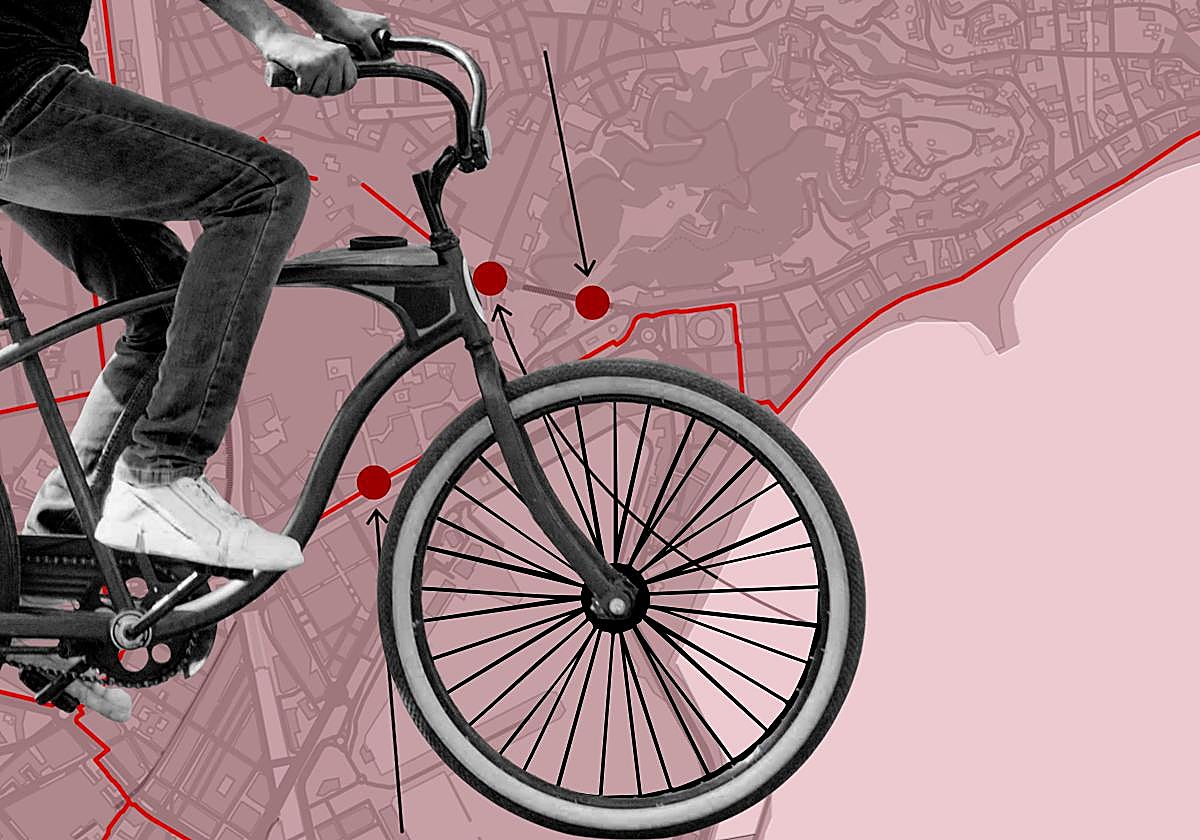

In the sustainable mobility sector, before 'clean' cars, restricted zones and low emissions, the importance of promoting collective transport and cycling was always emphasised, in addition to walking. Cities, such as Seville, invested in in two-wheeled transport over a decade ago. In Malaga, the reality is that users complain about a network that was built in spurts, with many stops and starts. Additionally, some areas are hazardous for cyclists and even pedestrians, poorly separated at many points (the lanes are just a piece of road that's a different colour).
Daily coexistence
Day-to-day, the coexistence of cyclists, pedestrians and road vehicles seems convoluted. And there are factors that make things even more complicated. For example, many tourists with suitcases take advantage of the cycle lane's smoothness to make hauling around their suitcases more bearable. At other times, visibility is poor, as the lanes go around bus stops or kiosks. Worst of all are the points where the lane ends and the cyclist does not know where to go next. Moreover, when there are roadworks, cars and pedestrians are usually given alternatives to work their way around: bicycles are not.
According to the City Council's Mobility Department: the city now has 51 kilometres of cycle lanes. A further 4 kilometres are under construction and 9 more are being planned. In addition, there are 63 kilometres of lanes that have a speed limit of 30 kilometres per hour for both motor vehicles and bicycles.
Current cycle lanes in Malaga
Furthermore, the Andalusian Regional Government has already pushed for a cycle lane in the Malaga Tech Park and is now working on its continuation with a 2.6 kilometre road to the Goods Transport Centre through the Asperones. The Andalusian Government has also taken responsibility for restoring the services and roads affected by the metro construction works in Callejones del Perchel.
A study carried out by PONS Mobility, an international consultancy firm specialising in sustainable and safe mobility, together with the digital platform Meep, analysed the twenty most populated cities in Spain in 2024 and cycle lanes per inhabitants. Malaga did not do well. It was the city with the fewest kilometres (4.95, which would now be 5.1) of lanes per 100,000 inhabitants. Vitoria-Gasteiz has the most, with 70.34 kilometres. Following on from this, Cordoba (41.08), Alicante (38.08) and Seville (27.48). At the bottom, just before Malaga, are Elche (10.91), Vigo (6.81) and Madrid (5.85).
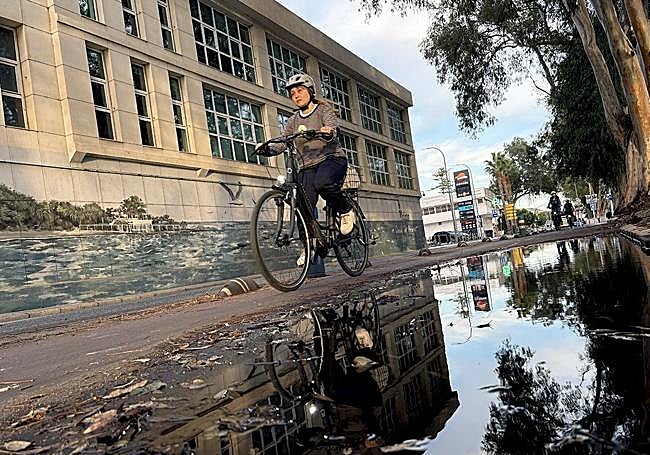
"From El Palo to the centre there are no cycle lanes because it ends at the Baños del Carmen, and so the people who live there have no safe way to get there".
María José Márquez
Presidenta de Ruedas Redondas
María José Márquez, professor of Architecture at the UMA, is the president of Ruedas Redondas, a group that has been for years fightingfor a better road network for cyclists inMalaga. The list of "black spots" where cycling accidents occur begins in the east of the city. "From El Palo towards the centre there are no cycle lanes because it ends at the Baños del Carmen, and so the people who live there have no safe way of getting there. The same happens on the other side El Palo, on the way from Rincón de la Victoria, through El Candado and La Araña. "It's as if El Palo is in the middle, isolated from everything. A lot of people live there and they are completely disconnected".
Another problem is the Alcazaba tunnel. "After spending almost three million euros to put up screens that are useless, they haven't left any room for a cycle lane," the activist complains. In fact, the group took their own measurements to prove that it would fit, "They simply didn't want to put it up". The worst case is in the direction of Plaza de la Merced, where because of a certain ramp, it is more difficult to cycle. "The cars are in a hurry and it's quite stressful". The route from the centre to El Ejido and along Calle Victoria to Fuente Olletas is also problematic.
The same situation occurs in the Alameda Principal: after investing almost 8 million euros into the road network, they did not create a cycle lane. "The pedestrian lanes are not enough for us either. There is only red paint, but all you have to do is walk by to see that because people can't all fit in the bus stops, they end up queueing in front of the kiosk and block it".
Missed opportunities
Márquez regrets that both cases have been "missed opportunities" to improve urban mobility. To this, he adds what he calls "disastrous spaces for coexistence", such as the aforementioned Alameda and the Pablo Ruiz Picasso promenade, where confusing and poorly delimited stripes separate cyclists from pedestrians.

It's the same problem in the expansion area of La Térmica towards Sacaba, "there are large avenues with 6 or 7 lanes for cars and none for cyclists. We put cycle lanes in places where they already exist, normally taking space away from pedestrians, and yet in major construction projects like this one, they don't put them in at the beginning, and then they have to shoehorn them in".
Likewise, there are many complaints from those who the cycle lane that used to exist in Carlos Haya, where "people feel that it was removed overnight and they have been left with no alternative".
In any case, these roads are finally picking up speed, in large part due to funding from the EU's Next Generation. Work is underway to connect Teatinos with the Palacio de Ferias area and the routes around the Martín Carpena, Sostoa, Juan XXIII, Ortega y Gasset, Avenida María Zambrano and Intelhorce.
Technical keys
Although the cycling community continues to demand more cycle lanes, it also calls for other measures, such as the "peace model" that is being imposed in Europe.
Although the cycling community continues to demand more cycle lanes, it also calls for other measures, such as the "peace model" that is being imposed in Europe, which is "infinitely cheaper", stresses the president of Ruedas Redondas. The idea is that in the side streets of the neighbourhoods, cars should go in only one direction and bicycles should be able to go in both.
"That doesn't cost anything, just vertical signage and a bit of paint on the ground. You don't have to build the lane or take space away from pedestrians, it just has to be well signposted and explained". This would, in theory, create "cycle-friendly streets", which are being done in many European countries, such as Germany, Belgium and Ireland.
Credit
-
Data, illustration and graphics Alba Martín Campos
![[]](http://static.vocstatic.com/voc26/latest/assets/images/favicon/surinenglish/apple-touch-icon-57x57.png)