
SUR Exclusive
Inside Google's basement in Malaga: Bernardo Quintero and a team of 20-somethings are 'cooking up' the ChatGPT of cybersecurity
The founder of VirusTotal leaves management and returns to entrepreneurship with Omnia: an AI platform used for cybersecurity purposes, that serves both tech experts and the public

Malaga
He greets us in the 'hall' of Google Málaga, his face tired. "I haven't slept much... I stayed up working until 1am." Any big cyber-attacks we aren't aware of? "No, I was busy with my own stuff and the time flew by," he says apologetically.
He hasn't gone on holiday this summer either. But Bernardo Quintero feels "like a little boy" again: he's back to tinkering, experimenting, creating and breaking things... to entrepreneurship.
At the end of May he announced that he was leaving team management at Google to go back "to the start, to what I am passionate about, to what makes me happy": in other words, innovation. A decision that surprised people both inside and outside the company, but for the engineer from Vélez, made perfect sense.
"I'm going back to the cave, to the basement... to the place where ideas are cooked," he said.
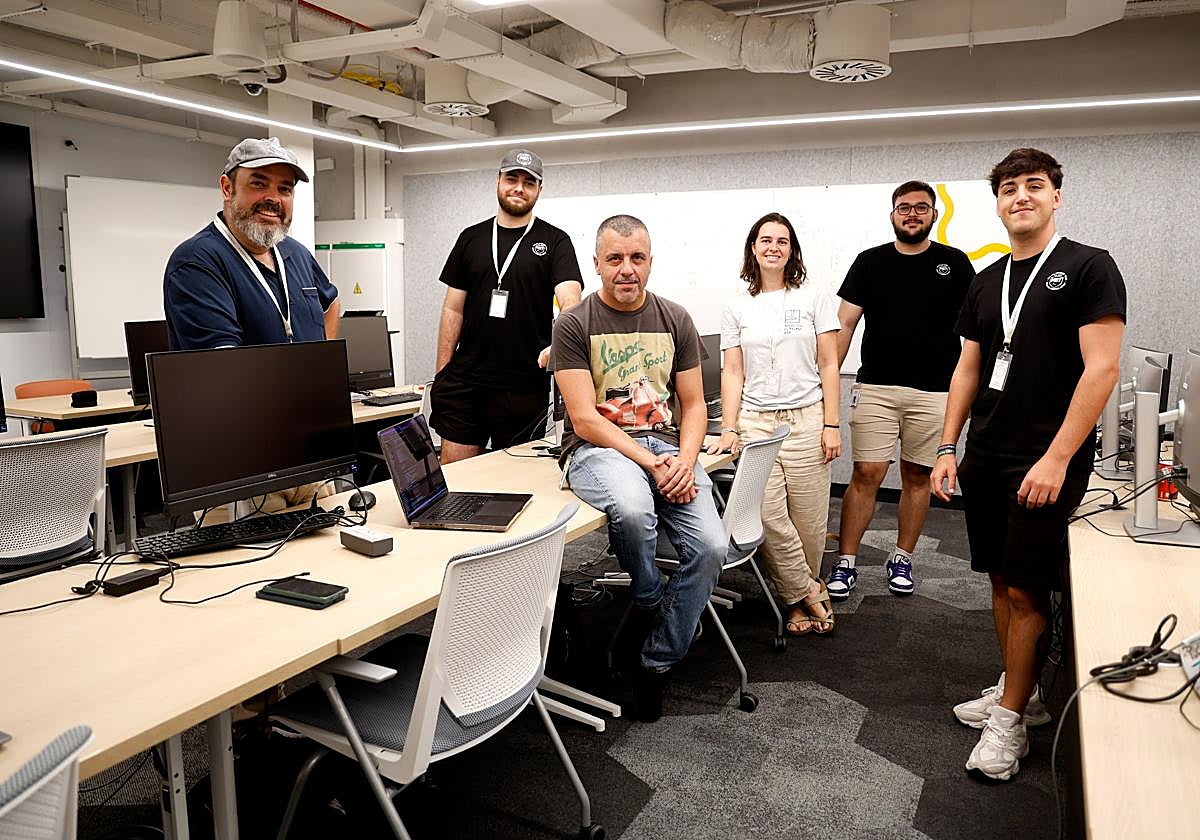
The basement is literal. For months, Quintero has been working for on floor -1 of the GSEC (the Google base in Malaga), leading a small team of five people - four of whom are fresh out of university - who 'cook' ideas with two key ingredients: AI and cybersecurity.
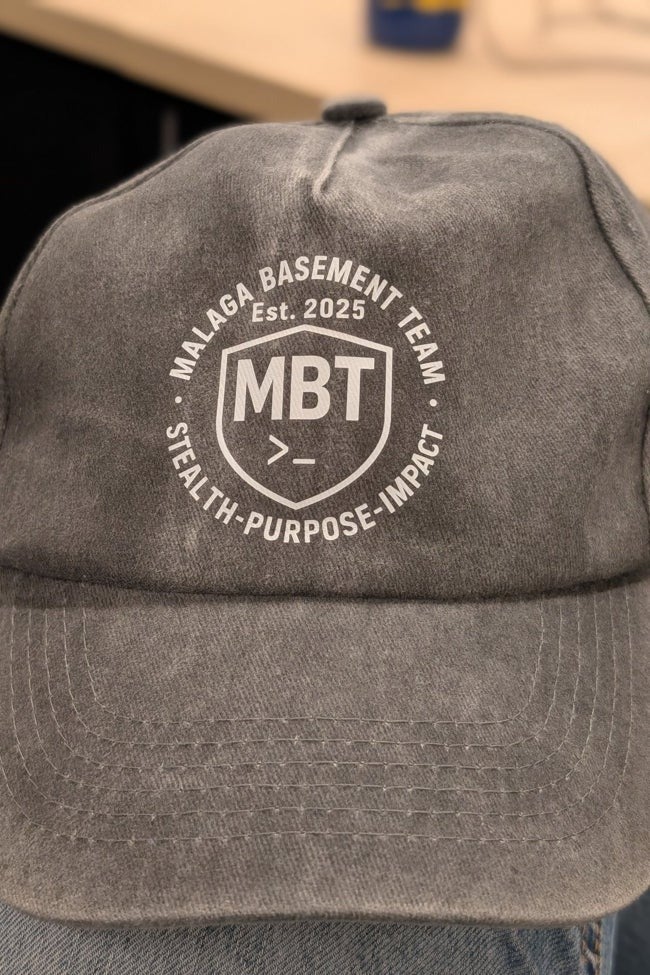
They have named themselves the Málaga Basement Team and are already gaining notoriety within Google: recently, several senior managers came to visit them from the US. They have even created merchandise: caps and T-shirts with the slogans "Innovate to protect" and "Stealth, Purpose, Impact".
They are not in the basement for the sake of it, having done well with the resources they had. They work there because when Bernardo recruited them earlier this year, none of them was a Google employee, so for confidentiality reasons they were not allowed access to the GSEC main floors.
"I had already been experimenting with AI for some time and, together with Javier López, the director of the UMA Cybersecurity Chair [which is funded by Google], at the beginning of this year, we decided to create an opportunity for a small group of young people to come and work here with me on an R&D project," explains Quintero.
Brilliant minds of the UMA
Some of the brightest minds in the UMA's engineering schools responded to the Chair's call for applications. Arturo Aguilera, Álvaro Sánchez and Alejandro García are all either 22 or 23: the first two are joint honours degree students in Computer Engineering and Mathematics and García studies Computer Engineering. All three took the Reverse Engineering and Malware Analysis course organised by the chair last year.
As for age, the fourth member of the Málaga Basement Team is the exception: Darío Guerrero is 46 years old and had just left his civil servant position at the UMA Supercomputing Centre because he was bored; he was beginning to explore other career paths when Manolo Enciso, the director of the School of Computer Science, introduced him to Quintero.
They clicked, and there he is, doing what he has loved to do since he was a child: tinkering. And the final member, Natalia, was actually working in the basement, but on another project to do with her area of expertise, user experience and user interface (UX/UI). From listening to them - because they talk a lot - she began to get involved in the tasks that her colleagues were tackling and ended up joining in on the adventure.
Omnia is the name of the 'creature' being created in Google's basement in Malaga. The initial challenge Bernardo took on was to find a way for AI to automate tasks that until now cybersecurity analysts had to do 'by hand': analysing files to see if they are malicious.
To do this they have to 'disassemble' the file and look at the code. That challenge is in the process of being solved: although there are many types of files and they have to train artificial intelligence to work with all of them, they have already proven that it can be done.
Now, what they have ended up creating has developed far beyond what it was built for. Omnia is Latin for 'everything' and that is what it aims to be: a platform capable of helping with all kinds of cybersecurity-related tasks.
What is Omnia?
Quintero explains in detail what Omnia is: "It is an AI platform applied to cybersecurity and designed for the community, both for expert analysts and the general public. It works as an assistant specialised in virus analysis but also other aspects of cybersecurity, being able to execute very technical tasks or answer questions that users have. Omnia's toolkit is useful for both complex investigations as well as helping with anything a general user may need. Additionally, it allows users to create and share resources such as 'prompts', workflows, knowledge bases and intelligent agents, with the option to select different AI models. In short, an AI-based shared space where experts and the curious can learn, experiment and contribute to making the internet safer."
Omnia itself summed up its purpose: "It is an artificial intelligence platform in cybersecurity, open to experts and the public, that functions as a specialised and collaborative space for learning, researching and protecting oneself on the internet".
Like any good 'startup' (albeit technically part of Google), the Málaga Basement Team works hard and fast.
"If there's one thing we all have in common, it's that we love what we do. And when you love what you do, you don't look at the clock: in the middle of the night you remember how you could solve a problem and you ask... no matter what time it is, if we put a message in the chat, someone is sure to answer," Alejandro explains.
And so, in record time, they had a prototype ready, which they presented at Google and is now being tested by more than 800 analysts at multinational companies. Soon - perhaps by the end of this month - they hope to launch a version of the platform that is open to the entire community. "The driving concept behind Omnia is that it should be a tool for the community; something like the VirusTotal of artificial intelligence," he explains.
From the basement to the top floor: signed up by Google
This R&D project in the 'catacombs' of the GSEC has already helped create job opportunities for two of its members: Álvaro has been employed at Google for a couple of months now - he combines his 'normal' job as a frontend programmer with working in the basement - and Arturo has passed the interview stage and is now waiting for an opening.
For the time being, Alejandro does not want to apply to Google, despite pressure from his family: "I want to be sure that it's something I actually want to do. What we have built here is causing a sensation within Google. We work in a way that suits us, in an area that we are passionate about, we move fast.... I don't know if I need to wear the 'Googler' label," he explains. "What he wants is to brag about is having said no to Google," Quintero exclaims with mock annoyance. So for the time being, it is Álvaro and Bernardo who are responsible for going upstairs to the 'microkitchens' for supplies when they are hungry.
The similarities between this crew and how VirusTotal began are evident - a team of six members, opening doors without asking for permission, the informal atmosphere, the lack of protocol and hierarchy or the working incessantly fast to maximise efficiency - a question arises: is there jealousy among the 'senior' members of VirusTotal?
"There is a bit of prickliness upstairs; I think they do miss me," the founder laughs, "happy" to be back doing what he really likes... and to have given up what he doesn't like: meetings.
He assures us that he has had no trouble delegating roles. "I was doing it before I stepped down.... At VirusTotal there is a great team, with people like Juan Antonio Infantes, Paloma Simón and Emiliano Martínez who already had management skills; now they have the opportunity to demonstrate their leadership and to continue moving up the ladder," he says.
A word to those interested: the UMA Chair of Cybersecurity will soon be offering an opportunity to grow this unique team.
![[]](http://static.vocstatic.com/voc26/latest/assets/images/favicon/surinenglish/apple-touch-icon-57x57.png)