
Housing crisis
Experts warn: 'The housing problem in Malaga is worsening'
Consultancy firm Savills says that the rate of construction of new homes must be doubled, with the focus on the Guadalhorce valley area

Malaga
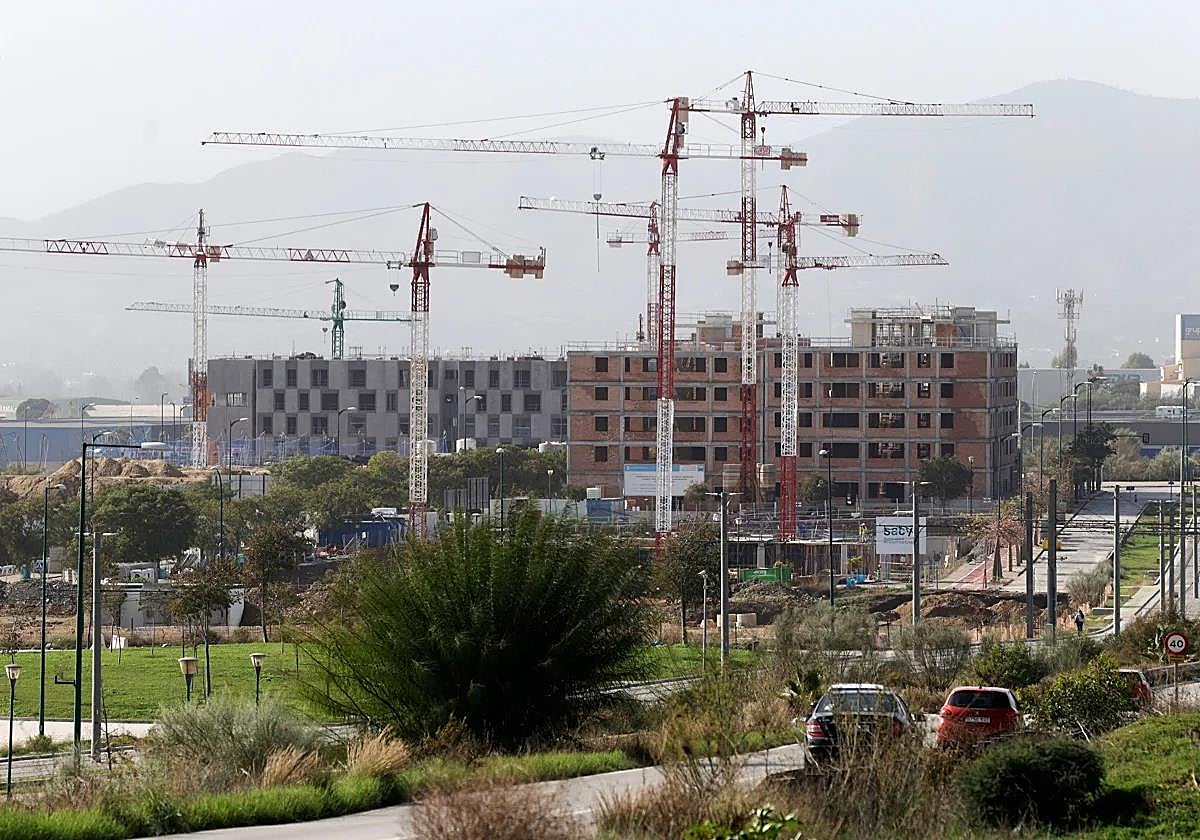
The housing crisis is worsening every year in Malaga. For the moment, no effective solutions have been found. This is the bleak but realistic picture that experts from real estate consultancy firm Savills painted with their last report presented on Wednesday. Director of Savills Andalucía José Félix Pérez-Peña said that the situation in Malaga city is "going to get worse in the short term". As he did last year, he stated that production of new homes must be increased.
Pérez-Peña highlighted that demand has been getting stronger and stronger since 2020. According to him, in the last five years, some 4,000 homes have been entering Malaga city's market every year. The director estimates that another 4,000 should have been built, as demand requires around 8,000 new homes every year.

However, Pérez-Peña was optimistic in his calculations that some 16,400 homes could be built in Malaga over the next ten years, of which 9,000 would be more affordable social housing. Within this figure, he included the developments in Distrito Zeta, Cortijo Merino, Térmica and Universidad. There are other projects, which have not been started yet, like Repsol and Campanillas, that face uncertainty as to their viability.
Pérez-Peña stated that the effort must be collective if the objective is to be reached and urged all public administrations to do their best to ensure that the transformation of land does not take almost ten years, as is currently the case.
151,000
homes needed in the province in next ten years
Savills estimates that Malaga city needs 8,000 new homes each year
The Savills report admits that these new housing projects are "insufficient" for a housing demand estimated at 151,000 new homes in the next ten years at provincial level. When talking about demand, it should be noted that this includes not only the basic needs of the population for a roof over their heads, but also private investors, second homes, students, young professionals and digital nomads. Therefore, the need is only expected to continue expanding.
Savills believes that demand can be met through the promotion of 'coliving' (short-term residence) and 'flexliving' models - temporary accommodation that can be provided on commercial or hotel grounds, mostly suitable for students, digital nomads and employees with temporary contracts. "There are many funds investing in these segments," Pérez-Peña said. Savills estimates that some 5,000 such accommodations will be added in the next five years in Malaga city.
Taking Seville as an example
The report also highlights the potential of the northern part of Malaga city and its surrounding areas. The Guadalhorce valley, with municipalities such as Pizarra and Cártama, offer easy transport to the Costa del Sol capital thanks to the short-distance Cercanías railway service. Therefore, large residential developments in the north can absorb part of Malaga's demand.
Seville, for example, uses exactly its surrounding areas and suburban villages and towns to offer housing. This has led it to have "three times the housing production capacity of Malaga", which also helps keep prices lower.
However, Pérez-Peña does not see a halt in the escalation of prices in Malaga, at least not in the short term. The most expensive homes in Malaga - those that exceed one million euros - account for 2% of supply, while 90% of new and second-hand homes are sold for under 450,000 euros.
The Savills report states that the housing crisis cannot be attributed exclusively to the proliferation of tourist accommodation. "Tourists are not the problem. Demand, typologies and lack of product are," Pérez-Peña said.
Need for more hotels
Savills also highlights that there is still a need for more hotels in Malaga city, which is "on a par with Granada and far from the 25,000 beds in Seville. The number of tourists has grown by 15% and overnight stays by 6%". According to Pérez-Peña, tourist flats are not the solution, because many people look for hotels during their stay and investors are growing more interested in areas of the city that have been overlooked until now.
One aspect of supply that Malaga has proved to be successful in is the provision of office spaces - the Insur group projects in Tabacalera and Martíricos evidence this. However, this implies the arrival of more workers who will need housing. Pérez-Peña called for more tertiary projects, such as the one planned for dock 4 of the port and the land of the former Siemens.
As for Malaga's commercial fabric, the report advocates extending the offer in the city centre towards Calle Victoria and Plaza de la Merced. However, it also highlights the need to attract luxury and semi-luxury brands for the guests of the new five-star hotels that will open in the coming years. In addition, Malaga needs to modify and adapt its logistics, as the land for distribution centres in the city is already at 100% of its capacity.
![[]](http://static.vocstatic.com/voc26/latest/assets/images/favicon/surinenglish/apple-touch-icon-57x57.png)