
History
Earthquakes in Malaga and their history
Particularly intense were those of 1680, 1755 and 1884, when the number of deaths and injuries reached significant figures, with the collapse of a large part of the buildings both in the city and in the surrounding villages
Francisco Cabrera
"The day of St. Dionysius the Areopagite, the ninth of October and the ninth of the September moon in the year 1680, at quarter past seven in the morning, the bright sun... and the sky serene. The land and the sea being calm, without a breath of wind, from the sea there came to this city, as the sailors feel, an earthquake so great, so dreadful and so extensive that, according to common opinion, no one has ever seen, heard or read of any other like it."
The words above that come from an interesting document in the National Library, describe in detail what happened in Malaga on that terrible morning in October 1680: the deaths caused by the earthquake, the extensive damage it caused and the vehement reaction of the citizens to events whose origin and nature were unknown to them.
Related story
Unfortunately, the earthquake of 1680 was no exception, neither in terms of the number of victims nor the damage it caused. It is not our intention here to explain the geodynamic causes of such phenomena: we only intend to take a historical approach to one of the main earthquakes that Malaga has suffered over the last five centuries: that of 1755.
Although we can affirm that such phenomena also took place in Islamic Malaga, we must wait for the account contained in later documents for a more complete history. The earthquakes of 1494, 1497, 1522, 1581, 1680, 1722, 1755, 1767, 1804 and 1884 were particularly intense. Among them, those of 1680, 1755 and 1884 stood out above all, where the number of deaths and injuries reached significant figures, with the collapse of a good part of the buildings both in the city and in the nearby villages.
Tectonic activity
Today we know that Andalusia is located at the southern end of the Eurasian plate, in clear tension with the North African plate due to the complex tectonic activity of the faults, which carry the risk of triggering seismic activity in this area. Earthquakes whose isoseisms are concentrated between the south of Granada and the Axarquia region of Malaga.
Centuries ago, however, none of this was known. Little scientific knowledge led people to believe that the essential cause of such phenomena was a "just divine punishment for the follies of mankind". The official doctrine of the Church sought a providentialist explanation for the general ignorance of the dynamics of these natural forces.
Until the 18th century, the study of the cause of earthquakes was based on Greek philosophical thinking. Prominent among the pre-Socratics and pluralistic materialists were those who, like Empedocles, considered that the irreducible and immutable principles of the cosmos were to be found in the four traditional elements: earth, water, air and fire. The imbalance of these elements and the supremacy of fire over the others produced the earthquake.
However, these analyses of the human and the divine began to change from the 18th century onwards. The arrival of the Enlightenment movements led to more rigorous attitudes, even among the clergy themselves. The investigations of Buffon in his work 'The Epochs of Nature' and of the British James Hutton on the origin of rocks that came at the end of the century spread rapidly.
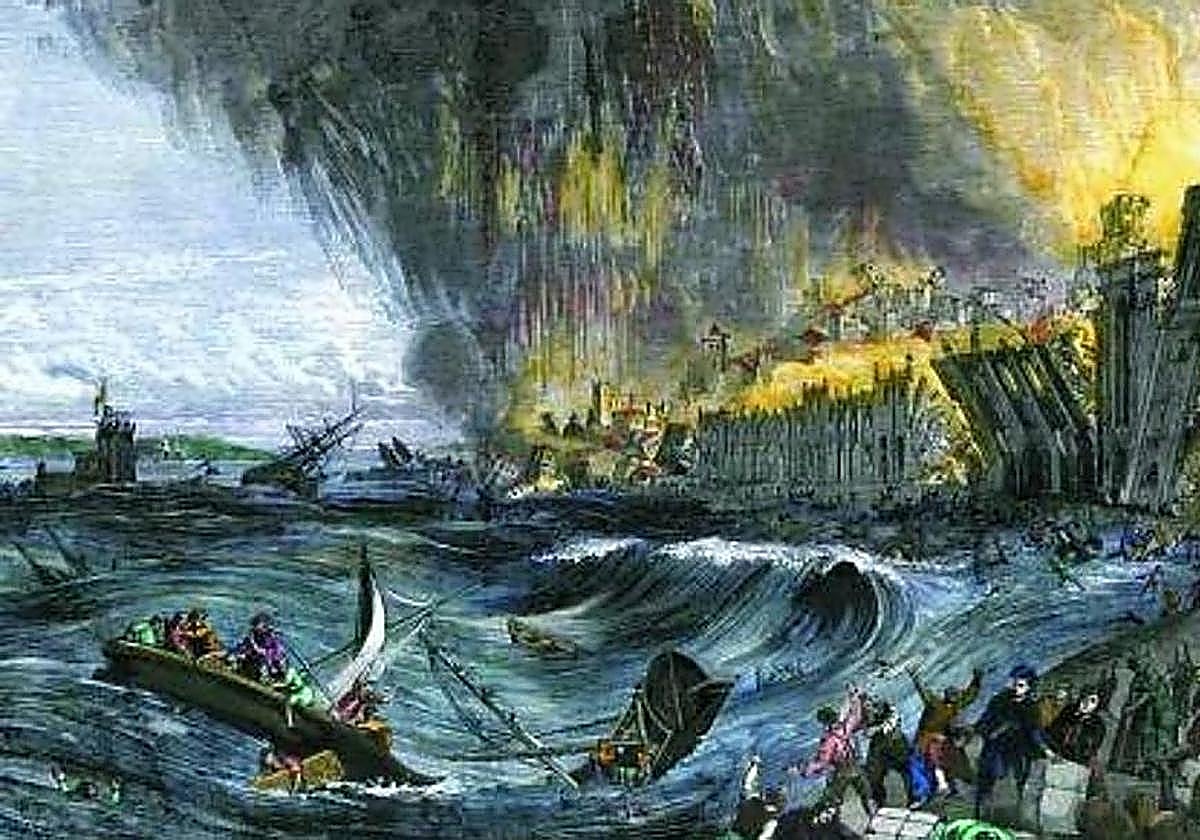
Thus, in the seismic activity of 1755, known as the Lisbon earthquake because of the damage it caused in that city (damage that was caused more by the subsequent fire than by the earthquake itself), a professor from Salamanca stated in a letter the reasons for such phenomena "that one should not have to resort solely to God alone, when one can instead find in nature... the corresponding activity".
Naturally, the cataclysms that occurred during the 19th century were dealt more scientifically. The deistic positions of the previous century and the progress of nineteenth-century science allowed progress to be made in the knowledge of the geodynamic nature of such phenomena. In 1830, the British scientist Lyell published his 'Principles of Geology' in the same year in which the first Geological Society was founded in France, and the discipline was taught at the Sorbonne in Paris.
Signs and premonitions; superstition and science
In the aftermath of the 1755 earthquake, numerous analyses were made by different researchers who were supposedly informed about what had happened in the hours before the earthquake. In general, these are statements that are closer to superstition than to reality. The following document serves as an examplar of what we are saying: "Also indicative of earthquakes are the red, fiery clouds in a pyramidal shape which remain in the air for a few days, and the long, white cloud that remain in a straight line for a few months. Thick, thick, crude vapours held in the air in a round shape are also signs of earthquakes".
In one of those that took place in November 1755 (there were several in the same month), that we call Lisbon, some more objective data qas given: "Until the twenty-seventh, when it was believed to by all to be the last in this city, since then a new earthquake of short duration, which barely lasted a minute, but very violent, occurred at eleven hours and half a quarter in the morning".
Naturally, on all occasions the relevant processions were organised with either the Patron Saints or the Virgen de la Victoria. The immediate reaction in the aftermath was to consolidate the popular belief that the damage was so immense that it could not be caused by any human force and rituals of penance and mortification were imposed. There were cases in which the prevailing religiosity of those years led to situations such as the following, as recorded in a document from the Royal Academy of History: "Day and night, devout and repeated processions of religious and secular people are seen in the streets: some disciplined, others with crosses on their shoulders, their bodies half naked, their heads covered with ashes and girded with piercing crowns of thorns, their feet bare and crying out for mercy".
Effects and consequences
Having analysed the causes of earthquakes as understood by the ancients, we now turn to their effects, fears and consequences.
Clearly, it is easy to imagine that the most terrible consequences of earthquakes derive from the loss of life and the high number of injuries that such catastrophes cause. The collapse of buildings and structural damage to communications are also important aspects to take into account in the analysis of these phenomena.
In the 1755 earthquake, which had numerous aftershocks throughout the month of November, it was necessary to close several streets in Malaga - Granada, Beatas and Calle Nueva, among others - to stop traffic, due to the danger of buildings collapsing as a result of the slight vibrations that the carriages could produce as they passed. Thus, the report of the Mayor of the city, dated 1 December 1755, stated the following: "... it has been noted that many previously undamaged houses have since been damaged and some of them are in a state of total or partial ruin, as has been done and others have been reinforced or shored up to prevent damage to the public".
Particularly interestingwas the fact that some locals spread the word throughout the city that "the sea was getting out of control", so that the frightened people of Malaga abandoned their homes completely. The governor was forced to bring out the troops to prevent the "friends of others" (the first to want everyone to flee) from making a "killing" in the month of November. He also placed a guard at the Puerta del Mar who would give warning, if the waters invaded the city, by ringing the "bell of Espantaperros".
The terrible earthquake of Christmas 1884 unleashed an immense outpouring of support from inside and outside Spain. A wide variety of events were held in numerous cities to raise funds for the victims in the province of Granada and the Axarquía region of Málaga, which ended up being visited by King Alfonso XII himself in a very harsh winter.
We do not want to end our hasty analysis without a sober reflection: most of the damage caused by earthquakes around the world derives from the collapse of buildings that are poorly adapted to the extraordinary stresses generated by these phenomena. Since we cannot prevent earthquakes, let us at least try to reduce their consequences as far as reasonably possible by heeding the recommendations of engineers and architects.
Heraclitus, the Greek philosopher born in the 6th century BC, said that "nature likes to deceive us". It would be a good thing if 21st century science were finally able to prevent, if not avoid, such "deceptions".
![[]](http://static.vocstatic.com/voc26/latest/assets/images/favicon/surinenglish/apple-touch-icon-57x57.png)