
Politics
Diputación approves record-breaking budget for Malaga province, despite all opposition groups voting against
The provincial authority's governing party clashed with the other groups over the way the figures are presented, the cuts, the rate of investment rollout, the increased debt... and even national politics

Malaga
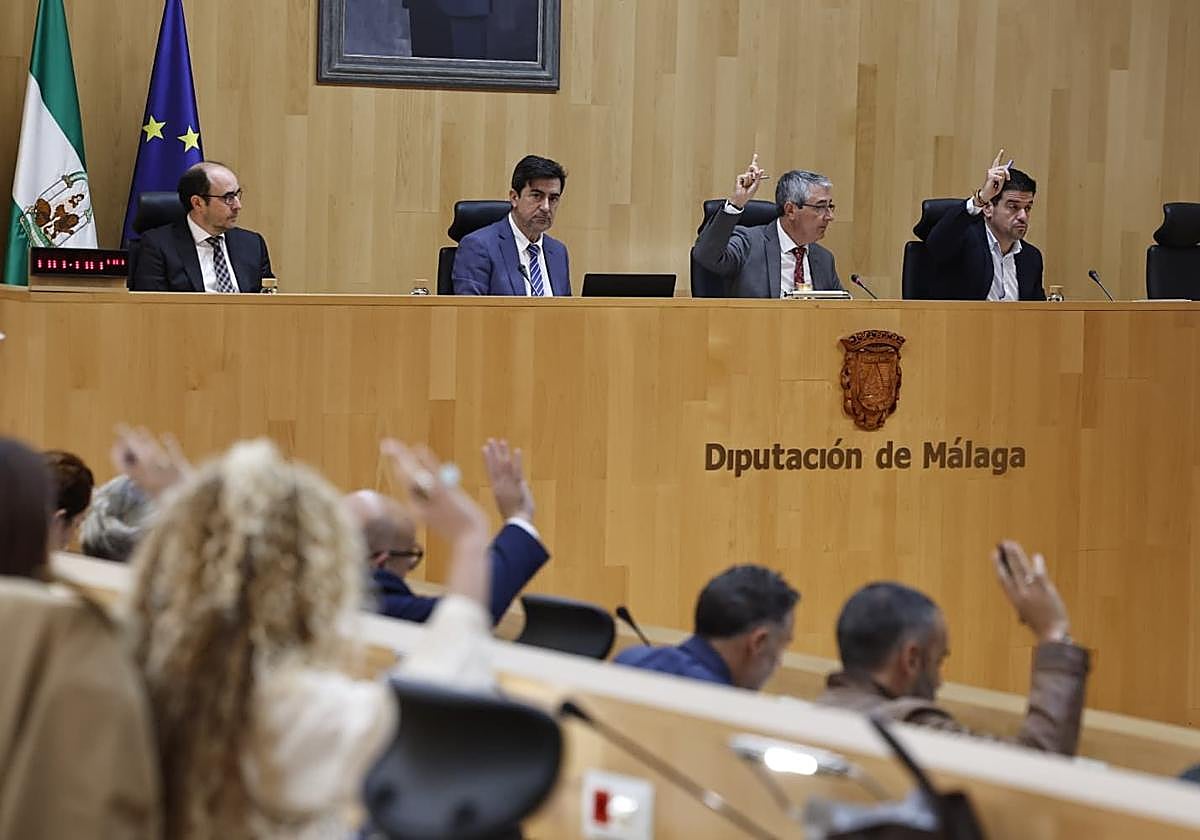
The annual budget debate in Malaga's provincial authority held on Monday morning involved a heated exchange between the ruling People's Party (PP) and all opposition groups, not only for the economic plan for next year, but also encompassing arguments over national politics. The session concluded with the approval of the budget, but only with the ruling party's support voting in favour as every opposition group voted against it, from Vox to Con Málaga, with PSOE too. Following this procedure, a 15-day period for submitting objections will begin and the budget is expected to be submitted for final approval at the next session of all representatives on 17 December.
For the time being, faced with the PP's criticism regarding the uncertainty surrounding the Diputación's revenue given the absence of a state budget, the socialist group countered by asserting that the Diputación's accounts for next year are "expansionary" thanks to "the strong performance of the Spanish economy, state transfers, increased revenue without raising taxes and higher employment and lower unemployment". In any case, the socialist group conceded that it is a historic budget, as PP deputy María del Carmen Martínez argued to open the debate: the 516.21 million euros "are a milestone in the history of this institution", she said, "for the first time, we've surpassed 500 million euros", she reiterated and, with this, she added, the Diputación demonstrates "responsibility and a commitment to protecting municipalities, families and businesses to improve the province".
"Express processing"
516.21
million euros
is a record-breaking budget for the Diputación de Málaga, with around 100 million dedicated to investments
The opposition's complaints also focused on procedure: Josele González, PSOE's spokesperson, complained of the PP's "disdain" for the other groups, implying that the budget was being debated "without negotiation" and "without including contributions" from other parties. Meanwhile, Con Málaga's Juan Márquez criticised the "express processing": "In less than 24 hours after the documentation was submitted, the budget had already been reviewed by the accounts committee and, in less than a week, it was approved using the steamroller tactics of the absolute majority."
This recrimination was echoed by Vox, expressing "disappointment" at the way Francisco Salado's provincial authority had provided the accounts to the groups. "It was very difficult, if not impossible, to ask questions of the general comptroller or the Diputación, because we were unaware of the budget's contents. This makes oversight difficult," explained the Vox representative. In response, the head of the institution's finance department stated that, since 11 July when the budget process began, "no one has asked any questions, submitted any proposals or checked the progress of the budget's implementation. They complain... but there's a certain lack of effort. Proposals from the opposition? Zero, just like for 2025 or 2024."
The clash stemmed from national policy, the budget approval process and also the budget's content itself. The ruling PP party for the provincial authority boasted of the record-breaking budget, its ambition and the allocation of 96 million euros for investments, prioritising a mobile population and the integrated water cycle. However, PSOE justified its vote against the budget by citing what they consider to be cuts to programmes for the elderly, in the provincial drug addiction centre, in family services and in the employment promotion programme. "The budget should have two priorities: combating depopulation and, most importantly, housing, yet not a single cent is allocated to housing. This institution has neither a plan nor a model for housing and we are not surprised, because they see it as a business, not a right," asserted the socialist representative.
"The budget should have two priorities: combating depopulation and, most importantly, housing, yet not a single cent is allocated to housing," asserted PSOE
In the same vein, Con Málaga said: "There is neither a provincial housing policy, nor a change in the production model, nor rural development", adding: "It is not true that the greatest growth is in investments, it is in public debt. What is increasing most is the debt." Márquez also criticised the fact that the budget "forgets the smallest municipalities" and that what is transferred to local councils has increased by less than half of the increase applied to the whole budget. "Chapter 1, personnel, has only grown by 3.9%, while the 'miscellaneous expenses' item, which includes sponsorships and protocol expenses, has risen by 61%," said the Con Málaga representative.
"Ideology" and increased debt
Meanwhile, Antonio Luna for Vox added to his typical criticism of the 2030 Agenda budget for social and environmental sustainability: "The budget is far from meeting the needs of the people of Malaga, it is laden with ideology and detached from the priorities of families, farmers and livestock breeders in Malaga. We're seeing an agenda that responds more to ideological impositions than to real needs."
Furthermore, Vox linked this to another common criticism: what they calculate to be the poor budget execution rate of previous years, which casts doubt on whether the now-presented budget will be fully implemented. "Based on the demonstrated execution rate (33.49%) of those 114 million euros, only 38 million euros will be spent at best. The rest, once again, will be propaganda, budgets that deceive mayors and generate false expectations in municipalities," said Luna. The PP responded that the year is expected to end with 80% of the budget spent, as recorded in the Ministry of Finance's databases.
Salado lashed out at Vox and central government
The votes against the budget from Con Málaga - including a comprehensive amendment - and PSOE were decisive. Vox announced that it will submit objections, consideration and acceptance when the budget returns to the full session for final approval next month. The president of the Diputación, Francisco Salado, closed the debate and had specific words for Vox: "You are joining the PSOE in the 'no means no' stance," he said. Salado also reproached the Vox spokesperson for a change of opinion regarding the budget, allegedly due to a phone call he received from higher-ups in the party in Madrid, and reiterated: "You'll know if you want to align with the PSOE. Since that call, you have had to come up with arguments. The other day you congratulated us on the budget."
Salado, to Antonio Luna (Vox): "You'll know if you want to align with the PSOE. Since that call, you have had to come up with arguments"
Salado also lashed out at PSOE and Sumar, known as the Con Málaga group in Malaga province: "They have no legitimacy to talk about budgets. They haven't presented them out of political cowardice because they know they will be rejected. They have been failing in their duty for three years and this has negative repercussions for Malaga. In this plenary session, they should show a little more humility. When budgets can't be approved, elections must be called." Then, specifically addressing the socialist representative, he said: "Sharing in state revenues is not a gift, it is what the people of Malaga are entitled to. If more is collected, the people of Malaga make a greater tax effort, and that must be transferred."
![[]](http://static.vocstatic.com/voc26/latest/assets/images/favicon/surinenglish/apple-touch-icon-57x57.png)