
Rail travel
Punctuality of Malaga's commuter rail service reached almost 97% in September
The Spanish government's provincial representative, Javier Salas, was keen to point out that Malaga's commuter "C1 and C2 lines have only been surpassed by Zaragoza"
SUR
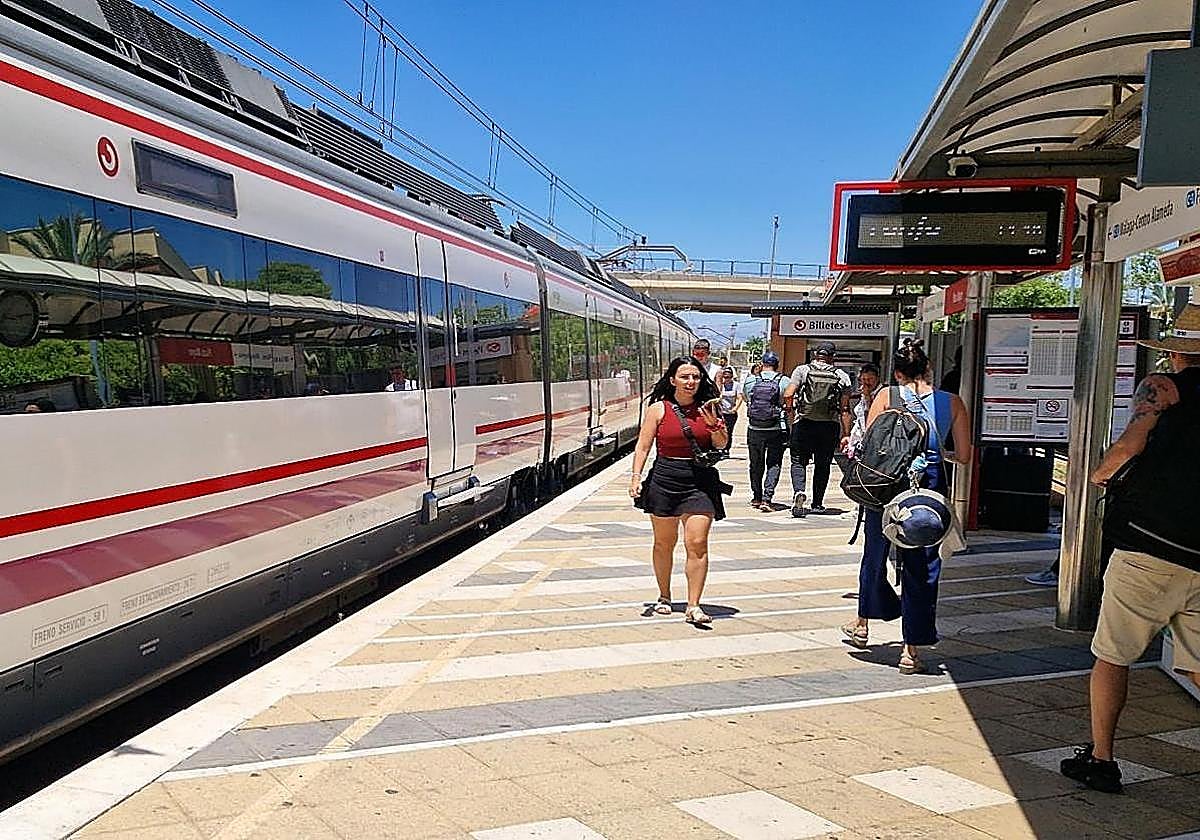
The Spanish government's sub-delegate for Malaga province, Javier Salas, was keen to highlight on Wednesday the punctuality rate achieved by Renfe's commuter rail service (Cercanías) in Malaga for its two lines (C1 and C2), which rose to 96.9% during September, according to data published by Renfe in its monthly report on punctuality. This percentage refers to train services that reached their final destination with a delay of five minutes or less.
Javier Salas noted that "Malaga's C1 and C2 lines have only been surpassed by Zaragoza in relation to this punctuality indicator in the aforementioned month out of all the Cercanías services across the different provinces of Spain."
The central government official also highlighted the "great role played by Renfe's commuter rail service as part of public transport usage in the metropolitan area of Malaga, with a volume of 1.3 million passenger journeys taken in September". He further encouraged "other governing bodies, especially the Junta de Andalucía, to work to reduce the use of private transport for intercity journeys that has reached 90% in our province".
Javier Salas also mentioned "the level of service compliance achieved by Malaga's Cercanías lines for the month in question, which was 99.8%", an indicator that reflects the relationship between scheduled train services and the trains that actually completed their runs, discounting cancellations or journeys cut short.
Timetable compliance
In September, a total of 3,786 train journeys ran on the two Cercanías lines in the Costa del Sol province, resulting in a timetable compliance rate (trains running on time) of 85.9%. On-time performance is defined as the percentage of trains that arrived at each station within their scheduled arrival time. A deviation of three minutes or less is regarded as being on time. The average delay for journeys made in September was 0.5 minutes.
As for regularity, that is, the frequency of train arrivals at each station on the route and whether it is keeping to time with respect to the previous train, this stood at 96.6% for September.
![[]](http://static.vocstatic.com/voc26/latest/assets/images/favicon/surinenglish/apple-touch-icon-57x57.png)