
Drought crisis
Pipeline switched on to send treated wastewater from Malaga to Axarquía crops
The new regeneration system at Peñón del Cuervo treatment plant will provide nine cubic hectometres more water to help irrigate crops
José Rodríguez Cámara
Malaga
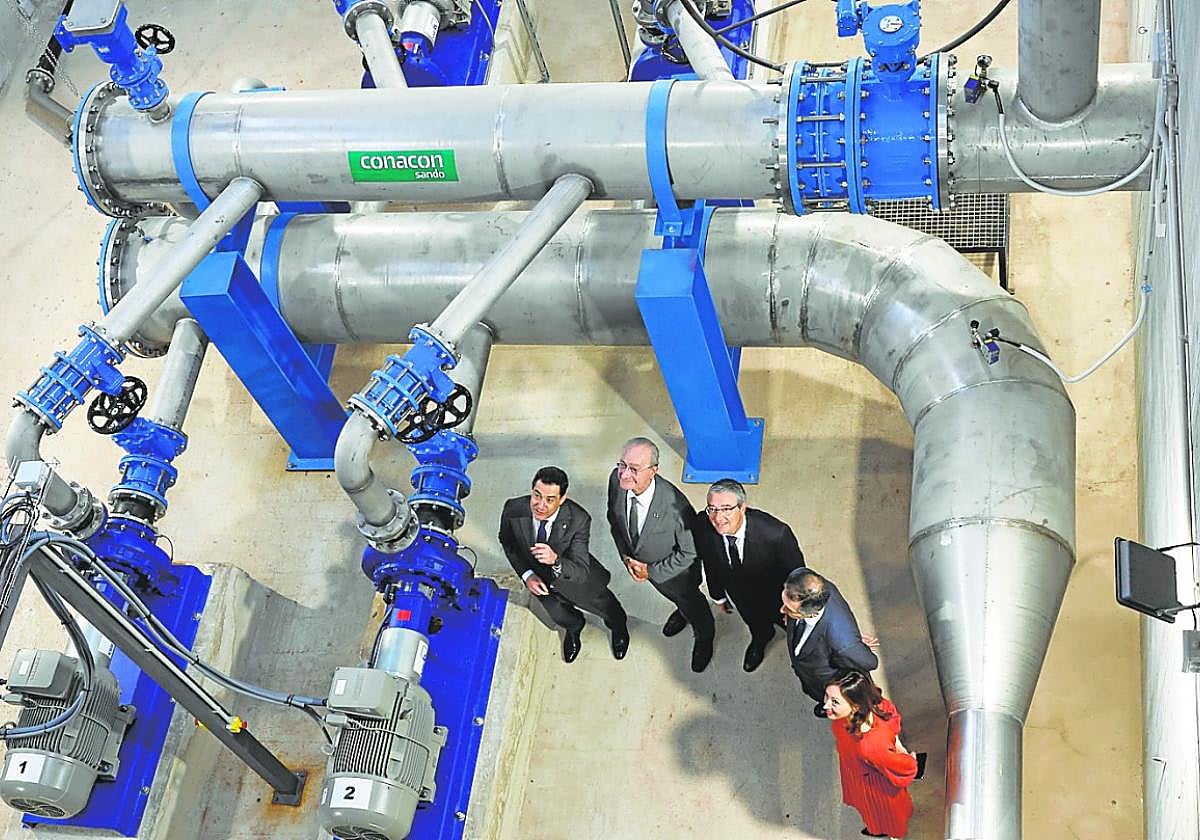
A new pipeline that carries treated wastewater from the sewage plant at Peñón del Cuervo in Malaga city via the coastal town of Rincón de la Victoria to irrigate crops in the Axarquía was officially activated on Wednesday.
The president of the regional government, Juanma Moreno, pressed the button that operates the system, which now means valuable recycled water will be sent to the drought-stricken farms of eastern Malaga province.
The work to install the pipeline involved digging up the nine-kilometre-long seafront promenade of Rincón de la Victoria last summer, leading to local businesses losing trade during the Costa del Sol's busiest time of the year. Hotel and catering business owners claimed they had lost around two million euros as they considered that the planned deadlines were not being met.
The work on the 10-kilometre pipeline, which forms part of the Andalusian regional government's drought plan, was assigned a budget of 27 million euros. The new system will contribute an extra nine cubic hectometres a year for the irrigation of crops.
Crucial
"The water that irrigates the countryside sustains the local population," Juanma Moreno said. He pointed out that treated wastewater from Malaga city is crucial to helping the drought situation in the hard-hit Axarquía area, which is known for its vines and water-hungry subtropical crops like mango and avocado.
On one hand, along with other initiatives planned for the Axarquía, the water from the pipe goes towards 22.5 cubic hectometres of water which covers the needs of half the crops in the area. On the other hand it takes the pressure off drinking water supply for the 210,000 residents in that part of the province.
Moreno thanked the support of Rincón town hall and the construction companies for their work which ensured a "highly complex project" was completed in just 13 months.
The opening comes less than a week after the drought alert for Malaga city and the Guadalhorce valley areas was raised to red, a level already applied to the Axarquía and the Costa del Sol areas.
Other measures
Work has also begun on connecting underground water supplies from boreholes in the foothills of the Sierras Tejeda, Almijara and Alhama, with the much-depleted Viñuela reservoir in the Axarquía. According to calculations by the Junta de Andalucía, these boreholes could provide around 50 litres per second, which would mean around two cubic hectometres per year.
Related news
-
Drought crisis
Eugenio Cabezas -
Meanwhile Malaga city will rely on at least half of its water supply this summer coming from old wells in the lower Guadalhorce valley, which threw the city a lifeline in the drought of 1995.
The 18 disused wells are expected to provide up to 25 cubic hectometres a year following the completion of restoration and cleaning work.
A pipe will be installed to take the flow to a water deposit tank to the north of Malaga Airport; and another will connect to the network that reaches the treatment plant at El Atabal.
![[]](http://static.vocstatic.com/voc26/latest/assets/images/favicon/surinenglish/apple-touch-icon-57x57.png)