
Food and drink
Mangoes from Malaga: the tropical flavour that conquered Europe
More than 4,500 hectares are currently cultivated in the province, a figure that continues to grow every year

Malaga
The mango is one of the most popular tropical fruits in the world. Sweet, juicy, aromatic and rich in antioxidants, vitamins and fibre, it has gone from being an exotic product to a key crop in Spain, especially in the province of Malaga. Its culinary versatility - from eating the fruit itself to use as an ingredient in smoothies, salads, sauces or desserts - has contributed to its growth in popularity.
The arrival of mangoes in Malaga
The mango comes from southeast Asia and has been part of human agricultural history for more than four thousand years. Although it is difficult to pinpoint its exact point of origin, most researchers agree that it originated in southern India and the Malaysian archipelago. From there, cultivation gradually spread to other areas of the world with tropical and subtropical climates.
Its global expansion is largely due to shipping and colonial trade. It was the Portuguese who brought it to America, introducing it first in Bahia (Brazil). From there it spread to the West Indies, Jamaica, Haiti and, later, Hawaii. It was also transported to the tropical coast of Africa, from where it advanced south to the Cape of Good Hope and to island territories such as Madeira and the Canary Islands.
In Spain the mango was introduced in the Canary Islands at the end of the 18th century, although it was not until the 1970s that it began to be cultivated commercially on the islands. Shortly afterwards, in the 1980s, it made the leap to the mainland and to Malaga and Granada provinces where it has become a key crop.
Malaga, Europe's tropical orchard
Its epicentre is the Axarquía, a privileged enclave on the eastern side of Malaga province. With mild temperatures all year round, the absence of severe frosts and well-drained soils, the area offers ideal conditions for its growth. It is no coincidence that it is known as the "tropical orchard of Europe".
Today, the province of Malaga is home to 90 percent of the Andalusian surface area and almost the entire national mango crop, with 4,600 hectares, making it the true European epicentre of this fruit, followed by Granada, the Canary Islands, Valencia and Murcia.
In Andalucía, the mango is the second most important subtropical crop economically, after avocado, according to the Andalusian regional government's department of agriculture. A record production is forecast for this season, which is expected to exceed 35,000 tonnes; three times more than in 2024, across Spain. This recovery is thanks to the heavy rains of autumn 2024 and spring 2025.
An ever-closer market
Mangoes are no longer an exotic fruit from overseas, but a local product. The Spanish market responds enthusiastically to the proximity, the freshness and the possibility of acquiring mangoes harvested at their optimum ripeness, without long journeys or artificial preservation processes.
France (32%), Portugal (29%) and Germany (14%) are the main destinations in economic terms according to the price and market observatory of the Andalusian regional government.
Varieties and characteristics
The mango harvest in the south of Spain lasts from August to December, depending on the variety and the best time for consumption is in September, October and November.
The most grown variety is the Osteen, which is characterised by a purple skin with green tones and by its excellent balance between sweetness and aroma. Then the Kent, which is very juicy, without fibres and with an intense sweetness that makes it particularly popular in international markets. The Keitt, which ripens later, offers a different profile, with pulp without fibres and an acid touch that contrasts with the usual sweetness of this fruit.
Other varieties complete the mosaic of flavours and colours offered by the Axarquía. The Palmer, elongated and with purple skin, has a firm, sweet flesh and small acid touches, while the Irwin, smaller and more aromatic, has a reddish-yellow skin. The combination of all of them allows the season to be staggered from the heat of summer until well into the cooler autumn, which prolongs the presence of the Malaga mango in the markets and reinforces its competitiveness with regard to exporting countries.
How to cut a mango
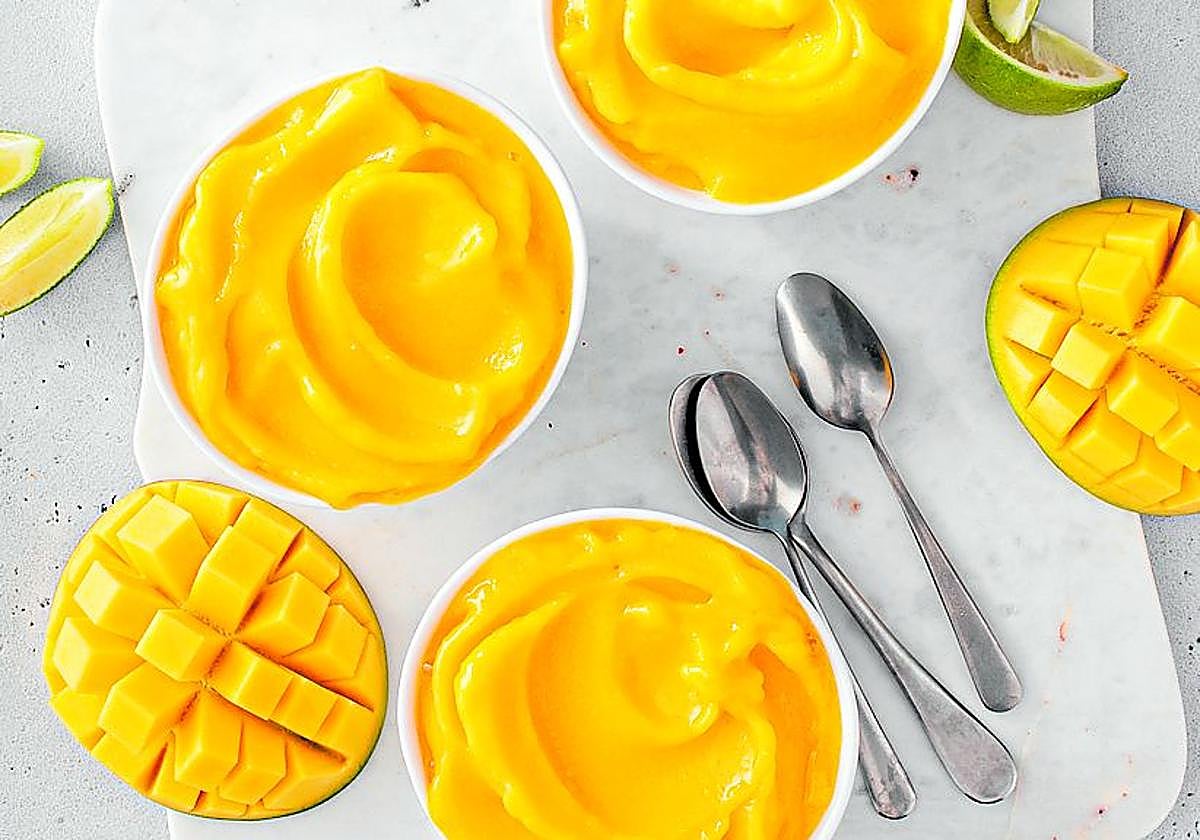
The mango is one of those fruits that often generates doubts when it comes to cutting it. The key is to get around its large, flattened central stone to get as much of the fruit as possible. To do this correctly, the first thing to do is to cut both sides of the fruit, following its natural shape and avoiding the stone. Then, with one half in your hand, make small cuts along the length and width of the flesh, drawing a grid. Then, peel the skin off (when the mango is ready to eat, the skin should come off easily).
Mangoes and their benefits
Beyond its irresistible taste, the mango is a real nutritional treasure. Its ripe fruits are an important source of vitamins A and C, essential for keeping the skin and immune system in good condition. It also provides vitamin E and folates, while its minerals include potassium and manganese, which contribute to bone health and fluid balance in the body.
Malaga accounts for 90% of the Andalusian surface area and almost all of the national crop
The fibre it contains aids digestion, while its bioactive compounds - so-called phytochemicals - are being studied for their potential health benefits, from the prevention of chronic diseases to cellular protection against oxidative stress.
The Malaga mango is an example of how a tropical crop can take root in Mediterranean soil and become a symbol of identity in the agri-food sector. Its expansion has transformed the landscape of the Axarquía area, boosting the local economy and bringing a fruit that until recently was considered exotic to European consumers.
![[]](http://static.vocstatic.com/voc26/latest/assets/images/favicon/surinenglish/apple-touch-icon-57x57.png)