
Migration
'No incidents' reported as Costa del Sol hotel marks two years as migrant reception centre
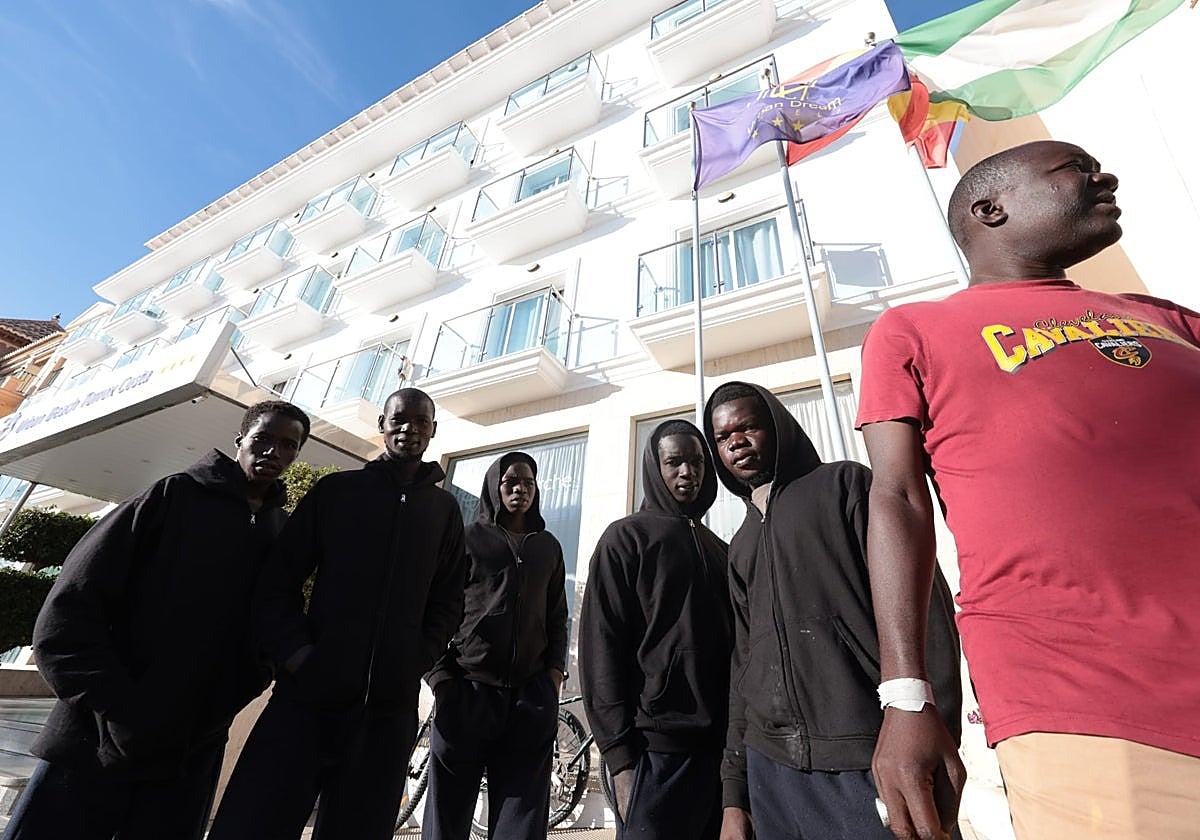
Since the former four-star Urban Beach hotel received the first group in October 2023, around 1,600 people - mainly young men from African countries - have passed through its doors
Eugenio Cabezas
Torrox Costa
Migration pressure on the Canary Islands and more recently, the Balearic Islands, continues unabated in Spain. Last year ended with a new record number of arrivals from African countries to the Canaries, with nearly 44,000 of the more than 60,000 who came to Spain illegally. People have been distributed throughout Spain through emergency measures involving organisations such as the Red Cross and the Spanish Commission for Refugee Aid (CEAR).
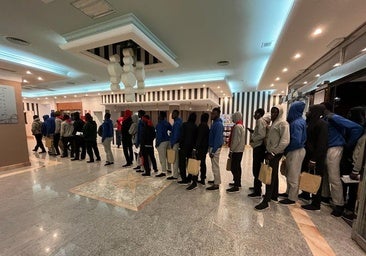
In Malaga province the first emergency reception centre to be set up was the former four-star Urban Beach hotel in El Morche, Torrox Costa, on the eastern Costa del Sol in October 2023. According to the Red Cross, in the two years since then around 1,600 people have passed through the hotel, which has since been converted into a reception and care centre for migrants. In the first few months most were from Senegal, but in recent months the majority have been young men from war-torn countries including Mali and Somalia.
Related story
This means that these people can apply for political asylum in order to obtain refugee status, which gives them faster access to the documentation they need to work legally in Spain. Those from other countries who do not obtain this status have to prove that they have been in Spanish territory for at least two years in order to obtain their papers through a procedure known as 'arraigo'.
Almost all of the migrants housed in Torrox are young men. The Red Cross provides social services at the hotel, offering them Spanish language and culture classes and providing training to enable them to work here, according to the provincial coordinator of the NGO in Malaga, Samuel Linares. "We have a lot of demand from fruit and vegetable companies in the area for harvests," he said in statements to Cadena Ser radio in the Axarquía.
Of the 362 people currently staying at the hotel, more than 160 have found a job "with decent conditions" Linares added. Migrants who are in an irregular situation and cannot return to their countries of origin, as there are no extradition agreements, have to remain working irregularly in the underground economy for two years, according to the provincial coordinator of the Red Cross.
No incidents
Despite complaints and criticism from the PP government team in power at Torrox town hall, the reception of these migrants has so far been "without incident" said Linares. He highlighted that "these people have no other plan than to try to work here legally, to make a living, to help their loved ones and families, because they have left their homes and embarked on a dangerous journey in a small boat covering more than two thousand kilometres".
In November 2023 the Partido Popular (PP) in Malaga province opened an investigation into Torrox’s PP councillor for culture and popular traditions, Salvador Escudero, following his controversial comments to Radio Torrox.
His comments were in relation to the first group of migrants who arrived at the hotel in El Morche that October. Escudero compared the migrants to “animals” and said: "We don't know if they are going to steal a car, it's like putting a time bomb on you".

The reception programme at the Urban Beach hotel in El Morche, will remain in place for at least another six months according to the provincial coordinator of the Red Cross. "This is the period for which the central government is extending the programme," Linares explained.
The Ministry of Inclusion, Social Security and Migration is responsible for the transfer and assignment of NGOs that take care of migrants arriving by canoe in the Canary Islands or the Balearic Islands, their transfer to the mainland and temporary accommodation in Malaga. All migrants referred to Malaga have full freedom of movement, although they are subject to an expulsion order for having entered Spain illegally. Obviously, not all of them will be deported immediately, but it will depend on each case and, above all, on whether there are extradition agreements with their countries of origin.
In fact, they have the option of requesting international protection, the right to shelter or asylum in Spain, which, if granted, would halt the expulsion order. The Ministries of the Interior and Migration are responsible for assessing these applications for international asylum. If they apply, they leave the Red Cross centres and are taken care of by the Spanish Commission for Refugee Aid (CEAR).
If, after two years in Spanish territory, irregular migrants have not been sent home or granted international protection through asylum, they can apply for residence providing they can demonstrate that they have been in Spain for this period of time. It is estimated that there are more than half a million irregular migrants in Spain, a group that Pedro Sánchez's government plans to regularise.
![[]](http://static.vocstatic.com/voc26/latest/assets/images/favicon/surinenglish/apple-touch-icon-57x57.png)