
The story of Malaga's 'espetero' Manolín, competing for a Goya Award
The short documentary El Amoragaor, by Adrián Ordóñez, has been shortlisted for several Spanish film awards for its human portrayal of the tradition of roasting sardines over an open fire on the beach
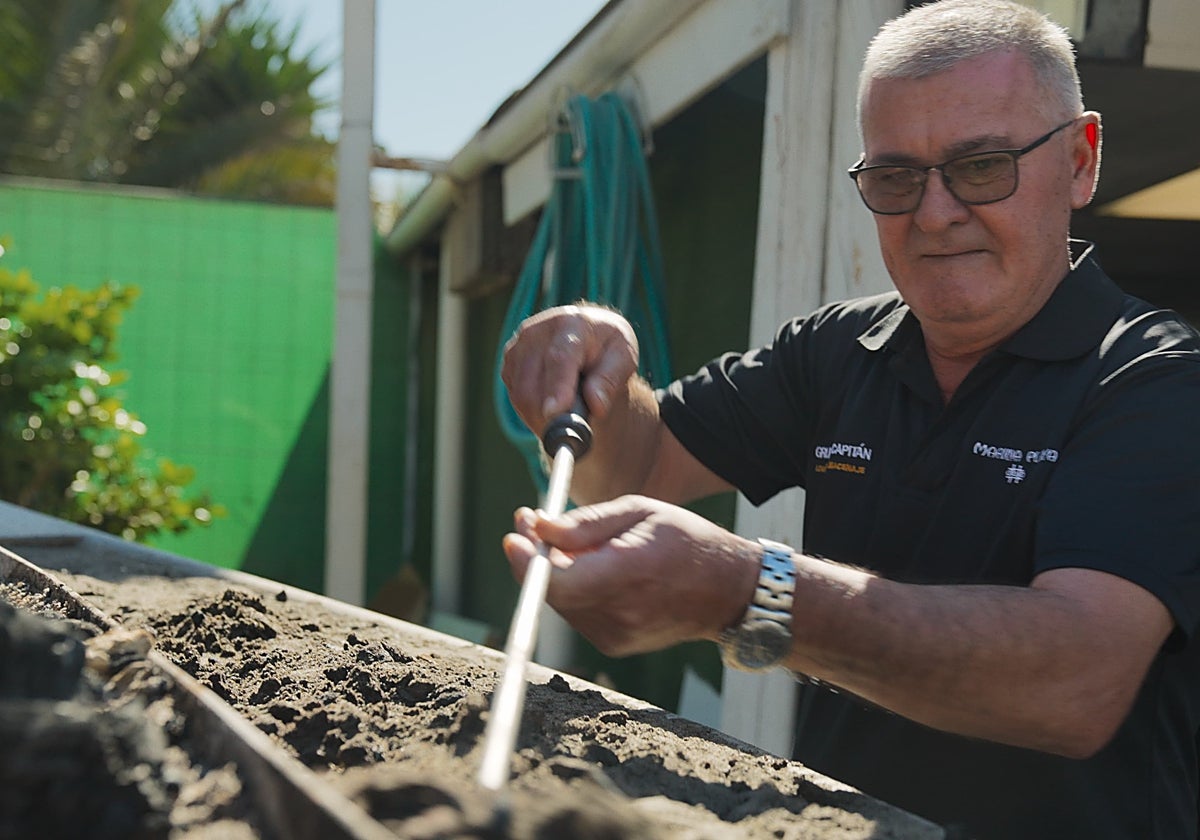

Behind every 'espeto de sardinas', the skewered sardines roasted on an open fire so typical of the beach bars on the Costa del Sol, there is a story that speaks of tradition and identity, of memory and craft. And this is the story of Manolín, the 'espetero' of Marina Playa, in Rincón de la Victoria, a story that could be worth a Goya award. The short documentary El Amoragaor, directed by Adrián Ordóñez, has entered the shortlist of short films vying for a nomination in the Goyas, Spain's equivalent of the Oscars, after touring festivals around the world and receiving eleven international awards.
A local story becomes universal through the portrayal of one of those people capable of threading sardines to "feed 300 people" per service. But it is not a foodie or a tourist documentary; not at all, the tone is human and deeply emotional. It all stems from an idea had by the writer, director and playwright Sergio Rubio, who was interested in putting the spotlight on something as quintessentially local as the espeto in Malaga.
"It is the contrast between a symbol of the Costa del Sol and the humble person who makes it with all the hype of the hospitality industry that is generated around him," he explains.
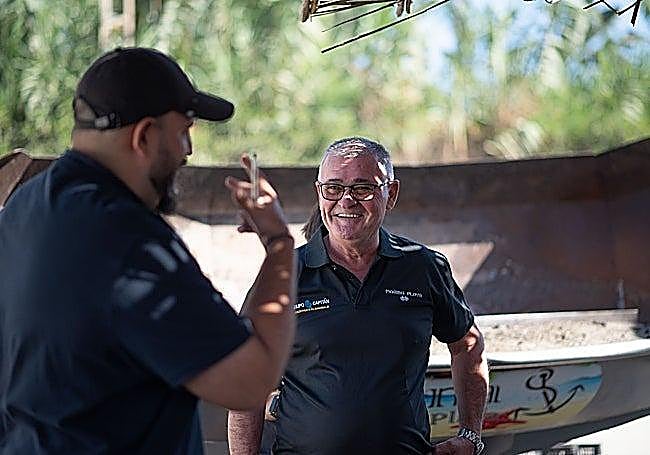
The short documentary, scripted by Paco Bernal, takes the viewer back to the beginnings of the craft, as evidenced by the title, the 'amoragaor': this was the person who tended the embers when grilling sardines by the beach.
Over the years, the skewered sardines would jump from the sand to the boats that today dot Malaga's coastline, something Manolín knows well. When Adrián Ordóñez met him, after months of searching from coast to coast, he knew instantly that he would be the protagonist of the short film. Manolín has always worked in the hospitality industry, but a few years ago he took over management of the espetos at Marina Playa, carrying on his brother's legacy. "He is a very reserved and polite man who, when he speaks, does so with a lot of emotion and affection," says Ordóñez. "He is a very modest person and an incredible human being," adds Rubio.
Humanity and authenticity
Manolín is "just the opposite" of what you would expect to find when you think of an espetero from Malaga. You don't hear him shouting, nor does he stand out for his Andalusian wit. He is a man of few words and his stoic nature makes sense as the documentary progresses and we discover that behind his work there is a loss that he is trying to recover from. It is this humanity, and the sincerity he conveys, that viewers in Croatia, France and Colombia empathise with him, where El Amoragaor has won awards. "In the end we are human beings, and everyone has lost someone, everyone has had that feeling at some point."
Filmed in natural light and at a leisurely pace, cinematographic language serves the documentary. Adrián Ordóñez spent five months talking to and observing Manolín so that everything would flow when the clapperboard sounded.
The skewer becomes the vehicle for expressing a universal pain, while at the same time showcasing the uniqueness of the craft
The espeto becomes the vehicle for expressing a universal pain, but along the way the documentary shows the harshness and uniqueness of a profession that surprises and attracts locals and foreigners alike. First, it accompanies the fisherman Carmelo as he spends more than ten hours at sea fishing for Malaga sardines. And then in the beach bar, filming while people eat in the dining room and food orders pile up.
"It was a tough shoot, but we've learned a lot. For people from Malaga, the beach is something we see every day and we have it right next to us, but we don't know what it means to work on the beach and everything we don't see," reflects Adrián Ordóñez.
The documentary, by the newly established production company Muy al Sur Films, is in the running for the top prize, competing with major names from Madrid and Barcelona. "We started out from a grant from Festival Málaga and another from Sabor a Málaga. But that's it. We do everything ourselves," Rubio confirms. And the collaboration works.
Soon Adrián Ordóñez and Sergio Rubio will premiere Inquilinos, a new short film about the housing crisis, starring Salva Reina, Joaquín Núñez, Carmen Sánchez and Melani Olivares. Perhaps by then they will already have a Goya.
![[]](http://static.vocstatic.com/voc26/latest/assets/images/favicon/surinenglish/apple-touch-icon-57x57.png)