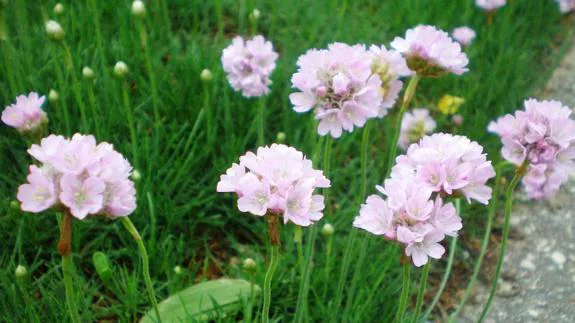
Armeria maritima
Sea thrift, a hardy perennial herb, loves dry, sandy soils and can also tolerate salty winds and spray
Denise Bush
Viernes, 1 de junio 2018, 12:41
Common names for this hardy European native include sea thrift, sea pink, cliff rose, March daisy and sea gilliflower. In Spanish it is called 'clavelina del mar'.
Amaryllis, a lovesick girl
-
This photograph of a gorgeous, red amaryllis was sent in by Ann Pennington. According to Greek mythology, Amaryllis was a maiden who fell in love with cold-hearted Ateo. She stabbed herself through the heart with a golden arrow and then walked to his house to declare her love for him. The drops of blood she shed grew into beautiful scarlet flowers and Ateo fell in love with her. Her heart healed and the flower was named amaryllis - that is, until it was reclassified in the genus Hippeastrum in the 1800s.
In its native habitat it can be found growing in coastal areas and dry sandy areas across Europe, in Serbia and the Americas.
Armeria is a genus in the Plumbaginaceae family with just a few sub species. It can tolerate copper soil contamination and can also withstand salty soils and winds but must have free-draining soil or it will rot. It is drought-tolerant once established and is invaluable for xeriscaping.
Sea Thrift has narrow,dark-green leaves which form a mound of foliage approximately 30cm by 30cm. The mound will spread slowly and the middle may die back. If this happens, the clump can be divided to produce new plants. It can also be propagated by basal cuttings and by seed.
The dense, rounded clusters of purple, pink or white blooms form on tall slender stems and usually appear from early spring to midsummer. They attract bees and butterflies and although Sea thrift will grow in partial shade, it needs full sun to reach maximum flowering potential. Deadheading will extend the flowering period.
Sea thrift can be used as edging, in borders or in containers. It is especially popular as a rockery plant. Armeria 'Vesuvius' has smoky purple leaves which form a stunning contrast to the bright pink blooms.
Sea thrift was used for the design on the back of the British threepenny bit between 1937 and 1952.
Extracts of the leaves and roots of Armeria are said to have antibiotic properties and can be used to treat obesity, nervous disorders and urinary infections.