
Toledo train crash 2026
Spain's Transport Minister directly blames Atocha control centre for deadly train crash: 'They could see exactly what was happening'
Puente has stated that the signals were working and that the order to resume the journey breached two basic rules of railway safety
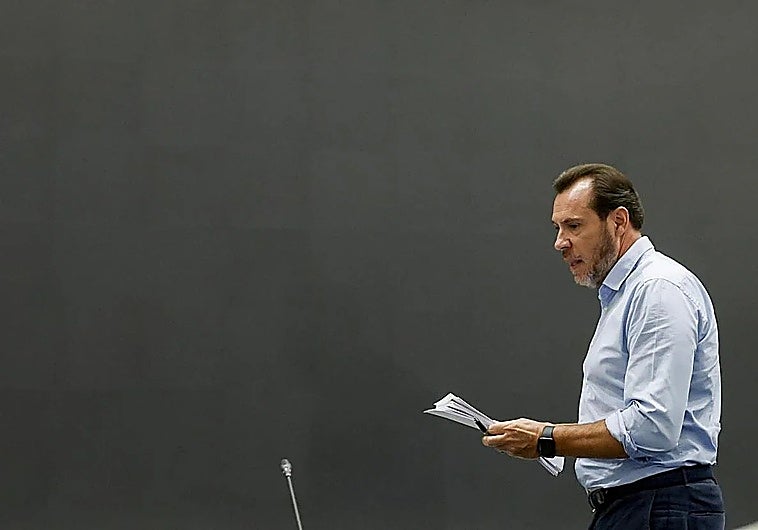

Spain's Transport Minister Óscar Puente has reiterated his verdict, pointing at the Atocha control centre's orders as the cause for the Urda rail accident on 28 October ... .
Puente said that, to date, there is no evidence that the country's rail infrastructure and its management could have caused the crash. While not explicitly referring to a "human error", Puente repeatedly highlighted the orders that had come from the control centre.
The minister blamed the staff because, as he pointed out, they could see on their screens where the trains were and had precise rules in place that prevented them from authorising the AVE to set off while the Iryo remained stationary ahead of it. They failed to comply with these rules, Puente stated.
Related story

"Those in the control centre could see what was happening", Puente said, adding that the screens can show "one train approaching while the other remains stationary".
The accusation introduced an element that had been less well known until now: the green signal that the AVE encountered before the collision. The control centre operators gave the Iryo the go-ahead, even though its driver was unable to restart the system. The signal in front of this train turned green, as did the advance signal encountered by the Renfe train.
"Why does this signal turn green, meaning the approaching train is completely at risk?" Puente wondered. According to him, the safety system, ASFA, did not warn the AVE of the danger because the signal indicated the track was clear, even though there was still a train stationary within the same section.
Puente said that the control centre was aware of the Iryo's delay, as it had authorised the train to depart and subsequently received a call from the train driver stating that she was still unable to set off.
The minister said that the responsibility for interpreting that situation lay with Atocha and not with the AVE driver. "The driver doesn't know what's ahead of him," Puente explained.
Puente recalled two rules which he described as "basic": do not move the rear train while the front train is still occupying the block section and operate under 'marcha vista' (40 kilometres per hour), when travelling in bad conditions. The first rule required waiting until the train ahead had passed the next signal.
"The train behind does not move until the train in front has started moving," Puente said. He also did not blame Iryo for failing to set off: "We don't know why it didn't start moving again." The crucial point, he said, was that it remained stationary.
The AVE was instructed to proceed at "normal speed" and was able to reach much higher speeds. The driver of a third train that day disregarded a similar order and requested to proceed at a lower speed. Puente said that only Atocha was fully aware of the situation.
At 8.31am on Wednesday, a communication fault between Urda's computer systems caused the LZB system to fail along a 63-kilometre stretch of the Madrid-Seville line. The automatic protection system brought the trains to a halt. Traffic was then switched to BSL operation, supported by the ASFA system and decisions from the control centre.
The control centre first authorised the AVE 2080 to resume its journey at 8.36am, something Puente described as "shocking", and then the Iryo 6076 at 8.41am. The latter was unable to move. At 8.48am, its driver reported once again that her train was still stationary. At 8.53am, the AVE caught up with it from behind.
"There was indeed enough time to warn the AVE," the minister said. In the five minutes between the last communication and the collision, he believes an attempt could have been made to stop it. "Why, if action could have been taken and there was time, was nothing done?" he asked.
The minister also rejected the possibility that stress was a sufficient explanation. He stated that the traffic controller was properly trained, had been posted to that sector since February and had clocked up just two hours on duty.
There was an assistant standing next to him and a supervisor. He added that 16 operators were working at the centre. The person in charge was suspended from duty following the incident, in accordance with protocol.
Puente defended the infrastructure's safety barriers and regulations. "Human beings are only the last resort," he said. The systems brought the trains to a halt. According to him, the risk resurfaced with the authorisations from Atocha.
However, the minister refrained from assigning definitive blame. "I have never used the term 'human error'", he stated and promised to "not use any worker as a scapegoat". He explained that the investigation would need to examine protocols, training, supervision and possible organisational shortcomings.
Puente also drew a distinction between Urda and Adamuz, the origin of which is still awaiting laboratory analysis. Here, he stated, the records make it possible to reconstruct the orders that were given, although the causes and those responsible have yet to be established.
The Aitat investigation is keeping all possibilities open and is examining an alleged "chain of faults, instructions and actions" in the absence of the necessary safety barriers. The trains' data is in the custody of the Guardia Civil.
170 incidents
Puente said that the cause of the IT failure was still unknown, but described the LZB transmission outages as a foreseeable eventuality. He put the number of incidents recorded this year at 170, 75 per cent of which were linked to external causes such as theft, construction work, maintenance or weather conditions. Of these, 13 occurred on the affected section. The most recent one took place on 14 October.
