
Toledo train disaster 2026
Urda rail investigation reveals third train continued on opposite track near crash site
Aitat and Guardia Civil confirm driver of a fourth train refused an incorrect control room order to proceed at normal speed amid LZB signalling chaos
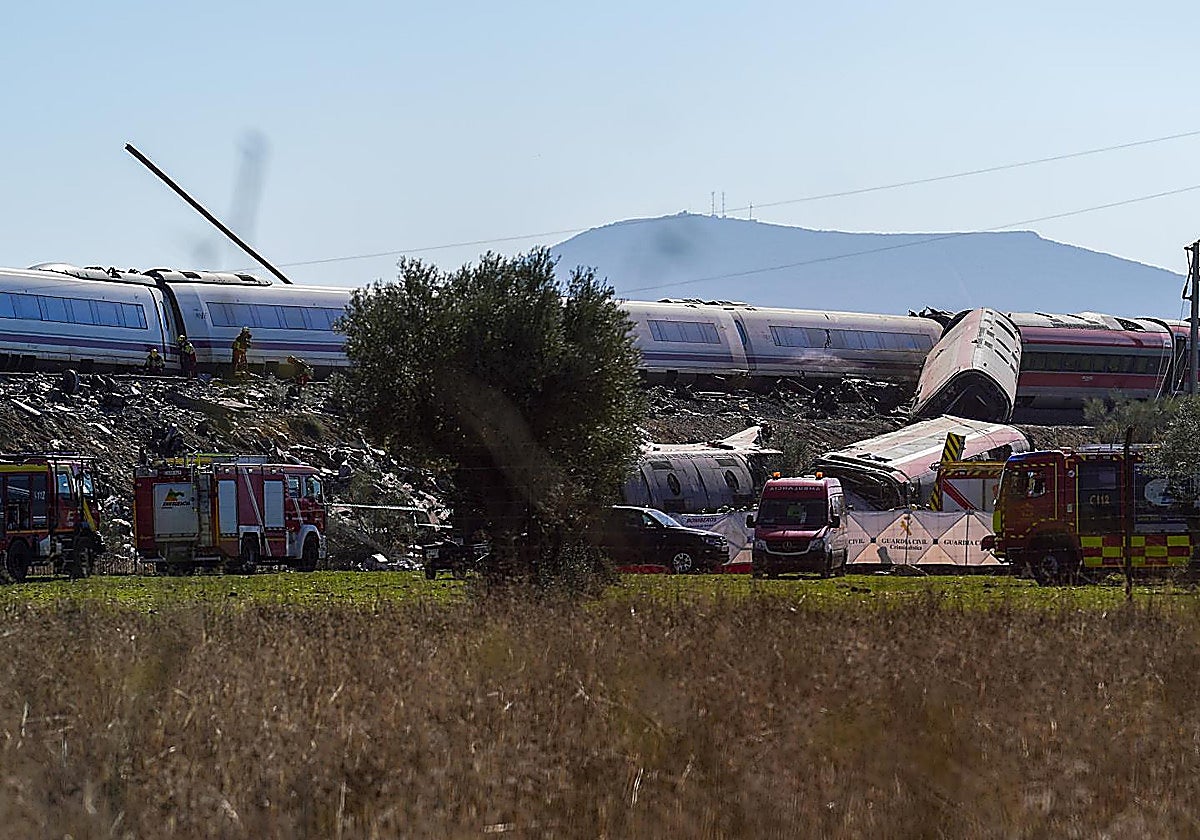

The Urda tragedy that happened when an AVE train rear-ended an Iryo train on Wednesday could have been even worse. Investigators from the ... Aitat transport body and the Guardia Civil have confirmed that, amid the chaos, a third train continued on its route and another driver, from a fourth train, overruled an incorrect order from Atocha.
The failure of the LZB, the automatic safety system, had affected six trains over a distance of some 63 kilometres, creating a "complete gridlock". Furthermore, a fifth train, an Avant, also travelled in the area, despite the fact that protocols require a complete halt to traffic on that section of the line.
The train that continued on its way was the AVE 02061, which had departed from Seville-Santa Justa at 6.05am bound for Madrid. It was travelling in the opposite direction to the trains involved in the accident and it came to a halt near the wreckage.
The preliminary reconstruction places the first stop of this third train at around 8.39am, at kilometre 125.2. It remained there until approximately 8.52am. The distance from that point to the site of the collision, at kilometre 118.8, was 6.4 kilometres. The accident occurred at 8.53am, by which time train 02061 had already started moving.
The AVE remained stationary for around 13 minutes, until it set off again at around 8.52am, barely a minute before the collision. It travelled towards Madrid at an average speed of between 34 and 73 kilometres per hour, came to a halt again and, minutes after the accident, resumed its journey at an even slower pace. It finally came to a halt at kilometre 121, about two kilometres from the spot where the other two trains had collided.
Contrast in speeds
The contrast between the trains' speeds is striking. While the AVE 02061 was travelling slowly towards Madrid, the AVE 02080 reached speeds of over 200 kilometres per hour on its way to Seville. Ahead of them, the Iryo 6076 remained stationary, as its driver had reported that she was unable to get the train moving again.
Authorisation for AVE 02080 was transmitted at 8.36am, but the first clear indication of its movement in the reconstruction appears at 8.43am. The 17 minutes leading up to the collision therefore include a period during which the train was stationary. Around nine minutes elapsed between the first recorded movement and the impact.
Four minutes after setting off, the AVE was travelling at an average speed of 214 kilometres per hour. At 8.51am, near kilometre 111, the calculated speed reached 236km/h; in the following interval, it dropped to 181km/h. Aitat estimates the impact speed to have been between 160 and 200km/h, pending data from the data recorders.
The movements of the AVE 02061 are not the only ones under scrutiny by the investigators. Another Iryo train, the 6011, which was operating on the Seville-Madrid route and was about 50 kilometres from the accident, is also reported to have received an incorrect order from Atocha to resume normal service. Its driver spotted the error and insisted on proceeding at a lower speed.
The Avant 08081, travelling from Puertollano and running behind the AVE 02061, also set off again after the accident. It had come to a halt at around 8.43am at kilometre 126.1. Its first significant movement was recorded at around 9.02am: a distance of some 900 metres, with a maximum recorded average speed of 37 kilometres per hour.
