
Ceuta migration crisis
Ceuta business owners protest against use of industrial areas as migrant reception centres
The government has not specified how it intends to manage "undocumented" migrants, while employers' organisations warn that misinformation is rife
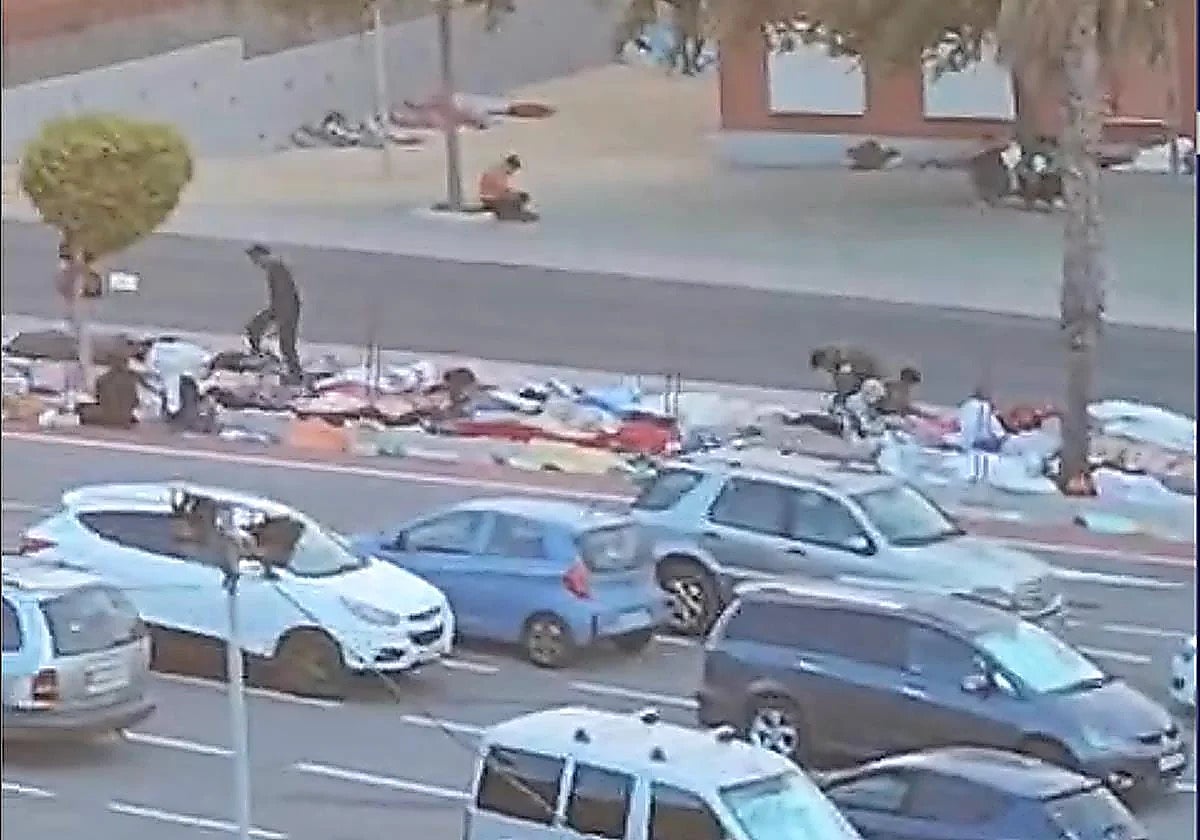

Business owners have been the latest to rebel against the model the government is developing to manage the flow of migrants in Ceuta. Since the influx of tens of thousands of migrants on 30 and 31 July ... , the crisis has been sowing uncertainty among the local population.
Rumours that this coming weekend some warehouses in the Tarajal area are to be converted into a makeshift reception centre have set off alarm bells among employers' organisations.
Business owners are now threatening to take action, after the new single command has backtracked on the initial plan to convert the sports halls of the city's schools into reception centres.
Related story

"The problem now is that the authorities have not been entirely clear about where they are going to house these people, with the result that misinformation is rife, suspicion is treated as a rumour and, in turn, as a threat," Begoña Hernando, spokesperson for the Ceuta confederation of business owners, said.
Business owners in the Alborán industrial area, next to the Tarajal border, have protested against the use of industrial units as reception centres for the 10,000 foreign nationals who remain at the border.
"What is certain is that they're looking for ways to bring together as many people as possible while they decide what to do with them. Several sites are being set up, because they'll have to be put somewhere, but nobody wants them nearby," Hernando explained.
On Thursday, for example, there was talk of an area in the port called Descampado, where there used to be some holiday homes, which immediately sparked complaints from neighbouring residential areas.
The situation is unsustainable, with reception centres already operating in Loma Colmenar and in several derelict industrial buildings in Tarajal.
"Look, any business owner with a warehouse, unless it's empty and they can rent it out to the town hall, doesn't look kindly on this operation. There are many industrialists who use their industrial units as warehouses and accessing your goods under these conditions is a problem, not to mention that the situation involves risks and you have to hire private security," she said.
Everything suggests that the problem, far from easing, is getting worse. "People are very tired and you can tell their patience is running out," Hernando stated.
The idea of converting school sports halls into reception centres, although shelved for the time being, has not helped calm tempers either. The city authorities insist that the initiative "is on hold" after the president of regional government, Juan Jesús Vivas, threatened to barricade himself inside these facilities.
"Yes, Vivas may well be very populist, but he has the public on his side, having earned their trust over the past 26 years. Just two days ago, for example, the crowd demonstrating in the streets of Ceuta escorted him home," Hernando said.
Meanwhile, the public is growing increasingly frustrated by the lack of short- or medium-term solutions. The start of the new school year is just round the corner, 8 September for nursery and primary schools.
"If they decide to use the sports centres, the outrage will only grow and the social unrest will escalate," Hernando warns.
"Where my son goes to school, the sports hall is right next to the building that houses the classrooms. There's direct access. It's true that, given his age, you always have to drop him off and pick him up and they've said they're going to provide security… But even if you leave him there, you can't help but worry. The problem gets worse when you move on to higher levels, such as secondary school. In my school's parents' association, many parents say that if migrants are grouped together in sports centres, they won't take their children to class, even if that means starting the school year without them."
Morocco does not recognise its victims
This is not the only aspect of the social problem looming over Ceuta.
On Thursday, hundreds of people gathered at the Sidi Embarek Muslim cemetery, in the Juan Carlos I area, to bury the bodies of the only 12 migrants, including one woman, who have been identified, either through DNA testing or fingerprint analysis.
On the Spanish side alone, the number of bodies stands at more than 80. The Moroccan government has refused to repatriate any of these bodies despite knowing who they are, according to sources at El Faro de Ceuta, which cites records compiled by the Guardia Civil.
"There is a court file containing all their details. Their identities are known and they are Moroccan, but the neighbouring country has refused to accept them, much to the grief of their families," sources at the aforementioned newspaper said.
![[]](http://static.vocstatic.com/voc26/latest/assets/images/favicon/surinenglish/apple-touch-icon-57x57.png)