
Fire safety
Meet the brave pilots of the 43rd squadron, the Spanish military's wildfire-fighting service
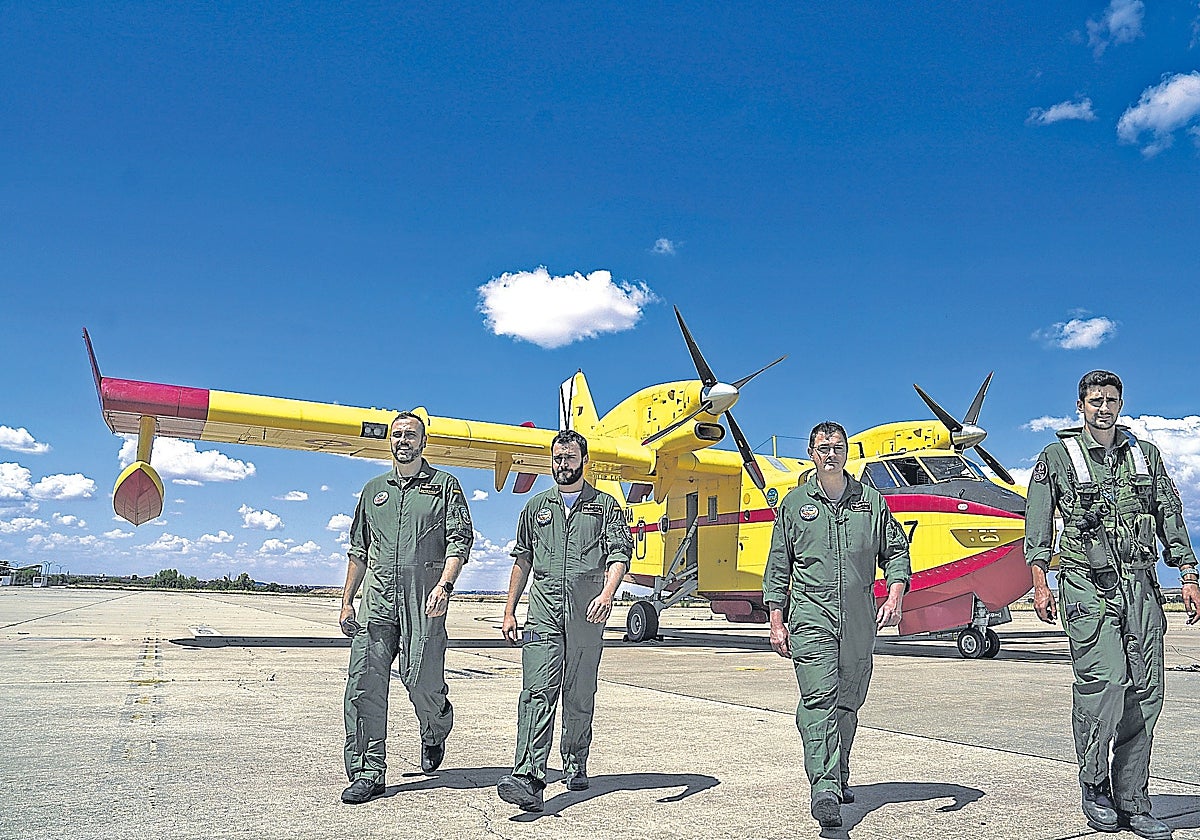
The ten operational aircraft of the '43' are deployed in eight detachments to cover the whole of Spain: Zaragoza, Pollensa (Mallorca), Santiago de Compostela, Salamanca, Malaga, Badajoz, Albacete and the headquarters in Torrejón de Ardoz (Madrid)

Madrid
They even have a licence to wear a pirate skull on their uniform, which identifies Spain's 43rd Air Force Group. The emblem did not please the old generals in the Ministry of Defence, who were reluctant to associate one of their best squadrons with such a 'punk' and informal badge.
But the logo gradually became popular among the pilots of the '43' - as the Air Force's fire-fighting unit is known - and finally the chiefs of the General Staff had to accept the pirate badge that their pilots proudly display today.
For this reason, and because of the peculiar fuselage of their aircraft - which resembles the hull of a ship - they are nicknamed 'privateers', and up there they also enjoy a licence to fly because their operations charter exempts them from restrictions to which other colleagues are subject. For example, they can fly over populated areas at low altitude if the situation requires it, or land in difficult places.
The Torrejón de Ardoz air base in Madrid is the headquarters of the '43', one of the eight detachments that the unit has deployed in Spain, ready for immediate take-off. From 1 June until 31 October, the start and end of the special campaign against forest fires, 100% of its personnel (140 men and women, including 45 pilots and 25 flight mechanics, all military) and almost its entire fleet (10 amphibious aircraft fully operational and another four under review) are available to attend to any emergency mission. Although it is an Air Force unit, it is the ministry of ecological transition (Miteco) that directs its steps at the request of the regions, which are responsible for firefighting.
The aircraft are stripped of all luxuries. No linings, no insulation, no trimmings, everything is kept simple and with pipes, cables and tanks in the open to facilitate access to the flight mechanic in the event of a breakdown.
"Anything that helps to lighten the weight, the better. The important thing is the water tanks," said brigadier Ángel, one of the mechanics in this unit that attacks the most virulent and aggressive fires at low altitude, risking his life in each incident.
Air deployment and assistance to third countries
10
Operational aircraft
The ten operational aircraft of the '43' are deployed in eight detachments to cover the whole of Spain: Zaragoza, Pollensa (Mallorca), Santiago de Compostela, Salamanca, Malaga, Badajoz, Albacete and the headquarters in Torrejón de Ardoz (Madrid). Last year, the pilots fought 240 forest fires from 1 June to 31 October. In 2023 they made 2,433 flights to tackle 343 fires. They also provide support to other countries in emergency situations. Just this week, two aircraft from the '43' took part in forest firefighting operations in the Yambol region of Bulgaria.
The aircraft can hold 6,000 litres of water, which the pilots fill from reservoirs and the sea, and then discharge it on the flames. They also carry two 600-litre tanks of a foam that acts as a fire retardant.
With a wingspan of 30 metres (from wing tip to wing tip) and a length of 20 metres, these planes are the largest in the entire air fleet dedicated to firefighting.
At the edge of the fire
But what really sets them apart are the extreme conditions under which they fly in what is considered to be a high-stress job and which requires years of experience and continuous preparation. "We fly at very low altitude and over terrain that can be complicated because there are reservoirs that are wedged between mountains. We also fly in conditions of low visibility due to the density of the smoke, with strong gusts of wind, turbulence, very high temperatures, and a large number of aircraft operating in the same area; we have to avoid power lines, and when loading water you can encounter boats, canoes, surfers or rocks that you have to avoid. Not to mention the birds of prey that can hit the fuselage," described Captain Ernesto Bonet, 47, a flight commander and instructor with 22 years' experience in the '43' and native of Segorbe (Castellón).
The pilots take to the skies with carte blanche under the motto 'Turn off... and let's go!' which is inscribed on the unit's official emblem, a moustached, aeroplane-shaped seal that gives its name to the Army's call sign for '43': Foca (seal).
They are all united by the fact that they belong to a squadron that works hard and risks death every time they take off. Perhaps for this reason, there is a complicity and camaraderie among them, which is even more apparent once the aircraft return to land, leaving the danger behind them.
"The challenge is to make the safest flight possible," says Captain Daniel Celada, a 31-year-old from Madrid who has been a pilot for eight years. The '43' has gone 21 years without a fatal accident, although the risks are more than evident, as is revealed by a golden plaque in the foyer of the barracks with the names of the 15 people who have died since the squadron was created in 1973.
This obsession with safety involves the six eyes that fly inside the cockpit of the planes: two pilots (command and decision-making usually falls to the most experienced) and a flight mechanic who complete the meagre crew. "The fire zones are chaotic and six eyes see more than two, which is important because they are very visual flights," explained commander Eduardo Gutiérrez, 'Guti', 48, from Madrid, at the controls of a Canadair CL-215 with two powerful 2,500-horsepower turboprop engines and analogue instruments, without automatic piloting or weather radar.
"Our flights are very manual, nothing like commercial flights, which are highly automated. In some areas we don't have a controller below to give us wind information, and we don't know if we're going to have waves at sea. That means experience and making up for the shortcomings by putting in years of instruction and training to become a first-class pilot," he said.
"Eyes and hands
Guti, wh ohas been with the '43' since 2007 and has seen a thousand fires, defines the way he flies as "flying by sensations", with a keen eye, his hands feeling the force of the controls, and his body shaken by the manoeuvres of loading and unloading water. In his case, he holds the record of having loaded 82 times at sea to extinguish a fire in Mallorca. "That was crazy, normally it's 20 to 30 a day," he explained.
Bonet, for his part, describes it as "very visceral piloting, which you feel in your hands and in your body" and which generates mental fatigue and physical wear and tear. "When you get off the plane, you're knackered. And he says that between the smoke, the wind, the power lines, the birds of prey, the helicopters and other aircraft acting on the fire... they use their mental coordinates ("situational awareness", he calls it) to analyse how to approach the fire and discharge water effectively. "And when you release the water," the captain continued, "the aircraft pulls up and you have to control it, balance it and steer it where you want it to go.
More complicated can be the loading manoeuvre, in which pilots hold the controls tightly as they overcome water resistance to fill their tanks: six tonnes in twelve seconds. Those 6,000 litres enter the tanks through two retractable slots deployed as the craft glides across the surface of the sea, lake or reservoir at 120 kilometres per hour. It takes a distance equivalent to four football pitches to load.
Privateers' can only fly from sunrise to sunset. They never fly at night as they are guided by what they see. They fly for a maximum of nine hours a day in four-and-a-half hour flights in order to refuel (5,200 litres).
But as Captain Bonet pointed out, you can spend four hours in one fire, three in another and another two in a third. "I started the day extinguishing a fire in the Valle del Jerte, then continued in Lérida and finished the day in Navarra," he said. For this reason, during the five months of the firefighting season, the pilots live with a three-day rucksack ready to literally fly out.
"I always have it ready with a change of clothes and toiletries. The minimum to spend a few days away because it's normal that they call you or send you a WhatsApp message saying 'get ready to leave for the Canary Islands in two hours'".
This way of life for almost half a year can take its toll on a couple's stability. "Divorces are not uncommon in the aviation world. I have two children and my wife is a nurse and we can cope with it thanks to the fact that we have grandparents nearby, but this is not always the case because everyone in the army is from outside", Bonet said frankly.
And the salaries (between 2,000 and 2,500 euros) are nowhere near the salaries of their pilot colleagues who fly with Iberia. And yet they are not at all 'burnt out'. They are proud of their work and feel very much appreciated by the citizens.
"Putting out fires is very rewarding and fills you with pride because you feel that your work reaches the people. But we put out the fire together with the ground brigades. We are in the air and everyone can see us, but without our colleagues on the ground we are nothing", added Commander Guti, showing the camaraderie between the emergency services.
The only aircraft with an anchor at the ready
Unlike seaplanes, the amphibious aircraft of the '43' can take off from both water and land. The aircraft are easily recognisable by their distinctive yellow colour and curious fuselage, similar to the hull of a ship. They are the only aircraft in the armed forces with the particularity of having a clearly visible line on the outer nose of the cockpit. They also carry an anchor and a boat anchor that the crew uses in case they need to anchor in the open sea or in a reservoir, or to dock in a port.
![[]](http://static.vocstatic.com/voc26/latest/assets/images/favicon/surinenglish/apple-touch-icon-57x57.png)