
Infrastructure
Centro Plaza: the building with a heart that changed Marbella
The well-known centre in Nueva Andalucía opened 35 years ago, growing into a catalyst for the Nordic community on the Costa del Sol Sol
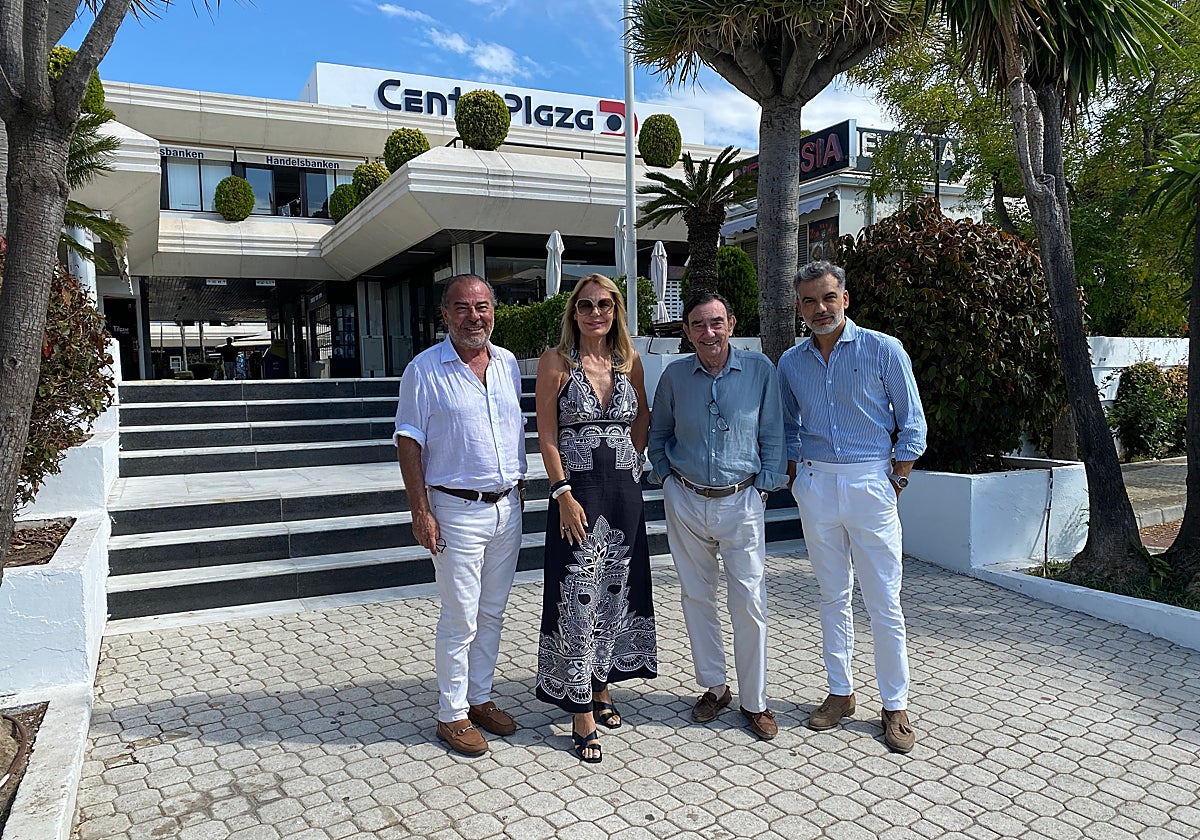

Marbella
Thirty-five years ago, a revolutionary building emerged on a Marbella hillside overlooking the Mediterranean.White, with floating terraces at different levels and corridors reminiscent of an Andalusian village, Centro Plaza was unlike anything the town had seen before.
The visionary project in Nueva Andalucía by developers Alfonso Fernández and Alberto Vidiella, alongside architect Javier Banús, unknowingly paved the way for the Nordic community’s arrival and settlement on the Costa del Sol.
In the 1980s, Marbella was undergoing unstoppable urban expansion. The first golf courses in the area (Aloha, Las Brisas and Los Naranjos) attracted a new type of Nordic visitor who didn't just come for holidays: they wanted to live there.
In parallel, in Sweden, the development of a long-term savings culture and Swedish pension funds, together with growing household prosperity, created the capacity and interest to invest abroad and many did so in this sunny and desirable corner of southern Europe from 1984 onwards.
They bought houses, opened businesses and, above all, found a space in the heart of the Costa del Sol, in Nueva Andalucía, that represented them: "luminous, functional and human", as Javier Banús told Diario SUR.
Together with Vidiella and Fernández, Banús came up with a novel concept: a mixed-use space with offices and commercial premises, designed for living, working, strolling, chatting and contemplating the sea. Hence its name: Centro Plaza, "a place where the interior streets converge as in the Mediterranean plaza, with special emphasis on this social meeting point".
Banús' aim was to design the space so that it aligned with its mixed use. "We had a modern element in our hands but we wanted to maintain the Mediterranean architecture while respecting the environment. The model has been successful and has subsequently been repeated in a few other shopping centres, while maintaining its modern architecture," Javier Banús told Diario Sur.
Banús admitted that "the terrain was complicated, with steep slopes that, despite this, worked in favour of the design", as it allowed them to "create panoramic terraces". "The building licence was hard to get and I ended up taking a model with me so that the town hall would understand the project because they were arguing with me about the terraces and the unevenness of the land," the architect said.
Visionary buyers
Construction took two years and Centro Plaza opened in 1990. It became the first shopping centre in Nueva Andalucía, Marbella and the Costa del Sol - "a true flagship of architectural and social modernity".
Everybody who bought a space in Centro Plaza at the time was considered a "visionary". Lawyer Javier Orizaola paid 20 million pesetas (approximately 120,200 euros) for his office of around 200 square metres. As he told SUR, the office was "an investment that over time has become a home, a meeting point and a symbol of identity".
The first Swedish businesses were a reflection of that community that was still forming and settling: a law firm, a real estate agency, a travel agency, a supermarket, a bank "and even the first Swedish bookmaker connected to the English racecourses, installed in the basement of the building".
Centro Plaza quickly became the symbolic centre of a new, more international and diverse Marbella. Even the current mayor, Ángeles Muñoz, had her medical practice there. Centro Plaza manager Carlos García Perujo compares the shopping centre to "what the Plaza de los Naranjos is to the old town of Marbella, a strategic centre".
Javier Orizaola, who has been at Centro Plaza for 35 years, specialising in real estate law and assisting the Nordic community from day one with their property needs, enrolling their children in school or buying a car. "Marbella is very dispersed, but people find each other here," he said.
Cultural mixing
Another voice that gives soul to the building is Swedish business owner Gunnel Bergman, who has been running her fashion establishment in Centro Plaza for more than two decades. "I'm happy here. It's like a family, like living in a village," she said.
"I came to Marbella on holiday and it was clear to me that I wanted to live here: sun, beach, golf and good weather. So we moved, I opened my small clothing and accessories shop 18 years ago and from the beginning I believed in the concept of building a community. I have two Spanish employees who have been with me for 18 years and that respect and cultural mix is the key to the success of the business in Centro Plaza."
Gunnel, who dresses women of all nationalities including the occasional European royalty, has witnessed the growth of the centre and how every Saturday, with the flea market, the place vibrates like a small cosmopolitan city. "There is no better place than this," she believes. Today, 70% of the businesses in Centro Plaza are Nordic.
From restaurants and boutiques to law firms or design agencies, gyms and restaurants, even a supermarket, all sharing a philosophy: working in community. "They are not just passing through," García Perujo said. "There is a real network of collaboration, with micro-events, workshops, snacks, cocktails... a small UN where cultures, languages and lifestyles coexist."
A phoenix
In 35 years, Centro Plaza has survived everything: the '89 crisis, the Gil era, the 2007 recession, Brexit and the 2020 pandemic. "Each blow has transformed it, but never stopped it. During Covid-19, for example, the visitor profile changed. Digital nomads arrived, whole families from northern Europe seeking sun, space and human connection. Centro Plaza is always coming back. It's our phoenix," manager said.
Today, it is home to around 90 companies, many with a long history. It continues being a point of reference for those arriving in Marbella for the first time. "The premises are in demand and every week there is someone new asking for vacant offices," García Perujo said.
Centro Plaza's design is still modern and functional but without renouncing the Mediterranean soul. "The success was that the container was born before the content," architect Javier Banús said.
35 years later, the building is maintained by a cohesive and international community of business owners, with rules that seek to preserve its identity and brand and a logo that has evolved with the times.
![[]](http://static.vocstatic.com/voc26/latest/assets/images/favicon/surinenglish/apple-touch-icon-57x57.png)