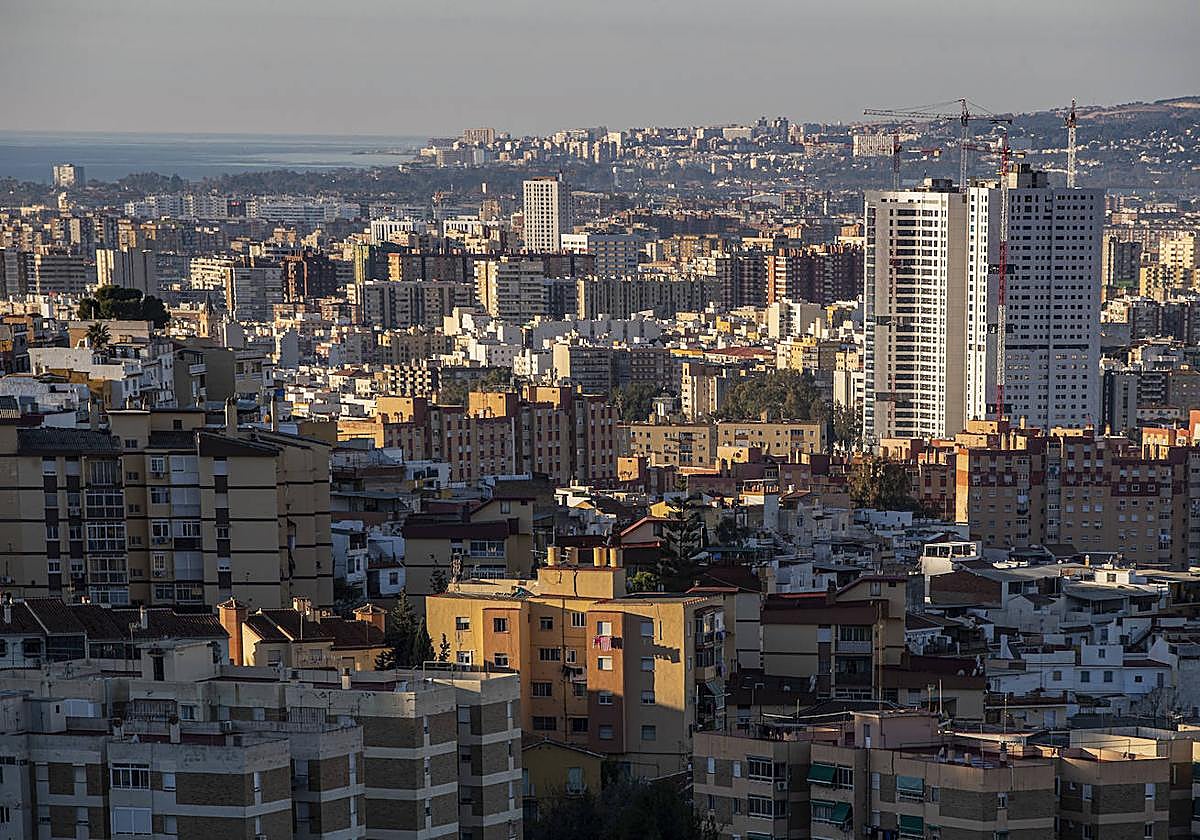
Malaga is the province with the newest housing in Andalucía
Only 18% of residential properties are more than half a century old, compared to 25% of homes in Andalucía and one in three in Spain

A stroll around the city centre, traditional neighbourhoods or the many beautiful old towns in the province of Malaga might give the impression that housing here is generally on the old side. But this is not borne out by the data. In fact, compared to the rest of the Andalusian provinces, Malaga is the one with the newest houses.
There are around one million residential properties in Malaga province: 996,557, to be precsise, a figure that makes this the Andalusian province with the most homes, ahead of Seville, where the housing stock is almost 913,000.
These are figures from the 2021 population and housing census prepared by the National Statistics Institute (INE) and released this summer. Of the one million houses in Malaga, just 187,158 were built before 1970. This means that barely 18.8% of the homes in the province are more than half a century old. Only Almeria comes close to the Malaga proportion: this eastern Andalusian province has just over 430,000 dwellings in total, 19% of which were built before 1970. This means that in both Malaga and Almeria, more than 80% of residential properties are less than 50 years old.
By contrast, in Andalucía as a whole, one in four houses was built before 1970, which brings the proportion of properties less than half a century old down to 75% - five points lower than Malaga. And in Spain as a whole, practically one in three homes has been standing for more than five decades, that is, at least since 1970. What is more, in Spain one out of every two homes was built before 1980 - more than forty years old- while in Malaga the proportion of properties dating from before 1980 is 36%, just over a third.
Within Andalucía, the province with the oldest homes is Jaén: almost 37% of its housing stock dates from before 1970, a proportion which rises to 50% if the dwellings built during the 1970s are included. Something similar happens in Cordoba, where dwellings built up to the 1970s account for 33%, while those built up to 1980 account for 48%. In Seville, 45% of the houses were built before 1980.
Malaga, the Andalusian province with the lowest proportion of pre-1970 houses, is also one of the provinces in the region where the fewest houses were built during the dictatorship - or where the fewest houses remain from that period: of the one million dwellings that made up the province's housing stock in 2021, 157,133 houses were built between 1940 and 1970, that is 15.76% of the total, a similar proportion to that of Huelva. Only Almeria has fewer houses built during Franco's regime (11% of the total). In Jaén and Malaga, those three decades of dictatorship produced 22% of the current housing stock.
The bulk in the 2000s
On the other hand, Malaga is the second province in the region with the highest proportion of properties built in the first decade of this century, which coincides with the genesis of the real estate bubble. Between 2001 and 2010, almost 270,000 houses were built in the province of Malaga, 27% of the total, a percentage that reaches 30% if we add the properties built in the following decade. Almeria leads the way, with 35% of its homes built in the first decade of the new millennium - 37% if we include the buildings constructed between 2011 and 2020.
A curious fact: there are still some properties in Malaga from before 1900. There are about 2,200, 0.2% of the total. In Granada, there are just over 1%. And if we add the houses from the first two decades of the 20th century, there are 10,140 in the province, 1% of the total, a proportion that in Granada and Huelva exceeds 4% and in Jaén is close to 7%.
More efficient, the same size, but with fewer rooms
The most prolific decade in property construction in the province of Malaga was the first decade of this century, that of the building boom, when 27% of the total housing stock was built, with just over 260,000 homes. As Ángel Sánchez, member for Malaga of the Federation of Real Estate Associations, explained, the newest housing is concentrated above all in coastal municipalities, such as Mijas or Estepona, as well as in areas of expansion in the city such as Teatinos. Meanwhile, older homes are found mainly in the inland municipalities of the province and in the city centre. Is there much difference between properties built several decades ago and recent construction? Sánchez said that the most relevant change was in energy efficiency to meet today's requirements. Another difference can be put down to the average family size reducing; now homes are being built with fewer bedrooms, although the average size is the same. While in the sixties there was barely any demand for a two-bedroom home, now it is the four-bedroom properties that are harder to sell. Modern properties are also more open-plan. While 30 years ago it wasn't popular to have the kitchen and living room all in the same space, now buyers love that arrangement, said Sánchez. Buyers also now place more value on light and orientation. The first properties to sell in a new building are top floor apartments with terraces and ground floor flats with gardens, said the expert.