
Innovation
Malaga to play key role in Vodafone's plans for satellite network that will bring internet access to every corner of the planet
This summer the British multinational will set up the first laboratory in Europe focused on this technology at the city's university

Malaga
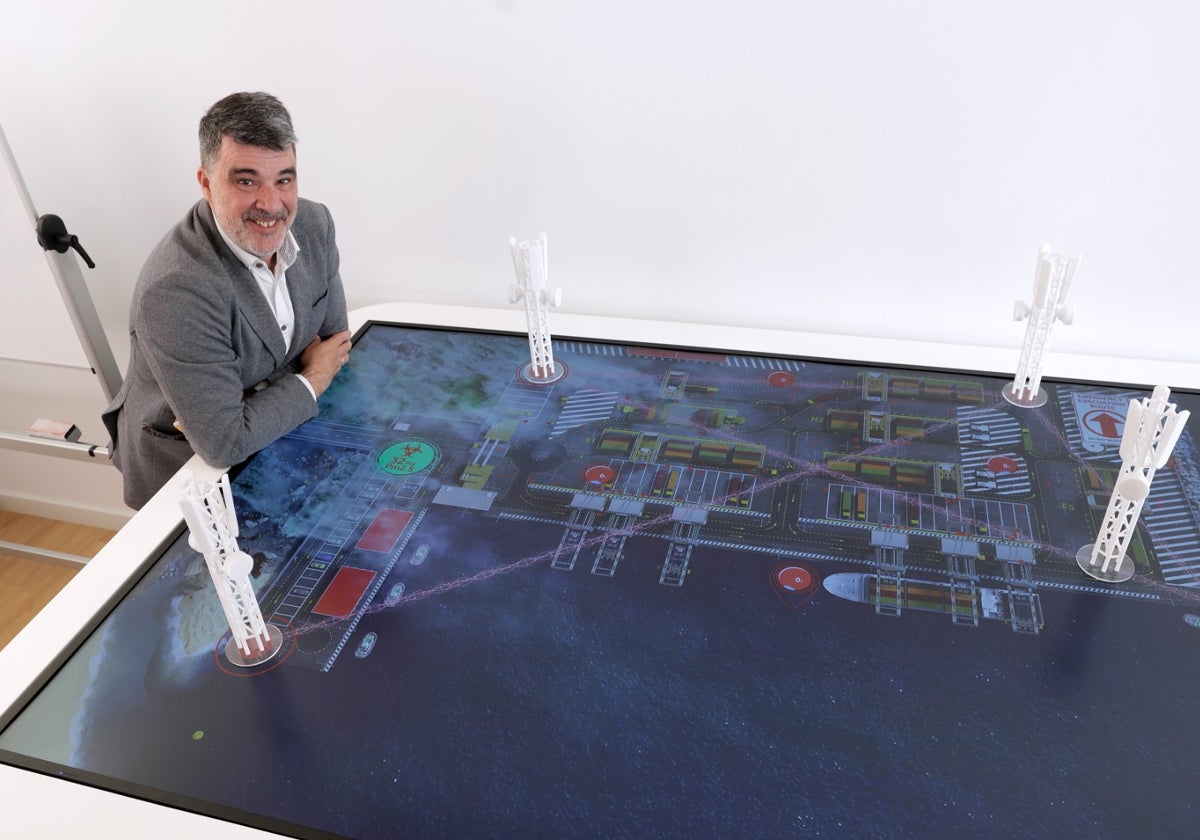
At Vodafone's innovation centre in Malaga, the communication technologies of the future are heading for the cooking-pot. Each of these technologies is at different stages of development, but some are nearly ready to serve up to the market and others are even already being consumed, with more features being added to them. Others are being tested in pilot projects. Lastly, some are still in their infancy, more like the stuff of science fiction right now, but all are set to transform telecommunications in five to ten years' time.
One such breakthrough technology is integrated mobile and satellite connectivity, which promises to achieve the desired milestone of universal coverage regardless of location. This is the notion that anyone can connect to broadband internet from any corner of the globe, no matter how isolated, and do so with just a conventional mobile phone, no additional router or device.
Malaga has taken up a key role in the development of this technology. This is thanks to Vodafone's commitment to establish Europe's first research centre dedicated to the development of integrated terrestrial mobile broadband services based on low orbit satellites. It will open in July and will form part of its innovation hub already operating in Malaga, but it will be located at the University of Malaga's (UMA) school of telecommunications engineering. As with many other projects, Vodafone is working hand in hand with the UMA, with which it has a strategic agreement that the innovation centre's director, Jesús Amores, regards as "unique in Spain". "We do not subsidise innovation, but rather we work side by side with the University's research teams to develop our next generation of products," he said.
To develop this project, Vodafone has received a grant of 2.6 million euros from the Centre for the Development of Industrial Technology (CDTI) under the Space Technology Programme. It is working with AST, the company that is building the first global satellite network to deliver broadband from space. A small team (about ten people) is currently dedicated to this initiative, which will grow as the development of this technology and the project itself progresses.
A gateway
This laboratory will be "only the first step", Amores advises. "Once we have the technology fully tried out - that is the objective of the laboratory - we will install in Malaga one of the space-to-earth gateways that will be necessary to connect with the 106 satellites that will be deployed by 2027. In Europe there will be five, and worldwide there may be ten or fifteen. And one of those gateways is going to be here in Malaga." In the long term, as the technology matures, the lab will evolve into an operations and service management centre for the whole of Europe. "This means that Malaga will be a communications hub to generate wealth, equality, justice and growth opportunities around the world," he states.
The UK company aims to lead the introduction of direct satellite connectivity to smartphones in Europe from late 2025 into 2026. To do so, it will have to redouble its R&D investment to date. The project for which it has received the grant amounts to 5.5 million euros and Amores believes this figure will easily quadruple.
Vodafone is not the only company pursuing the goal of universal satellite coverage. Let's not forget Elon Musk's Starlink project. Vodafone and AST's approach to the problem has one advantage: it does not require any additional devices to the ones users already possess. "It has its risks, of course: we are talking about developing something totally new that is not 100% proven. And from Malaga we are going to help make this technology a reality," said this Vodafone executive.
The European Union is subsidising the development of these satellite networks because they are a shortcut to achieve one of its own tech objectives: to accelerate the deployment of the 5G network. "Pressure is being put on operators to push deployment, but with terrestrial networks it is unfeasible to get 5G to places where there is no population," said Amores. He continued: "In practical terms, what will we achieve? That a person who is in a small village in the Alpujarra has the same capabilities to develop their daily and professional life as a person who lives in Madrid. For me this is real equality and democracy."
New microchips to break the mobile antenna oligopoly: PERTE Chip's nearly 15m-euro project
Vodafone's innovation centre has become the biggest winner of the second call for PERTE Chip grants. It has received nearly 15 million euros for an "open chip architecture" or Open RAN (open radio access network) project. What does this mean? It means that Vodafone is leading an initiative to break the existing oligopoly in the management of telecommunications networks, where three large multinationals (Ericsson, Nokia and Huawei) own the technology needed to control radio communications. "This project aims to design and validate new chips that allow working with radio communication antennas using different techniques than the current ones. We set the requirements, establish the validation tests and work with over 20 manufacturers in order to develop, test and optimise this alternative architecture, which will be open and therefore allow the entry of any player," explains Jesús Amores. "It is a long-term project: we are talking about five to ten years. But Vodafone is very serious about it: it plans to base between 5 and 10% of its commercial network on Open RAN."
The aim is to break down barriers to entry so that more companies can participate in network management. Thus, if there is more competition, costs will go down, hence Vodafone's interest. "The whole market will benefit and, ultimately, so will the citizen because, if it costs less to operate a network, this will ultimately encourage operators to continue rolling out networks and improving coverage," says this tech leader.
In collaboration with UMA's researchers, this project is also developing new algorithms using artificial intelligence techniques to manage and optimise the use of the grid in order to save between 5% and 15% of the energy currently required.
Vodafone started this project two years ago and currently has 30 employees working on it, which, with the significant subsidy received, will increase to 50 or 60 over the next year. If the rest of the companies and institutions involved are added, there could be 300 people dedicated to this initiative.
Amores acknowledges that they are in talks with IMEC, the Belgian microelectronics institute that is planning a chip design and manufacturing centre in Malaga, to "reach a collaborative agreement to provide access to this knowledge base and experimentation."
![[]](http://static.vocstatic.com/voc26/latest/assets/images/favicon/surinenglish/apple-touch-icon-57x57.png)