
Public safety
Political tensions erupt at Malaga local security meeting over housing protest encampment and recent shootings
Malaga City Council demands police deployment details while central government representative cites security protocols and falling crime statistics
-U27167358561usi-1200x840@Diario%20Sur.jpeg)

Political friction dominated a high-stakes meeting of Malaga’s local security board (Junta Local de Seguridad), following recent public disputes between municipal authorities and ... the central government over gang-related shootings and a housing protest encampment in the city centre.
The local security board - a coordinating body uniting municipal officials, regional authorities, and state law enforcement - met against a backdrop of heightened political debate.
On the one hand, the wave of shootings and violence stemming from the rise in drug-trafficking in the city and on the Costa del Sol. On the other, the unease that has arisen within the city council and the Local Police (and even within some National Police trade unions such as the CEP) due to the alleged passivity of National Police during the housing protest on Monday, 28 September.
Related story
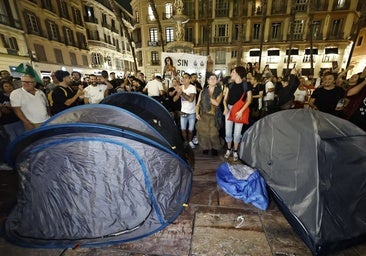
Against this backdrop, where the incidents on Calle Barcenillas, Calle Jara (La Trinidad) and Muelle Uno have been particularly serious, the meeting was as tense as one might have expected. It reflected president of the Andalusian regional government Juanma Moreno's fear that the increase in these incidents in Malaga could turn Andalucía into a "drug-trafficking region".
At the meeting, the city council expressed its concern about the shootings and demanded to know the number of police officers deployed as part of the 'Plan Costa del Sol' reinforcement, while the government sub-delegation declined to give a figure "for security reasons".
Furthermore, the city council expressed its dissatisfaction at "the lack of cooperation" from the National Police in preventing the setting up of tents in the city centre.
Local councillors focused on the shooting that killed a 20-year-old innocent man, the Turkish mafia-involved shooting at Muelle Uno and the general state in the Costa del Sol. Security councillor Avelino Barrionuevo demanded to know the number of reinforcement officers and the exact number of officers deployed on the night shift as part of regular police duties.
The city council also brought up the police response to the rally on 28 September. It criticised a "lack of timely cooperation" between the National Police and the Local Police in preventing protesters from pitching tents in Plaza de la Constitución, a location where, the councillor said, tensions ran particularly high.
The National Police's actions during the protest have sparked a political and policing row. On the one hand, the local ruling party (PP) and sources within the Local Police have stated that the government sub-delegation had issued instructions not to intervene.
On the other hand, the government sub-delegation and the National Police categorically denied such orders and justified their decision not to disperse the camp to avoid a major public order problem. The CEP trade union (National Police) has asked the sub-delegation to check whether the camp was complying with the conditions initially communicated and demanded clear instructions, while sending a message of support to the local officers.
Mayor of Malaga Francisco de la Torre claimed that some demonstrators might have attacked the Local Police.
The government's assessment: crime on the decline and "isolated incidents"
In response to local demands, the central government's representative in Malaga, Javier Salas, declined to provide figures on the number of officers on duty, arguing that the exact number cannot be disclosed for security reasons. Instead, he provided the latest statistics from the Ministry of the Interior.
According to this report, crime fell by 3.3 per cent in Malaga city between January and September 2026 compared with the same period the previous year. Across the province as a whole, criminal offences fell by 2.3 per cent during the first half of the year. The figures highlight a fall in the most serious offences across the province during the first six months: homicides and murders fell by 35.7 per cent, while attempted homicides fell by 17.2 per cent.
Salas also said that investigations had ruled out the existence of an organised crime network in Malaga city and described the violent incidents as "isolated". He stated that the National Police had solved 100 per cent of the murders resulting from feuds in the province, with the exception of the most recent case in the city, which remains under investigation.
During the meeting, Salas also presented the results of the National Police's 'Plan Costa del Sol'. This plan has been in operation in the province since April 2024 and in Malaga city since this September.
Since the operation began, a total of 1,619 people have been arrested in the course of 892 operations carried out against drug-trafficking, smuggling and money-laundering throughout the province. Furthermore, the police have seized 313 firearms and confiscated 626 vehicles.
![[]](http://static.vocstatic.com/voc26/latest/assets/images/favicon/surinenglish/apple-touch-icon-57x57.png)