
Health
Four-day strike by doctors leaves fewer patients at surgeries, but fills emergency rooms in Malaga on day one
Unions estimate the strike's participation rate across the Costa del Sol province at 75%, while the regional government puts it at 32.3%
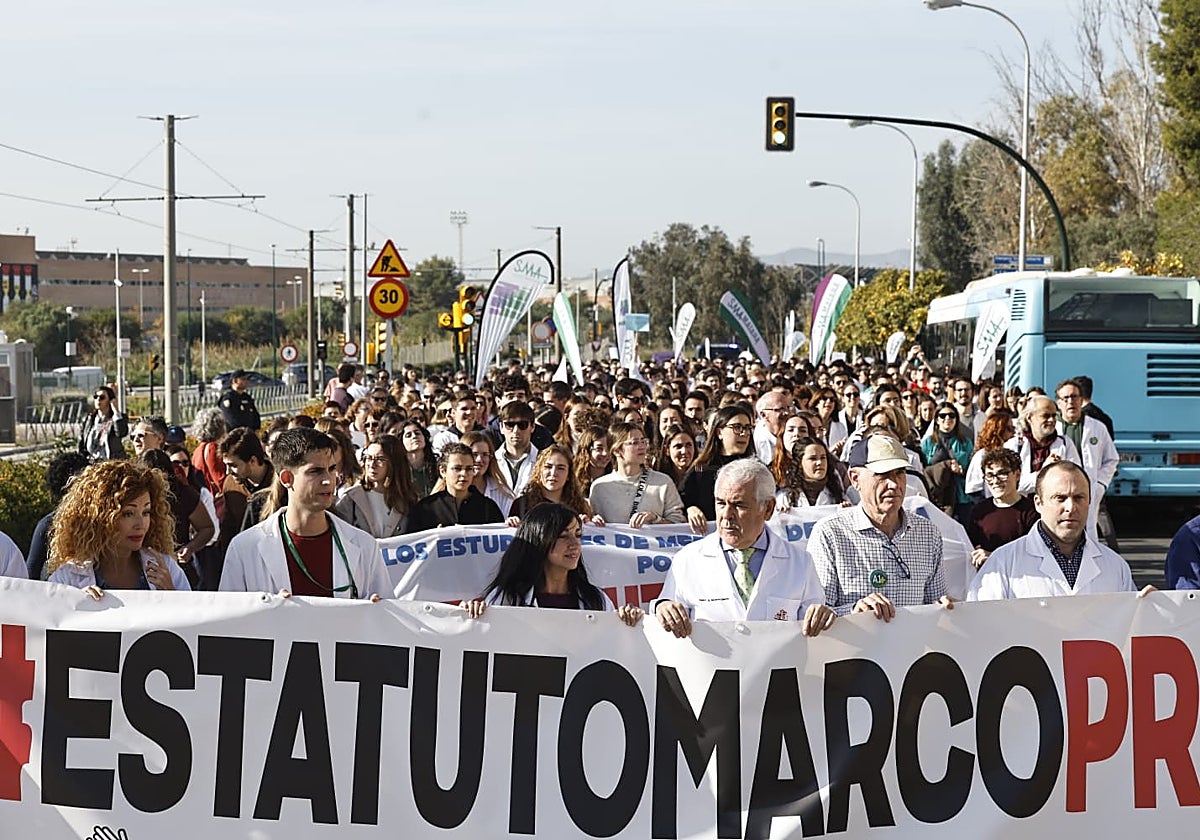

Day one of the strike by doctors and associated medical professionals protesting against the legal framework being prepared by the Ministry of Health is coming to a close. This is the document that will regulate the working conditions and rights of healthcare workers and it has been rejected by all sectors within the healthcare industry.
The Andalusian medical union (SMA) has called for four days of strike action, from Tuesday 9 to Friday 12 December. While there will be protest rallies each day, the main event in Malaga city on Tuesday consisted of two rallies by doctors and medical students and a march that took place between the Hospital Clínico Universitario Virgen de la Victoria and the University of Malaga's (UMA) faculty of medicine. Malaga's medical union (SMM) has reported a strike participation rate of 75%, 64% in primary care centres and between 70% and 90% across Malaga's hospitals, although updates keep coming.
This contrasts sharply with the 32.33% rate reported by the Junta. The suspension of some outpatient and hospital appointments has resulted in a greater influx of individuals turning to emergency rooms, especially in paediatrics, apparently a common occurrence in this type of doctors' strike.
The regional health minister (among other ministerial duties), Antonio Sanz, explained that the Andalusian healthcare service (SAS) reported a 32% participation rate in the strike. He asked for patience to see how the next few days pan out with the strike, "because this 32% multiplied by four days obviously has a very significant impact when the strike, in this case, is against the government of Pedro Sánchez". In Malaga, the strike participation rate on Tuesday morning was 32.33%.
The truth is that the strike has been felt in the suspension of some patient transfers and appointments in hospitals and health centres, considerably reducing the number of patients visiting both types of healthcare facilities. At Malaga city's Clínico hospital, for example, some patients did not attend their appointments, believing their doctor or consultant would be unavailable, despite some being on duty.
They did not consider it worth making the trip into the city just to be turned away, as many would be travelling in from the Guadalhorce Valley. There has also been a flood of calls from members of the public explaining that they had appointments with various specialists, but were asking if the doctor in question was at work or on strike, according to SUR. What SUR has confirmed with healthcare sources is that all of these patients will have their appointments rescheduled. A similar situation has been observed in other hospitals and outpatient clinics throughout the province.
High traffic in emergency rooms
Not surprisingly, healthcare sources consulted by SUR have pointed out that, with fewer family doctors in health centres, there has been an increase in the number of people heading to accident and emergency departments in Malaga's hospitals, especially in the main ones, a common feature of doctors' strikes.
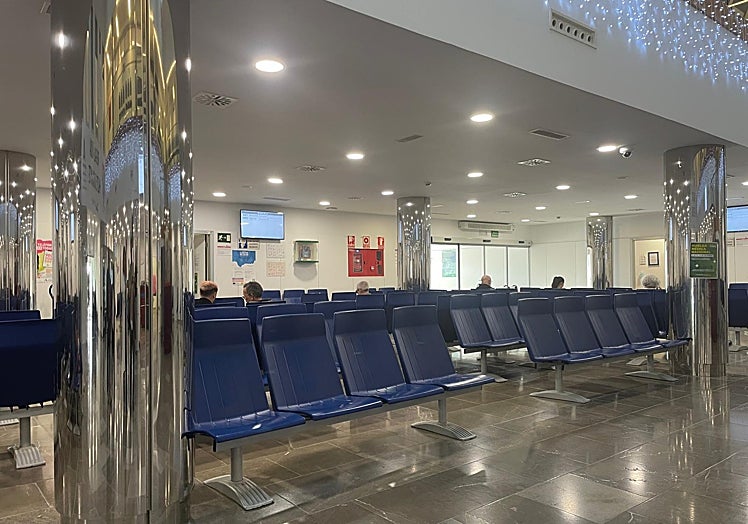
Around midday on the first strike day, the Patio Azul at El Clínico, a gigantic outpatient waiting-room that is usually packed every morning, had barely a dozen patients waiting to be seen by specialists. All those affected will have their appointments rescheduled in the next few days.
In any case, the SMA union has denounced the minimum service levels provided on this occasion as "excessive". The truth is that minimum services are high for this type of general stoppage: in primary care and hospitals, the usual holiday service levels were maintained, emergency services and intensive care units have operated as on any day off and urgent diagnostic tests and treatments for people with chronic or serious illnesses that cover a wide range of medical conditions were also guaranteed. Therefore, the greatest disruption has been in consultant appointments and patient transfers between healthcare centres or their homes.
Medical students and resident physicians have also joined the general strike that started on Tuesday: they are concerned about their future.
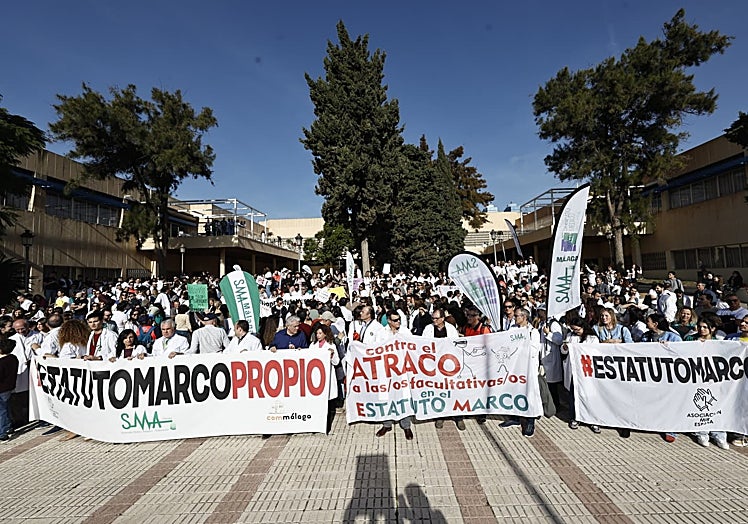
The strike was called by the SMM union, but it has been supported by Malaga's official college of physicians, medical students and resident physicians. Thus, a demonstration was held in front of the entrance to the Patio Azul at the Clínico university hospital. Then, with a banner held aloft, demanding their own legal framework, they marched to the nearby faculty of medicine, where three manifestos of their demands were read out loud. According to the organisers, almost 1,000 medics joined the demonstration.
"We have been forced once again, thanks to the attitude and mistreatment from the Ministry of Health [in Madrid] and the minister herself, to call another four-day strike. None of our demands have been accepted. They have refused to accept that we, as doctors, should be able to negotiate our own working conditions," stressed the president of the SMM, Antonio Martín Noblejas.
Noblejas had some harsh words to say on the Ministry's stance: "We want a reclassification that not only affects categories below those of doctors, but also that includes us. It makes no sense that a doctor, to be able to work in the public sector - because we're talking about a statute that regulates work in the public sector - has to have ten to 11 years of training, but then we're put on the same level as categories that have only six years of training." He went on to accuse the health minister with central government, Mónica Garcia, of "betrayal".
"Collateral damage"
Noblejas then went on to express his regret at the "collateral damage caused to the general public", pointing out that "there are no first- or second-class specialists here, nor primary care specialists, nor hospital specialists: the damage this statute will cause affects all doctors and we want the public to understand us and for the ministry, once and for all, to listen to us and put some of our demands on paper and in our own statute".
He also criticised the regional government for requiring between 300% and 500% more minimum service coverage than what is typically provided on a public holiday. "No personal days off have been allowed for these past few days. Take this hospital, for example: this long weekend just gone, there were no pneumologists, but today there are at least three. And the same thing in cardiology, two on call on weekends and today there are two who are physically present plus three more - that's a 500% increase in physical presence. It's a disgrace."
Lastly, he expressed his satisfaction at the "great turnout" for the two previous strikes, on 13 June and 3 October.
The president of Malaga's college of physicians, Pedro Navarro, told the media that the strike was not motivated by "salary or professional interests, rather that we are fighting for the dignity of the medical profession: the patient should know that the strike is not against them, but in favour of them. We want to dignify the profession", ensuring that the specific skills and responsibilities of doctors are recognised.
Regarding on-call shifts, Navarro demands that on-call hours be counted towards retirement benefits and that rest periods and responsibilities are properly regulated. "And, above all, it is also important to take measures to retain talent, to prevent doctors from leaving Andalucía, that neither should doctors leave Malaga and, of course, to give young medics a promising future. With this legal framework, there is no coherent structuring of the healthcare system and this has repercussions for the quality of care."
Rejection of 24-hour on-call shifts
One of the doctors' key demands is the abolition of 24-hour on-call shifts. "As you can appreciate, it's not the same for a paediatrician to see a child at eight or nine in the morning as it is to see them at midnight or 3am. The same applies to a surgeon. Everything is based on the professional's vocation, but vocation alone is not enough to maintain this quality of care. Rest periods must be taken into account."
In Navarro's opinion, these are "marathon shifts that make no sense", criticising the fact that these hours are regarded as "less than the norm, neither overtime nor regular hours and, on top of that, they don't count towards retirement. This means that a colleague of my age, for example, who could have easily spent five years on call, those five years are completely annulled, they don't exist. They have existed for social security contributions, but not for counting towards your retirement."
He calls for an equitable public healthcare system adapted to the times: "New members are leaving, young talent is leaving. This isn't our era, because there's a different concept of medicine, of globalisation and of the attitude of colleagues who, with such globalisation, can easily move to another region, to another country without any problem. We should have already considered this and it's an important point that hasn't been discussed." His final demand: stronger measures against assaults on medics.
"The healthcare system must continue to work as a team, but it is the doctor who leads the team, each with their own conscience and knowledge"
Dr Pedro Navarro
Malaga's college of physicians
"We know that the healthcare system, in order to function as it has until now, must continue to work as a team, this is clear, but everyone in their place and the one who leads the team is, of course, the doctor, each with their own conscience and knowledge, but each one must have their area of specialisation. This has to be regulated and documented and that's what we're all asking for", stressed Navarro.
"Mónica, listen up, the doctors are fighting back!"
During the demonstration, which marched under the main slogan "#Estatutomarcopropio" (a demand that the doctors' own statute be taken seriously), there were plenty more slogans such as "It's not a vocation, it's exploitation", "Hours worked, hour paid", "Mónica, listen up, the doctors are fighting back!"
Then there were the banners "No to 24-hour shifts", "Against the daylight robbery of doctors: for a proper statute" and "More resources, less hot air". Traffic disruptions were minimal and a significant National Police presence was maintained to prevent problems, although the protests had a decidedly festive atmosphere.
![[]](http://static.vocstatic.com/voc26/latest/assets/images/favicon/surinenglish/apple-touch-icon-57x57.png)