
Water supply
A larger capacity Costa del Sol reservoir would have collected twice as much rainfall this year
With 26% more rain than the historical average, La Concepción near Marbella had to open its spillways for several weeks and yet has still recorded its best water reserves for August in 12 years

Malaga
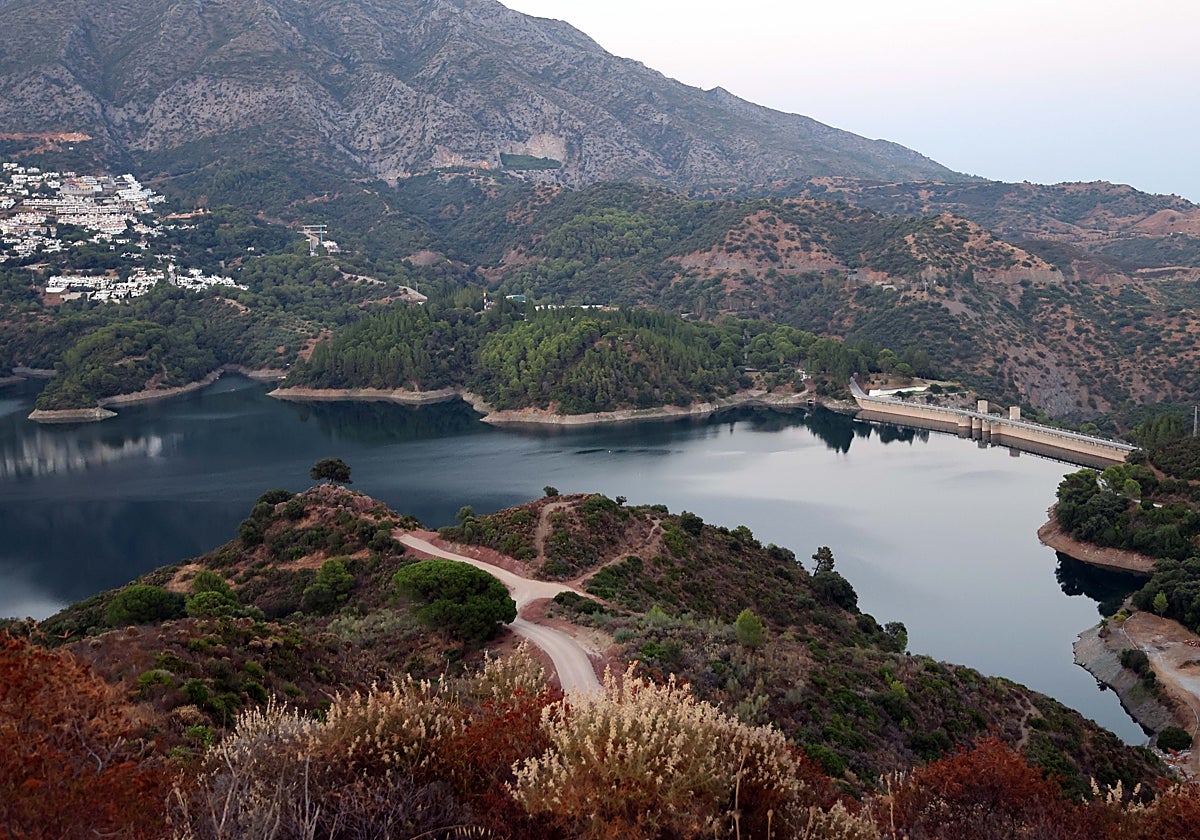
La Concepción reservoir near Marbella on the western Costa del Sol of Malaga province could have been filled up twice over this year if it had the extra capacity from the original plans to expand it, but this did not happen. These official figures are explained by higher rainfall than in recent years and a well-configured, rapid-response system. At the same time, the hydrological year, now drawing to a close, offers a rare sight: a nearly-full reservoir in the middle of summer in Andalucía. This is the best record in the last 12 years in terms of stored volume. As of Tuesday 9 September, this reservoir was storing 42 million cubic metres of vital water reserves.
To give the mid-August figure, which is when summertime water consumption is at its peak, 11 August to be exact, this reservoir - located between Marbella and Istán and the main water source for the western Costa del Sol - was storing 47 million cubic metres, or 83% capacity. According to the historical information provided by Hidrosur to SUR, you would have to go back to the summer of 2013 for a better result. Back then, reserves stood at 51 million cubic metres. Previously, these figures for August were also better in 2011, 2002, 2000, 1998 and 1997 (before then, serial statistics were not available). The best figure since records began was in August 2011 with 53 million cubic metres stored. The second best was in 2000 with 52.95 and third best was in 1997 with 51.39.
47
million cubic metres of water were held in the reservoir in mid-August. To find better data, we would have to go back to the summer of 2013, when it registered 51.
The latest report on the hydrological situation in Malaga province, prepared for the regional government's drought management committee and dated late July, mentions how productive the rainfall has been in the western Costa del Sol's exploitation system. "It has been a wet year, marked by abundant rainfall during several weeks in November and March. Thus, at La Concepción's pluviometer and weather station, 814.10mm were collected, which is 126% of the historical average of 645.10", stated the report.
The aforementioned document quantifies the amount of rainfall feeding into the reservoir at 101 million cubic metres. Bearing in mind that its capacity, updated with bathymetry in 2022, is 57.54 million cubic metres, the reservoir could have been filled twice over. It should be noted that this result did not start with an empty reservoir because, at the start of the hydrological year (1 October 2024), the reservoir already held 26 million cubic metres.
126%
the percentage of rainfall going into the reservoir during this hydrological year above the historical average. A total of 814.10mm of rain was collected.
La Concepción not only receives water from the Río Verde, but is also fed by the triple Guadaiza-Guadalmina-Guadalmansa water diversion tunnel. This year, the picture that nobody wants to see has been repeated: water being released from some of Malaga's reservoirs to avoid overspill because the safe maximum level was reached.
Thus, on Thursday, 15 May, the relief level and 100% capacity were exceeded and the surplus began to pour down the walls of the dam. It reached 104.94 metres above sea level. It was a very different situation to that of March, when the bottom spillways had to be opened on the 7th to contain the rising water level. The threshold that month was 48 million cubic metres.
101
million cubic metres, the rainfall contribution to the reservoir during the hydrological year that is now coming to an end. Considering that the reservoir began with reserves of 26 million cubic metres, the reservoir would have been filled twice over had it been possible.
Why was it necessary to open the floodgates on 7 March, when the reservoir had reached 48 million cubic metres, yet in May, with more than 57, did it hold its own? The answer lies in the operating plans. It's logical to assume that, having a full reservoir with a rainy season ahead, isn´t the same as having it when the upward curve, as it is now, is about to begin the sharp decline of peak season and increased consumption. Thus, for example, between the months of October and April, the safety buffer is left at approximately 100 metres above sea level, which translates to the aforementioned 48 million cubic metres. In May, the safety level was set at 104.90 metres above sea level.
104.94
metres above sea level was the maximum fill level this hydrological year, done in May. It has now begun to ease.
In 2001, the 'Plan Málaga', the province's plan for future and ongoing water supplies that forms part of Spain's national hydrological plan (PHN), revived the idea of expanding the reservoir. The then Confederación Hidrográfica del Sur, via its state-owned company Acusur, undertook the initial project feasibility study. Both proposals put on the table were ruled out: the first was simply to make the dam larger, the second, to build another dam in front of the current one. Instead, the Gibralmedina dam project was drafted - a new reservoir fed by the Guadiaro river, on the provincial border between Cadiz and Malaga) - from which up to 15 million cubic metres a year of pretreated water will be sent back to the Costa del Sol. However, it is an expensive project, costing 780 million euros, including all the pipelines, and the most optimistic scenario suggests it will take a decade to complete.
Both ideas for the reservoir's expansion were ruled out: neither enlarging it nor building another dam in front of the current one were deemed feasible
The preliminary project was completed in 2016. Not even the environmental approval process was pursued. No further explanations were given in public beyond brief environmental concerns and possible impacts on what is now the Sierra de las Nieves National Park.
With the current capacity and the new reservoir project mentioned above, the previously suggested proposal to add a water transfer from the Genal river to the Río Verde system has also been ruled out.
![[]](http://static.vocstatic.com/voc26/latest/assets/images/favicon/surinenglish/apple-touch-icon-57x57.png)