
Drought crisis
Emergency works ordered by Junta at historically low La Viñuela reservoir in Malaga province
The Andalusian regional government is spending 700,000 euros to install a floating pumping system in the Axarquía reservoir, which has reserves of less than nine per cent
-kTzE-Rlxs3drnFDOJFFWWPJZOfFM-1200x840@Diario%20Sur.jpg)
Eugenio Cabezas
Axarquía
The images speak for themselves. They are bleak. Agonising. Historic. Never in its 34 years of life has La Viñuela reservoir, the true economic heart of the Axarquía region in Malaga province, been so close to death. It is the first time that it has been below 9% of its capacity. On Tuesday it was at 8.9%, with 14.6 cubic hectometres in storage, compared to 22.2 a year ago.
Related article
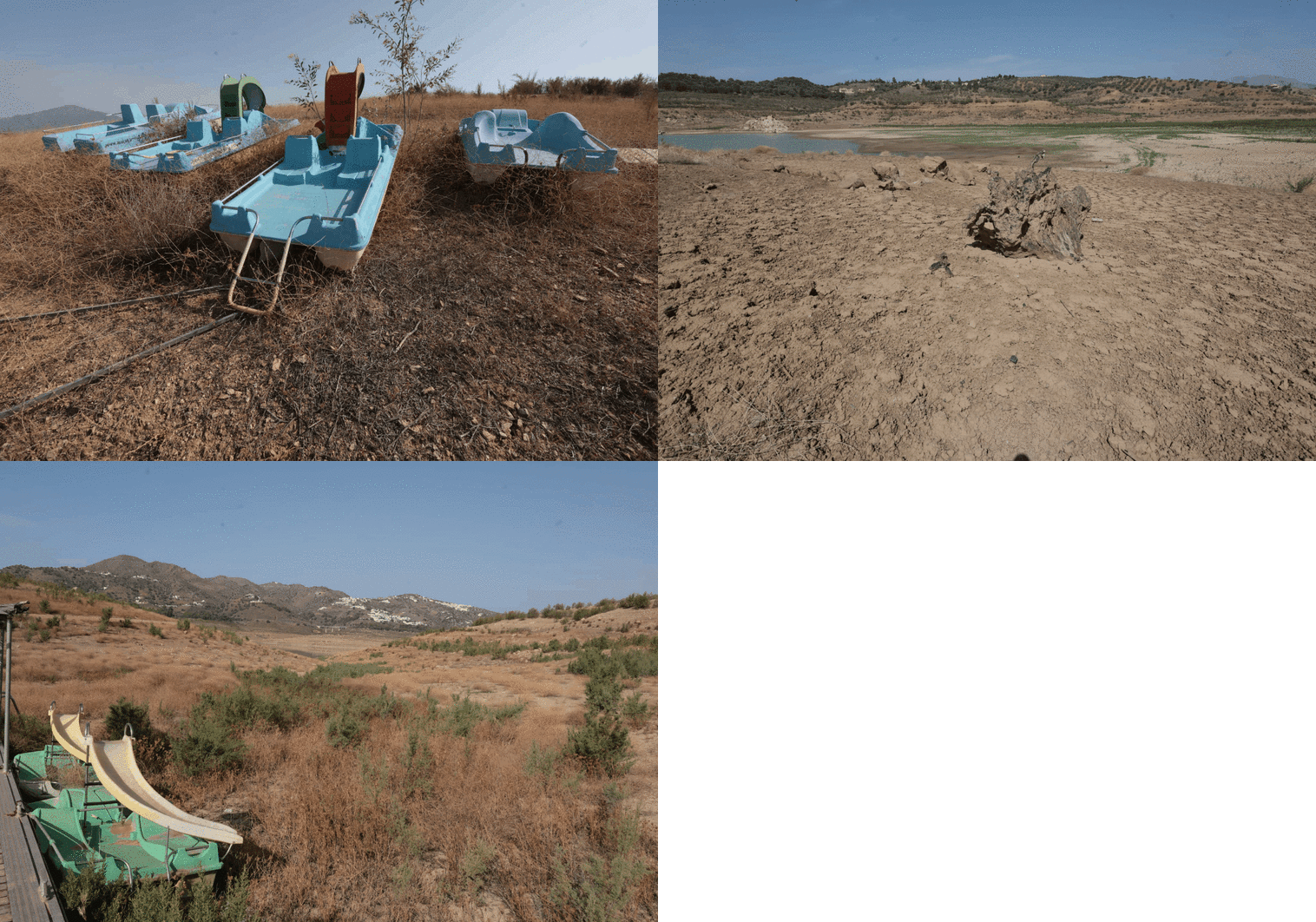
The apocalyptic situation has come about with potentiall more than six weeks of heatwave still to come and, to make matters worse, with very high temperatures, which increases the evaporation rate. Last year, the scarce reserves forced the Junta de Andalucía to take a decision that was also unprecedented and very drastic: since 1 October, there has been no water for irrigation for the more than 6,300 hectares of crops located below the river. Irrigated under the Guaro Plan, this has for three decades allowed the development of a flourishing agri-food industry of avocados and mangoes.
Between 1 October 2021 and 30 September 2022 barely 239.6 litres per square metre fell in the reservoir. So far this year the figures are even more dramatic: just 214.9. This amount does not even represent 50% of the average of the last 15 years, which was 430 litres.
In addition to the losses in the agricultural sector, are the supplies to local areas which are partially supplied by the reservoir. There are 14 municipalities below the level of the dam. In at least six of them, night-time cuts have already been established, after the Junta cut the supply for human consumption by 20%. These are Vélez-Málaga, Benamargosa, El Borge, Moclinejo, Iznate and Almáchar.
Rest of Malaga province
In the rest of Malaga province, the last drought management committee agreed to reduce consumption by 10%. The Junta maintains that each municipality has "freedom and autonomy" to establish whether or not to carry out restrictions, as long as the stipulated reduction is complied with. Faced with the dramatic situation of the Viñuela reservoir, the Junta, as the exclusive water authority in the Andalusian Mediterranean basin, is still trying to implement emergency measures, after approving three drought decrees in three years. While the first two focused on the use of regenerated water from wastewater treatment plants for irrigation, the third decree focuses on trying to squeeze the most out of the little water that remains stored in La Viñuela reservoir
Emergency works
On Tuesday the governing council declared emergency works for the installation of surface pumps connected to the supply intake, to try to ensure that the water sent to the El Trapiche drinking water plant is of the highest possible quality. As the reservoir level becomes lower and lower, the quality of the remaining water is poorer, due to the presence of organic matter. For this reason, at the same time, all the animal species that inhabit the reservoir, such as fish and turtles, will be eradicated.
The budget is more than 700,000 euros and its execution will last eight months, according to a statement from the regional administration. As announced at the end of April, this work is included in the third drought decree approved by the Andalusian government and is being carried out by the regional ministry of Agriculture, Fisheries, Water and Rural Development. It is set to improve the quality of the water supply to Almáchar, Benamargosa, El Borge, Comares, Cútar, Iznate, Macharaviaya, Moclinejo, Rincón de la Victoria, Vélez-Málaga, Totalán, Algarrobo, Torrox and Nerja, with a total of 170,000 inhabitants.
"Drastic measures"
The Andalusian president, Juanma Moreno, has been repeating in recent months that if there is no significant rainfall before September, "drastic measures will have to be taken in autumn".
As for the project to build one or two desalination plants in the Axarquía, the delegate of the Junta, Patricia Navarro, did not specify last week in Nerja whether the initiative launched by the Junta a year ago to grant a private company a concession to build a plant in Vélez-Málaga, with a capacity to generate up to 37.5 cubic hectometres, will continue or be definitively shelved after the announcement by the central government to provide one hundred million euros to build a desalination plant in the eastern region.
"Nothing is being ruled out, we are studying which model will be implemented, which one will guarantee supply and irrigation," Navarro said.
Desalination plants promise
Last May, in the middle of the election campaign, the Andalusian president, Juanma Moreno, at an election rally in Torre del Mar, made a commitment to build two desalination plants in the Axarquía, one private and the other public. Moreno promised that the private one would be awarded before the end of June. There are three companies interested in its execution: Aciona, Magtel and the alliance formed by Trops, Grupo Cobra and the University of Malaga.
![[]](http://static.vocstatic.com/voc26/latest/assets/images/favicon/surinenglish/apple-touch-icon-57x57.png)