
Gardening
Recommended for your garden in the south of Spain: Passiflora manicata
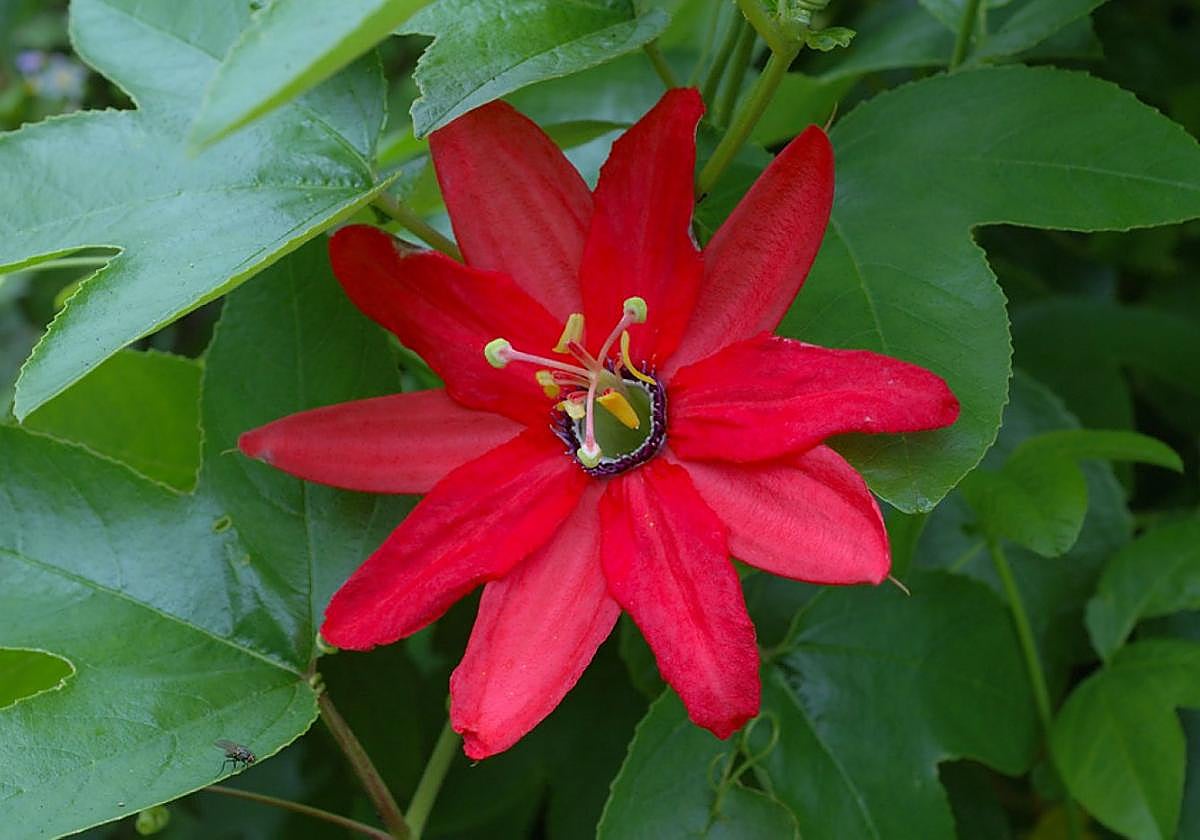
The large, bright red flowers produce a lot of nectar and attract bees and butterflies

Malaga
Passion vines are popular climbers famous for their spectacularly composite flowers. This one, Passiflora manicata, doesn’t have such detailed blooms but makes up for it with stunning, bright-red petals.
It is native to the high mountains of South America but is well adapted for Mediterranean climates. It develops a very deep root system so is drought resistant for short periods once established. It will also put up with colder weather although it may die back to the ground in a frost. Mulching around the roots will ensure it resprouts in the spring and, as it is a fast and vigorous grower, it won't take long to recuperate.
Passiflora manicata prefers a slightly alkaline soil and flowers prolifically in poor soils. The best location is a sheltered site with dappled shade and with free-draining but moist soil. It climbs by using coiling tendrils that emerge from between its dark-green leathery leaves so some sort of support it can grab hold of will help it to grow vertically.
The green oval fruits are supposedly edible but care must be taken that the fruits are fully ripe as immature fruit are toxic and could cause hallucinations (it is called 'el diablito' in some South American countries).
The roots and leaves possess a chemical substance, which, in Brazil, is used to treat fevers and skin problems and a tea is made to help calm nerves. It is said to have similar properties to morphine.
Propagation can be carried out by sowing fresh, ripe seed. There is no need to remove the pulp as this helps to break down the seed coating and speed up germination. It can also be grown from cuttings taken from new or ripe wood, just below a node. The easiest method to produce new plants is probably by layering the stems.
The large bright red flowers produce a lot of nectar and attract bees and butterflies.
Although better planted in the ground, Passiflora manicata can be grown in a deep pot in a patio although it will need regular watering to prevent it drying out.
![[]](http://static.vocstatic.com/voc26/latest/assets/images/favicon/surinenglish/apple-touch-icon-57x57.png)