
KEN CAMPBELL
The planet Uranus puts on a good show throughout October when it comes into opposition. Opposition means that it is directly on the opposite side of the Earth from the Sun. If you could look down on the solar system, the Sun, Earth and Uranus would be in a straight line with the Earth in the middle. This also means that Uranus is at its closest point to the Earth and this is the best time to observe it.
Uranus was the first planet to be discovered in modern times. Mercury, Venus, Mars, Jupiter and Saturn are easily visible with the naked eye and have been known about since ancient times. Uranus is just about visible under ideal conditions, but its motion against the background stars is so slow that it would only appear as a faint star to even the most experienced astronomer. There is evidence to suggest that Uranus had been observed several times by various astronomers but each time is was dismissed as being just another star. It was not until 1781 when the English astronomer William Herschel turned his telescope toward it from his back garden in Somerset, that Uranus was found to be a planet. At first he thought that he had discovered a comet and it was not until 1783 that it was confirmed to be a planet.
Uranus is the third largest planet in the solar system - only Jupiter and Saturn are bigger. And like Jupiter and Saturn, Uranus is a gas giant made up mainly from hydrogen gas. But the most peculiar thing about Uranus is its axial tilt. Whereas the earth has a tilt of about 23 degrees, Uranus is tipped over onto its side with an axial tilt of over 97 degrees and so it rolls around in its orbit on its side, taking 84 years to complete one orbit of the Sun.
For half of its 'year' the north pole of Uranus is pointed toward the Sun then for the second half the south pole points toward the Sun.
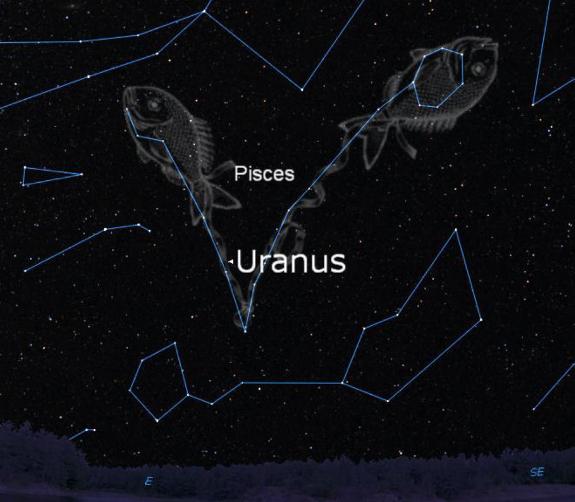
Uranus is easily visible with binoculars or small telescope if you know where to look. It rises in the east at around 8.30 and will be at its highest and due south by midnight. It is sitting right in the middle of the V shaped pattern of stars that form the constellation of Pisces.
At a distance of about 1.5 billion miles away, Uranus will appear as a tiny pale blue disc. Virtually everything we know about Uranus has come from a flyby from NASA's Voyager2 probe in 1986. Voyager made detail observations of Uranus's five largest moons and discovered 10 more.
![[]](http://static.vocstatic.com/voc26/latest/assets/images/favicon/surinenglish/apple-touch-icon-57x57.png)