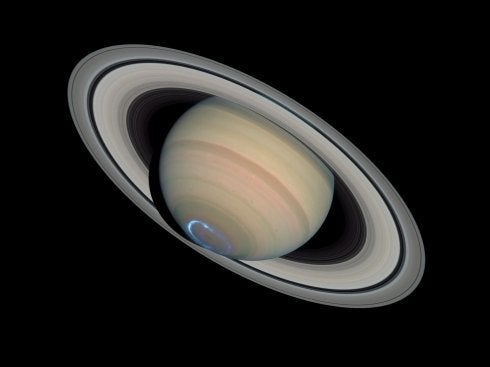
The rings of Saturn
The ringed planet comes to opposition on 18 June when it will be at its closest to Earth and directly opposite the Sun
KEN CAMPBELL
Viernes, 2 de junio 2017, 11:27
June will be a great month for observing the planet Saturn. The ringed planet comes to opposition on 18 June when it will be at its closest to Earth and directly opposite the Sun. It will rise in the southeast at sunset, be due south and at its highest position at midnight and set again in the southwest at sunrise. It can be found about halfway between the constellations of Scorpio and Sagittarius. Although Saturn is not as bright as Venus, Mars or Jupiter, it can still be easily spotted as it will be the brightest star in that part of the sky and is recognisable by its distinct yellow colour.
Saturn is the sixth planet from the Sun and the second largest planet in the solar system; only Jupiter is bigger. Like Jupiter, Saturn is a gas giant being made mainly of hydrogen gas. It was named after the Roman God of agriculture and since ancient times it was believed to be the farthest planet in the solar system (Uranus and Neptune had not been discovered). It is so far away (almost 841 million miles) that it takes about 29.5 years to orbit the Sun.
It has at least 62 known moons, 53 of which are named, but it is Saturns magnificent rings that makes it stand out. Saturn is not unique in having rings; Jupiter, Uranus and Neptune also have them but not nearly as impressive. Saturns rings are made from billions of tiny pieces of rock and ice that are in continuous orbit around the planets equator. They extend from 6,630 km to 120,700 km from the planet but are less than 20 metres thick. Even through binoculars the rings can be seen, giving the planet an elongated appearance.
At certain times during Saturns orbit the rings can appear edge on and so disappear from view but now they are wide open and displayed in all their glory.
At present there is a NASA probe called Cassini that has been in orbit around Saturn since 2004. It has been sending back incredible images of the planet and its rings but it is now on its final mission. It cannot be left to wander indefinitely around the planet so on 15 September it will perform one last manoeuvre and deliberately crash into the planet and be destroyed.