
Spain wildfires 2026
In-depth look at a monster: Huelva rewrites the rules on fires
Experts estimate that it will cost 400 million euros and take 20 years to restore the 39,000 hectares that the fire devastated in Niebla
Héctor Barbotta
Some fires can be extinguished with water, while others force us to rethink the very nature of forest firefighting.
The events in Niebla (Huelva) this August ... fall into the latter category. The fire has baffled experts and laid bare the terrifying way fires have evolved as a result of climate change.
Regional minister of emergencies Antonio Sanz was in Huelva on Tuesday to explain the logistical and environmental nightmare that marked a turning point in the region's disaster management. This was no ordinary fire, but an unpredictable seven-headed beast that defied all previous calculations, in the words of Sanz himself.
Related story
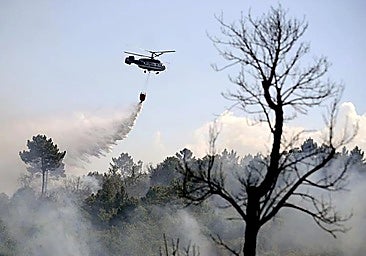
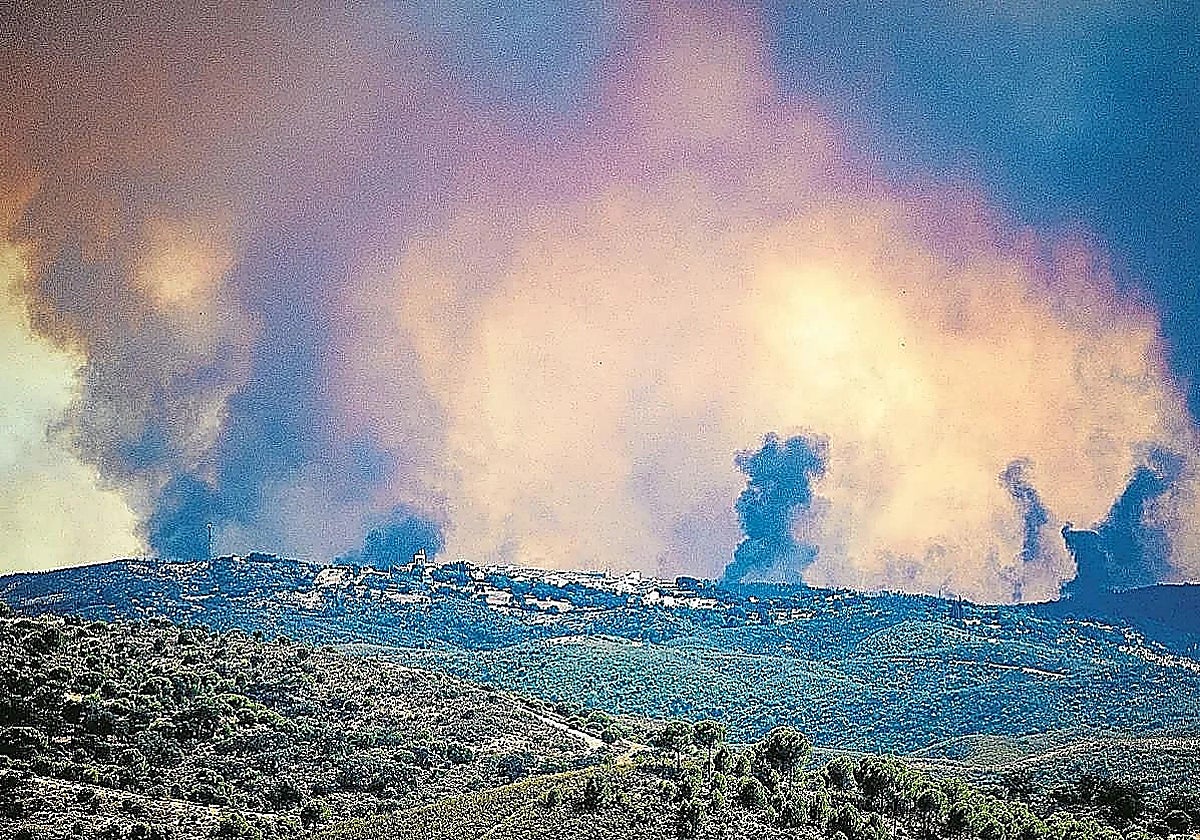
The fire experienced up to seven sudden changes in wind direction and generated pyrocumulus clouds of such magnitude that the water dropped by aerial resources evaporated before it hit the ground.
The traditional physics of emergencies broke down. A wind-driven fire normally advances at ten per cent of the speed of the gusts, but in Niebla those figures quadrupled.
A route that theoretically should have taken between 12 and 15 hours was covered in just 15 minutes, driven by leaps across forest areas of more than three kilometres and secondary hotspots that were sucked into one another, according to Sanz.
The nights, historically a window of opportunity for the firefighting teams, revealed the phenomenon's most hostile side.
The conditions forced emergency evacuations to rescue isolated firefighters, prioritising human life over containing the perimeter. In such a scenario, declaring that the fire could not be extinguished was not a surrender due to a lack of resources, but rather an acknowledgement of a physical limit.
When the atmosphere generates its own dynamics, the sheer force of the operation proves insufficient.
Although the regional government already uses algorithms and artificial intelligence to predict the behaviour of the flames three hours in advance, the events in Huelva have shown that the current simulators need to be updated as a matter of urgency.
A colossal bill
Out of the smoke emerges a colossal bill. Experts from the AFA (Andalusian forestry association) estimate that restoring the area will require an investment of 400 million euros and take around 20 years.
There is an urgent need to prevent soil from being washed away towards key infrastructure such as the Corumbel Bajo reservoir, an initial task to which 90 million will be allocated.
For the AFA, "there is no time to lose", particularly in light of a heart-wrenching fact: 40 per cent of the scorched land had already been affected by the devastating Minas de Riotinto fire in 2004, meaning that the flames have destroyed what took two decades to restore.
The forestry organisation has issued a stark warning. It has pointed out that shortcomings in forest management and a neglect of preventative measures have allowed history to repeat itself. If damage to property, the loss of rural income and the impact on tourism are added to the cost of vegetation restoration, the figure will far exceed that initial estimate, serving as a reminder of the adage that prevention is always cheaper than cure.
Given the scale of the disaster, the approach to reconstruction is also undergoing a paradigm shift. The reforestation strategy will move away from non-native species introduced in the 1950s for the paper industry, whose flammability facilitated the uncontrolled spread of the fires.
The regional government is already working with the regional ministry of sustainability and local councils to reforest the area exclusively with native, more fire-resistant species.
Sanz pointed out that human activity causes 95 per cent of fires, a third of which are deliberate, with the rest resulting from carelessness such as sparks or cigarette buds. He defended the management of the Infoca firefighting service, calling for emergencies to be kept out of the political arena.
With a budget that has doubled, annual contracts for 4,500 firefighters and the country's largest air fleet comprising 43 aircraft, Andalucía is now tackling the reconstruction process with the knowledge that the fires have changed the rules of the game.
![[]](http://static.vocstatic.com/voc26/latest/assets/images/favicon/surinenglish/apple-touch-icon-57x57.png)