
Spain wildfires 2026
The ‘new’ wildfires: shifting winds, extreme temperatures and a deadly risk
Fires such as the one that has been ravaging Niebla generate their own weather and make fire-fighting efforts impossible

J. J. Madueño
Málaga
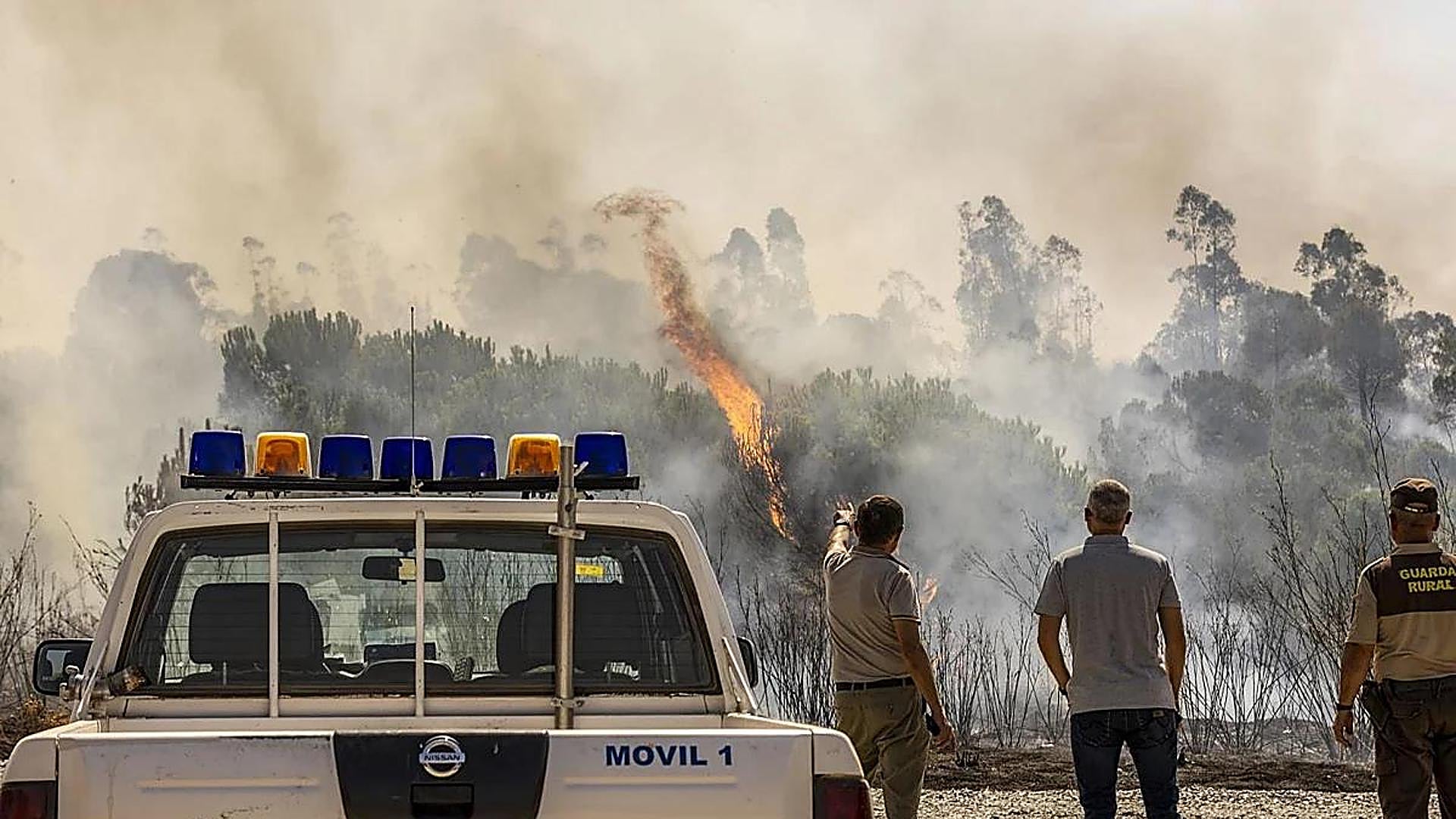
In Niebla (Huelva), hell has a perimeter of 210 square kilometres. Within that space, everything was devoured by flames in one of those 'new' wildfires ... that plague Spain every summer, unleashing a fiery apocalypse among the municipality's eucalyptus trees.
Battling the fire there poses life-threatening risks to those fighting the flames. "Air and ground access are both impossible," recounted Alejandro Molina, one of the incident commanders.
"It is an extreme fire," points out Juan Ramón Molina, director of the Wildfire Laboratory at the University of Córdoba, who maintains that a triple factor is turning suppression efforts into a titanic task - a perfect storm.
Related story

On the one hand, there is the fire's atmospheric convection - the way air moves according to its density, driven by temperature differentials between hot and cold air masses. This creates its own microclimate: a bubble of smoke and fire with internal wind and temperature conditions entirely distinct from the outside environment. "In Niebla, this convection is massive, creating instability by generating winds within the smoke column itself, known as pyrocumulus or fire mushrooms," the professor adds.
While convection allows the fire to rage freely, the vegetation - dry, abundant, and highly flammable - fuels it further. In Niebla's case, the land was densely planted with eucalyptus. "In Australia, they call it the gasoline tree," explained Alejandro García, director of Major Wildfires in Andalusia at the Emergency Agency (EMA).
"Eucalyptus has very notable characteristics. Its wood is highly flammable and generates intense heat, but it also features very thin bark and thin leaves packed with essential oils. That pleasant scent the tree gives off is due to essential oils that make it even more flammable," Garcia explains.
This tree species creates severe hazards. According to García, burning trunks release embers that travel up the smoke column. When they exit and land, contact with oxygen causes heightened combustion. "That is why every secondary spot fire ignited by flying bark takes hold," explains García, adding that the tree canopy burns with particular intensity due to oil-rich leaves igniting instantly.
Ember showers pose a severe safety threat to firefighting crews. "In Niebla, embers caused spot fires to jump more than two kilometres away. That cannot be stopped. No firebreak, road, or reservoir is two kilometres wide to block it; it jumps everything," notes Juan Ramón Molina, explaining that these spot fires can surround ground crews, trapping them in dangerous situations.
From biomass to infernal embers
The eucalyptus plantations in the Niebla fire zone were established primarily for agricultural and forestry biomass production. Regions such as Andévalo, the Mining Basin, and Huelva's Sierra de Aracena were heavily planted with eucalyptus, which now burn uncontrollably, turning the countryside into a death trap.
The Andalusian Forestry Plan Horizon 2030 reduced this tree cover by 63,700 hectares. Recent estimates from the Regional Government of Andalusia and the Environmental Information Network place current coverage between 80,000 and 90,000 hectares. Fires like the Niebla blaze continue to destroy these reserves intended for clean energy generation, which instead unleash an inferno from a single spark. Andalusian Regional President Juanma Moreno has already announced a plan to replace eucalyptus plantations with native woodland.
"They pose a risk to firefighters' lives," explains the University of Córdoba expert, noting he has viewed videos of crews taking shelter in previously burned areas - safe ground that cannot reburn. "This happens because the fire poses such a hazard that it can encircle them," the professor states, explaining that flying embers jump in all directions. Fire crews can easily become trapped, presenting a severe threat to life.
High fuel loads of dry vegetation generate extreme temperatures at the main fire fronts. "Direct suppression becomes impossible. Water drops, for example, evaporate due to the heat before hitting the flames," adds Juan Ramón Molina, highlighting unstable winds as another critical factor.
In Niebla, winds shifted every two to three hours at speeds reaching 40 km/h, exclusive of internal winds generated within the fire column. "Normally in a fire, you expect a morning wind that shifts at midday and again in the evening. Not here. In this fire, the wind shifts rapidly and changes direction continuously," notes Molina.
This caused the fire to repeatedly alter direction in recent days. Fire fronts are typically mapped using head, tail, and left or right flanks anchored to cardinal points. In Niebla, the head followed no single path, shifting from west to northwest and veering unpredictably. This creates hazardous conditions for firefighters, who can suddenly be exposed to a wall of flames while working in a previously secure zone. "The head keeps shifting without a fixed anchor point. Wind shifts every two to three hours alter the fire dynamics completely. It is uncontrollable," Professor Molina states.
Analysts continuously adjust forecasts and transmit real-time calculations to technical devices and command posts. Because the fire offers no windows of opportunity, tactics must evolve constantly to exploit brief openings.
"With standard fires, dropping nighttime temperatures allow you to attack. Not here. The heat remains extreme and does not abate at night. You cannot attack the fire by day or by night. In these fires, you have to wait for temperature shifts to find opportunities. Until that happens, it cannot be fought to a finish," the University of Córdoba expert affirms.
Experts highlight this relentless intensity as the primary challenge. "The Niebla fire is defined by extreme behaviour day and night. It gives no respite," affirmed Marc Castellnou, head of the Catalan Fire Department's GRAF unit and a leading national expert on wildfire management in the area. He noted that the fire advanced in a serpentine pattern through dense vegetation, complicating ground operations.
Extinguishing a fire with these characteristics is complex. "There are areas where you cannot work, but others where you can. That is where efforts must focus. Suppression teams must stay ahead of the fire, anticipate its behaviour, and act proactively. You cannot work at the head, but across a perimeter exceeding 200 kilometres, there are other zones where work is possible," states Juan Ramón Molina, adding that resources are being concentrated on accessible points to gradually contain the fire along its weaker flanks.
![[]](http://static.vocstatic.com/voc26/latest/assets/images/favicon/surinenglish/apple-touch-icon-57x57.png)