
Industry
Steel cutting for first ship built by Spanish company for the Royal Navy begins on British soil
The three 39,000-tonne logistics support ships will join the Royal Navy's aircraft carriers
JAVIER RODRÍGUEZ
CÁDIZ
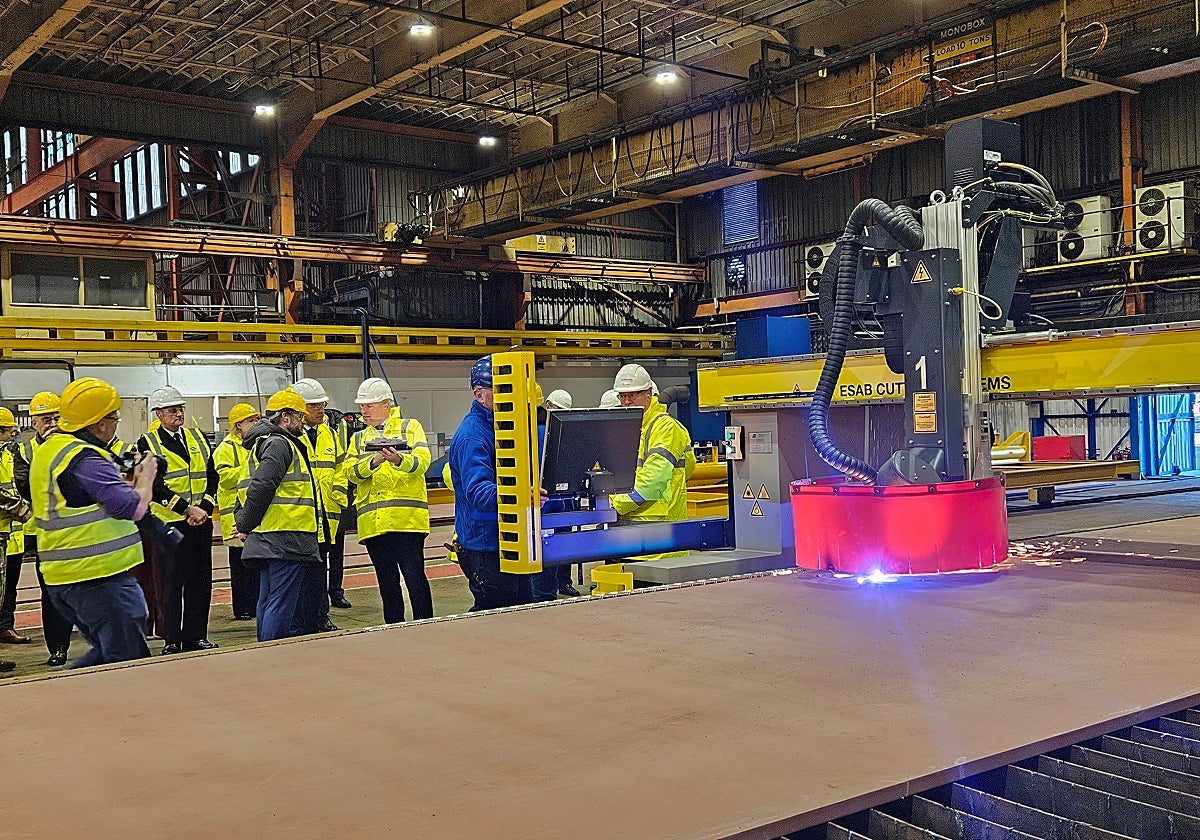
The symbolic steel cutting for the first ship built by Spanish company Navantia for the British Royal Navy was honoured with a ceremony held at the Appledore shipyard in Devon on Wednesday. With this action, Navantia's subsidiary in the UK started the construction of the first of three Fleet Solid Support (FSS) vessels destined for the British Ministry of Defence.
Minister for Defence Readiness and Industry Luke Pollard presided over the ceremony that was also attended by Commodore RFA Sam Shattock, who unveiled the name of the vessel: RFA Resurgent. The symbolic task was the cutting of the bow section of the vessel.
The three FSS ships will be operated by FRG personnel to provide support (ammunition, spare parts, food and other essential supplies) to the Royal Navy's aircraft carrier group at sea.
The start of construction marks a milestone in Navantia's commitment to the UK and the promotion of a local shipbuilding industry. "This collaboration between the UK and Spain is important. At a time when European nations are facing security challenges, industrial cooperation like this makes us stronger," Navantia chairman Ricardo Domínguez said.
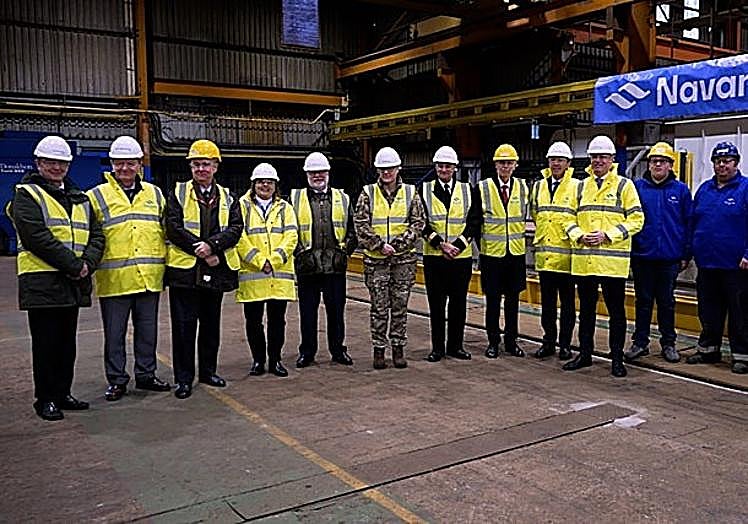
The ceremony took place a few weeks after the FSS programme passed the critical design review (CDR) milestone with the participation of teams from both countries and in close cooperation with the UK Ministry of Defence.
CEO of Navantia UK Donato Martínez said: "At all our shipyards, we have worked tirelessly to reach this milestone. It is a proud day for the whole team whose commitment has brought us this far. The FSS programme delivers on two fronts: providing critical capability for the Royal FleetAuxiliary and building long-term sovereign industrial capability for the UK through investment in infrastructure, technology and skills. Today's steel cutting is proof of what we have always said: when we commit, we deliver."
British soil
The construction of the FSS vessels has started on British soil less than three years after the signing of the contract and shortly before the first anniversary of the acquisition of the Harland & Wolff facilities by Navantia UK.
"It has been almost a year since the Appledore, Belfast, Methil and Arnish facilities joined Navantia UK. Today I would like to recognise the hard work of everyone involved in the integration and creation of this new player in British shipbuilding. Today we also celebrate your commitment and professionalism, as members of a multinational family of more than 6,500 people," Domínguez said.
Each FSS ship will be 216 metres long (the equivalent of two Premier League football pitches) and have a displacement of 39,000 tonnes, making them the second-largest vessels in service with the UK Defence, behind only the aircraft carriers. This new capability will strengthen defence operations, allowing the Royal Navy to remain at sea for extended periods without needing to return to port.
Wednesday's ceremony marked the first time Navantia has established an international programme outside Spain at its own shipyard. The FSS programme involves Navantia UK's shipyards in Appledore and Harland & Wolff (Belfast) in collaboration with Navantia's shipyards in Spain (mainly Puerto Real, in Cadiz, with support from Ría de Ferrol, A Coruña).
Appledore will build the bow sections of the vessels, which will consist of three individual blocks. In addition, a barge for the transfer of the blocks from Appledore to Belfast is under construction at Navantia UK's Methil (Scotland) site.
"This is a significant moment as we begin construction of the new FSS ship, which will keep our Royal Navy combat-ready and capable of deterring future threats. By supporting British shipbuilding, we are creating over 1,200 skilled jobs in Devon, Belfast and beyond. This shows that defence is acting as an engine of growth, boosting communities across the UK. In a new age of threats, we are investing more of a growing defence budget in new platforms and technologies," Pollard stated.
Commodore RFA Sam Shattock added: "The ship is innovative, meets the latest environmental protection standards and is designed from the ground up to provide maritime sustainment in the most efficient way possible. I am excited to see this vessel join the flotilla and demonstrate its capabilities at the right time. A true enabler for the Royal Navy's warfighting of tomorrow."
Navantia UK's investment in its four centres will enable the application of the design and construction technologies that Navantia is implementing in its shipyards in Spain, with the installation of state-of-the-art equipment, such as robotic plasma cutters, a fully mechanised flat panel line and automated quality control systems.
Delivery systems, warehouse management and digital integration are also improved, ensuring that FSS vessels can be delivered faster and more accurately. At Appledore, the investment includes a three times faster plasma cutting system, crane automation (36 units) and other improvements to optimise manufacturing and delivery times.
![[]](http://static.vocstatic.com/voc26/latest/assets/images/favicon/surinenglish/apple-touch-icon-57x57.png)