
Ceuta migration crisis
Spanish Defence Ministry study warned a year ago of possible 'covert invasion' of Ceuta and Melilla via immigration
"Morocco's main strategy would be to avoid an armed conflict and portray the situation as a spontaneous and mass influx of illegal immigrants," predicted the document Academia General Militar published
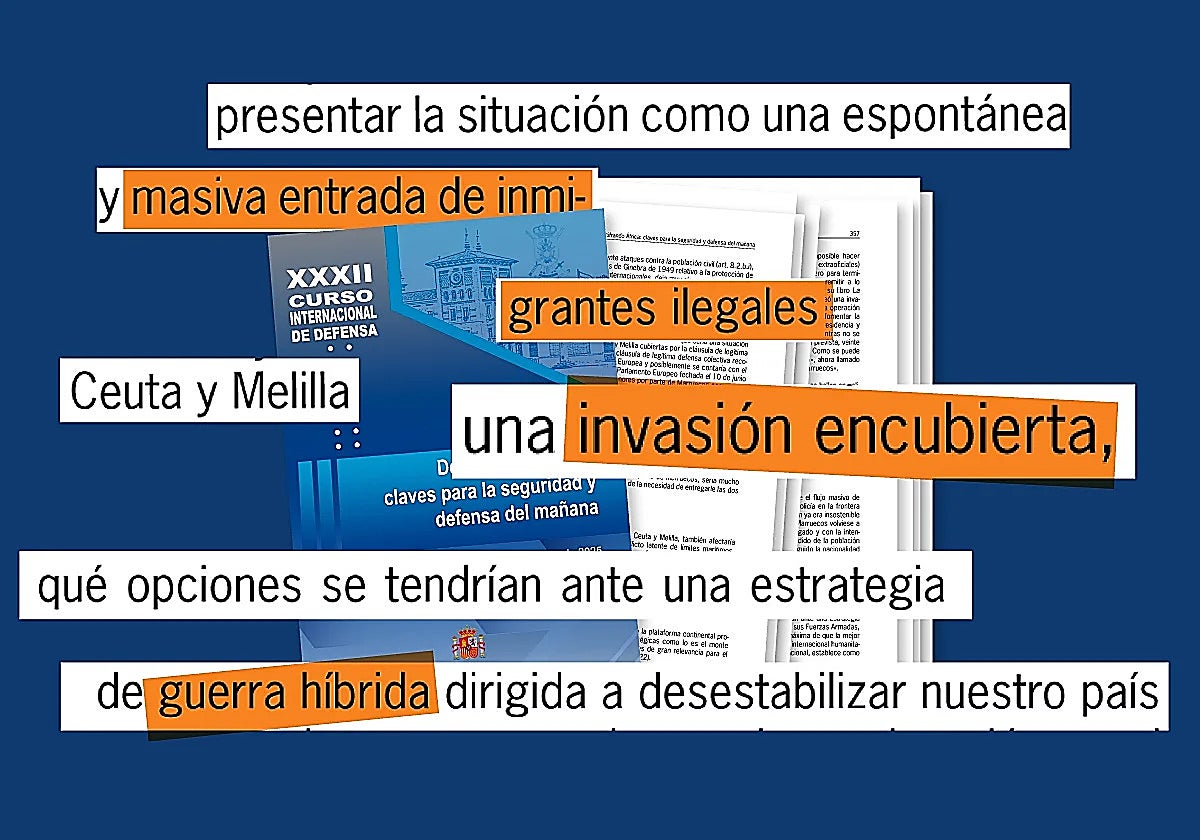

"Morocco's main strategy would be to avoid an armed conflict and portray the situation as a spontaneous, mass influx of illegal immigrants," says ... an official Defence Ministry document from a year ago.
It describes a very similar, if not identical, situation to what happened in Ceuta on 30 and 31 July, when around 80,000 people entered its territory illegally.
The prescient document warns of a possible "covert invasion" through migratory pressure. Its authors even set out how to respond to a "hybrid warfare strategy aimed at destabilising our country without using its armed forces".
Related story

Related story
-

Melchor Sáiz-Pardo
The dossier, part of which is this document, brings together presentations and papers relating to XXXII Curso Internacional de Defensa, held in Jaca (Huesca) in September 2025.
The lectures addressed immigration, terrorism, strategic resources and African security. The chapter on Morocco discusses how Spain's African territories are "under constant threat".
The report begins with an accusation: "Morocco repeatedly challenges our sovereignty over Spanish Africa" through statements and "by planning and even carrying out specific actions that could seriously affect us".
Regarding Ceuta and Melilla, the document states that Rabat "acts as if they were already its own when publishing official maps". The idea of 'Greater Morocco' represents, according to the study, "a clear threat to" Spain.
"No matter how good relations with our neighbouring country may be, the fact that it has never ceased to claim part of Spanish territory must keep us constantly on our guard so that we can take the necessary preventive measures and safeguard the sovereignty of our homeland," the document states.
The review includes the attempt to seize the island of Perejil in 2002. Spain reacted with force, but "this did not deter them from their ambition". The study mentions Morocco's "significant rearmament" and considers it more likely that a tactic similar to that used in 1975 to occupy Western Sahara will be employed, with civilians advancing into the disputed territory.
The authors consider that Spain's territories outside Europe "are under threat" and envisage a new "march" through "manipulated immigration".
They refer to Ceuta in May 2021, when there was a "mass influx of migrants facilitated by the Moroccan authorities". They point out that the CNI (national intelligence centre) framed this as part of a pressure strategy by Rabat.
"The massive influx of people came to a halt when Morocco sought to deploy its police at the border after having caused chaos in Spain," the document states. Building on this precedent, it examines a repetition of this "over a prolonged period and with the intention of claiming" Ceuta and Melilla. The result would be "a state of chaos" that the Spanish authorities would "struggle to control".
The scenario involves people who, as well as staging a mass demonstration, will cause "disturbances on the streets of our cities' and demand their 'release'".
The authors anticipate a crisis "far more serious" than that of 2021, "leaving us overwhelmed and without sufficient police and security forces to maintain order". Added to this pressure is the need to care for those who arrive by swimming "suffering from hypothermia or already exhausted".
The operation would fall within the "grey area", with the civilian population used as a means of exerting pressure and difficulties in mounting a military response. The study adds "a possible media manipulation campaign by Morocco".
This combination, the study states, would make it "much easier to convince public opinion of the need to hand over the two autonomous cities".
'Morocco 2030'
The chapter also includes an account by former intelligence officer Fernando San Agustín of an operation known as 'Morocco 2030'. This refers to a plan devised by Hassan II, the father of Mohammed VI, for a "massive, simultaneous and peaceful" invasion of Ceuta, Melilla and the Canary Islands.
According to this account, "20,000 people would enter the cities by land and sea". The strategy would include "fomenting a climate of terror among the Spanish public to convince public opinion of the need to cede our North African territories to Morocco".
The plan sets out its proposals for "peaceful" and "symbolic" mobilisation and the attempt to project a supposed "internal popular will" in favour of annexation. It also reviews references to Melilla as "an occupied garrison" and claims of "Moroccan sovereignty".
The analysis extends the territorial dispute to the waters near the Canary Islands and the mineral resources of Monte Tropic. It states that maritime disputes "sow mistrust" in economic relations and that "Morocco is seeking to expand its territory, both on land and at sea, beyond its means in North Africa".
Another paper by Juan Manuel León Larios of the University of Granada describes a "strategic dependence on actors who do not always share the same interests". He defines the 2021 Ceuta crisis as "sudden, though not spontaneous", and migration control as a "mechanism of diplomatic coercion".
León Larios warns of a "structural vulnerability". "The effectiveness of Spanish border control is partly contingent upon the political will of Rabat."
He describes "a deliberate act of political instrumentalisation of migration control" and a "deliberate relaxation of Moroccan controls as a means of political negotiation and strategic deterrence". He refers to this as "hybrid pressure tactics": an instrument of "deterrence or retaliation, as suits the strategic interests of the actor employing it".
Warnings from the CNI and the police referred to the situation on the ground prior to the crossing. Both analyses point to the use of immigration as a means of exerting pressure.
On 28 July, the CNI analysed the risk of "a mass breach of the Ceuta border fence or a crossing by swimming" and highlighted a possible relaxation of Moroccan controls as a "mechanism for exerting political pressure".
National Court judge María Tardón is investigating the planning of the influx and the response to those prior alerts, the scope of which has been questioned by the Minister of the Interior.
Her ruling of 7 September cites evidence of "active guidance" from the Moroccan side and of "objectives other than migration". The judge has requested that Moncloa provide the declassified documents so that they can be included in the case and the information available prior to the crisis can be examined.
![[]](http://static.vocstatic.com/voc26/latest/assets/images/favicon/surinenglish/apple-touch-icon-57x57.png)