
Spain wildfires 2026
Major Ávila fire in Spain burns 50,000 hectares, making it the most devastating in national memory
More than 90,000 people have had to either leave their homes or stay in lockdown

Madrid
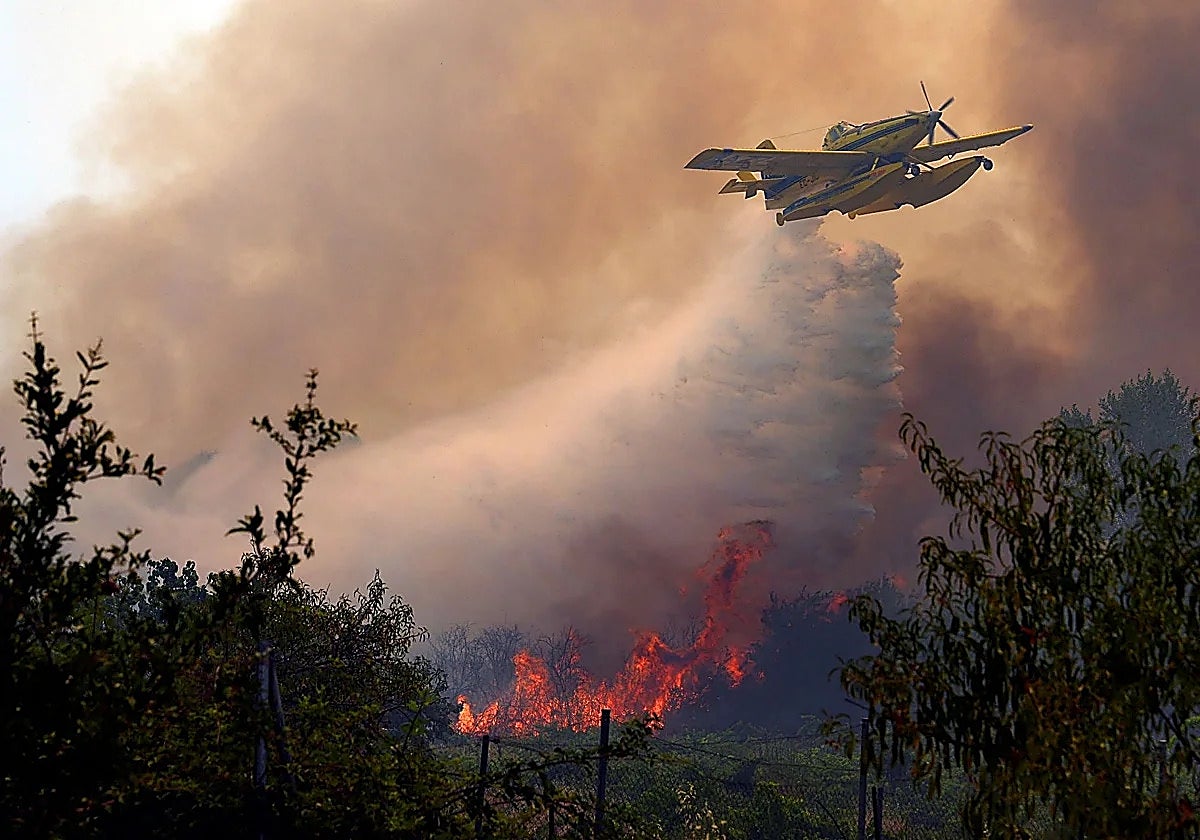
The titanic efforts of the forest firefighters and the military emergency unit (UME) during the early hours of Sunday have delivered a more favourable development ... in the fire ravaging much of the provinces of Ávila and Toledo and the region of Madrid.
Some hotspots in Castilla-La Mancha, Castilla y León and the municipality of Mijares, however, flared up again late in the afternoon.
"There are still difficult hours ahead, but tonight has been very positive in terms of bringing the fire under control," PM Pedro Sánchez said on Sunday.
Related story
Related story
-
S. Vallejo / M. G. Casallo / J. M. L.
Cautious optimism was the prevailing mood throughout the day following a few calamitous days, during which the uncontrolled spread of the flames had forced the evacuation and lockdown of more than 90,000 people.
Last Friday, for the first time in Spain's history, the country declared a state of emergency of national interest in the province of Ávila and the region of Madrid. The following day, the state of emergency extended to the province of Toledo to ensure maximum efficiency in the coordination and deployment of available resources.
In addition to the thousands of people who had evacuated or remained in lockdown, some for the fourth night, there was the desolate landscape of 77,000 burnt hectares, 50,000 in Ávila.
According to third deputy PM Sara Aagesen, this makes it "the largest forest fire" in Spain's history. The region of Madrid has lost 25,000 hectares to the fires, while the province of Toledo has seen 2,000 hectares of its land devastated, roughly equivalent to the entire island of Menorca.
The Aemet state meteorological agency reported that the smoke was visible from the Meteosat satellite.
President of the regional government of Castilla y León Alfonso Fernández Mañueco attributed the fire in Ávila to negligence and confirmed that the regional government would act as the prosecution against the individual the Guardia Civil had already arrested.
The objectives of the authorities remain: "protect human lives, populated areas and, ultimately, extinguish the fires". For the moment, the latest news depicts a "relatively favourable" prognosis, with "much of the perimeter" stabilised.
Sánchez has stated that, on Tuesday, Cabinet will declare the affected areas seriously damaged as a result of the fire.
In his latest statement to the media, Minister of the Interior Fernando Grande-Marlaska acknowledged that the weather conditions were not going to be favourable but hoped that the intensive work during the night would lead to a more positive start to the day.
"We are making positive progress compared with yesterday, but it is all very slow. Any progress we make is down to our efforts, because the weather is not helping us at all," he said.
Concerns over the northern flank
According to the government delegate in the region of Madrid, Francisco Martín, the fire crews have stabilised the western flank in the Madrid mountains. Their main concern now is the northern front.
"The possibility that some hotspots might reignite due to gusts of wind and rising temperatures could drive the fire towards the San Juan reservoir. We are already working on this," he said.
Martín assured that the situation in each municipality is under "constant review" and that some of the restrictions would only be lifted once "robust" technical criteria guarantees the safety of residents. Until then, he called for "patience and solidarity".
"The forecasts for today and tomorrow are good, so we have a wide window of opportunity to tackle and beat the fire. We are going to give it our all until we have defeated it," Martín stated.
The authorities have evacuated more than 35,000 people and ordered the lockdown of over 20,000 in the region of Madrid.
As for the wildfire that broke out in Burgohondo (Ávila), the bad news on Sunday afternoon was that it had reignited "with force" due to the wind. The two main hotspots are in Castilla y León, Castilla-La Mancha and Mijares, in the upper reaches of the mountain range.
The flare-up occurred in the middle of the afternoon, the "most critical hours" of each day. The operation focused on preventing the fire from spreading, as well as on "attacking the front", while prioritising people's safety.
As a result, 16 municipalities, home to nearly 40,000 people, remain evacuated, and a further three under lockdown, comprising a total of 8,000 people.
President of the region of Madrid Isabel Díaz Ayuso said that, according to their records, the fires have completely destroyed 43 homes and "heavily damaged" 300. These numbers, however, are certain to rise.
"We are already working on the recovery. We're not going to wait because Madrid never rests, just like its people. We're now assessing the losses so that we can provide aid immediately and people can rebuild their lives," she announced shortly before breaking down in tears.
Regional authorities have set up 19 shelters in 15 municipalities. A total of 13 people have required medical assistance. Fortunately, they are in good condition. In total, the region's health authorities have treated more than 1,000 people, most of them for respiratory problems.
The King and Queen of Spain have expressed their "support and solidarity" to all evacuees. "They have been away from home for four days, they have lost many of their possessions and we have all lost an inestimable cultural heritage," King Felipe said.
At his side, Queen Letizia emphasised the importance of attending to the residents who "have fled their homes in a hurry". The king praised "the exemplary coordination" of the authorities and the fire crews and called for an assessment that would prevent future tragedies.
PM Sánchez highlighted the need to put at work "the grand national pact to tackle the climate emergency". "It is no longer just about the economic damage. It is also about the emotional toll on many residents who are losing everything," he said.
Sara Aagesen echoed his words and described this year's fire season as "extraordinarily difficult". As of 26 July 2026, the 32 major fires across the country have destroyed "153,000 hectares (...) which is six times the figures for 2025 at this time of year".
In response to the national pact, leader of the opposition Alberto Núñez Feijóo said that "this is not the time to make political statements"
The regions where the emergency has been declared have received the support of 12 other regions in Spain, the European Union Civil Protection Mechanism, Portugal, Greece, Italy and Turkey.
Despite the optimism, Aagesen said that further evacuations might be necessary.
![[]](http://static.vocstatic.com/voc26/latest/assets/images/favicon/surinenglish/apple-touch-icon-57x57.png)