
Food and drink
Seven little-known facts about Malaga's famous Muscatel raisins
From the production process through to its nutritional benefits, this sun-dried fruit has earned its status of being a unique product in the province

Malaga
It is a traditional, healthy item that can only be produced organically, through sun-drying. The Malaga Muscatel raisin, a protected designation of origin product, has formed part of Axarquía's landscape for centuries, and, to a lesser extent, Manilva. Although its consumption has been declining in recent years, it is still considered as one of Europe's culinary gems. It has many unique features. Here are some of them:
1It only counts as a raisin from Malaga if the drying process is completely natural, i.e. it is left to dry naturally in the sun, which is done in the traditional raisin 'paseros' (raisin beds). This means raisins of the Muscatel de Malaga or Alejandría variety, which are sun-dried in Axarquía region and Manilva, are a Protected Designation of Origin.
2 The Malaga Muscatel raisin is a quality product with a long history. In fact, it experienced its greatest boom in the 19th century, although popularity declined after the phylloxera plague at the end of the century. Some believe that the production of these raisins can be traced back to Roman times, although it is most commonly associated with ancient Al-Andalus. It was during this period that the popularity of the Axarquía raisins grew, with clear references to sites such as Jotrón and Santopitar. Together with the wine made from the same grape variety, they became world famous. The only thing left unclear is the actual origin of the Muscatel variety, and at what point it was introduced in the Iberian Peninsula.
3 In addition to its protected status, it is one of the most exclusive products in the world. In 2017, it was declared a World Agricultural Heritage by the FAO (Food and Agriculture Organization of the United Nations). In addition to the Valle Salado de Añana (Álava) landscape, it was the first product to obtain this recognition in Europe, which is a milestone of great international relevance.
4 When the Muscatel grapes reach the paseros, many factors come into play that play a crucial part in obtaining good raisins. The bunches are carefully and skilfully placed along these drying beds, so that the grapes can dehydrate in the sun for several days. In any case, each bunch must be turned over, one by one, once they have dehydrated on the side they were initially exposed to. Depending on the weather, it can take between ten and fifteen days to turn the grapes into raisins. This part of the artisanal production process is fundamental, because the bunches must be removed at the right moment, that is to say, not when they are still 'crude', as we say in the Axarquía, nor too dry. Only expert hands are capable of finding the right moment. Notably, it is the sun-drying that gives the Axarquia Muscatel raisin its unique organoleptic characteristics, and also its well-known nutritional properties.
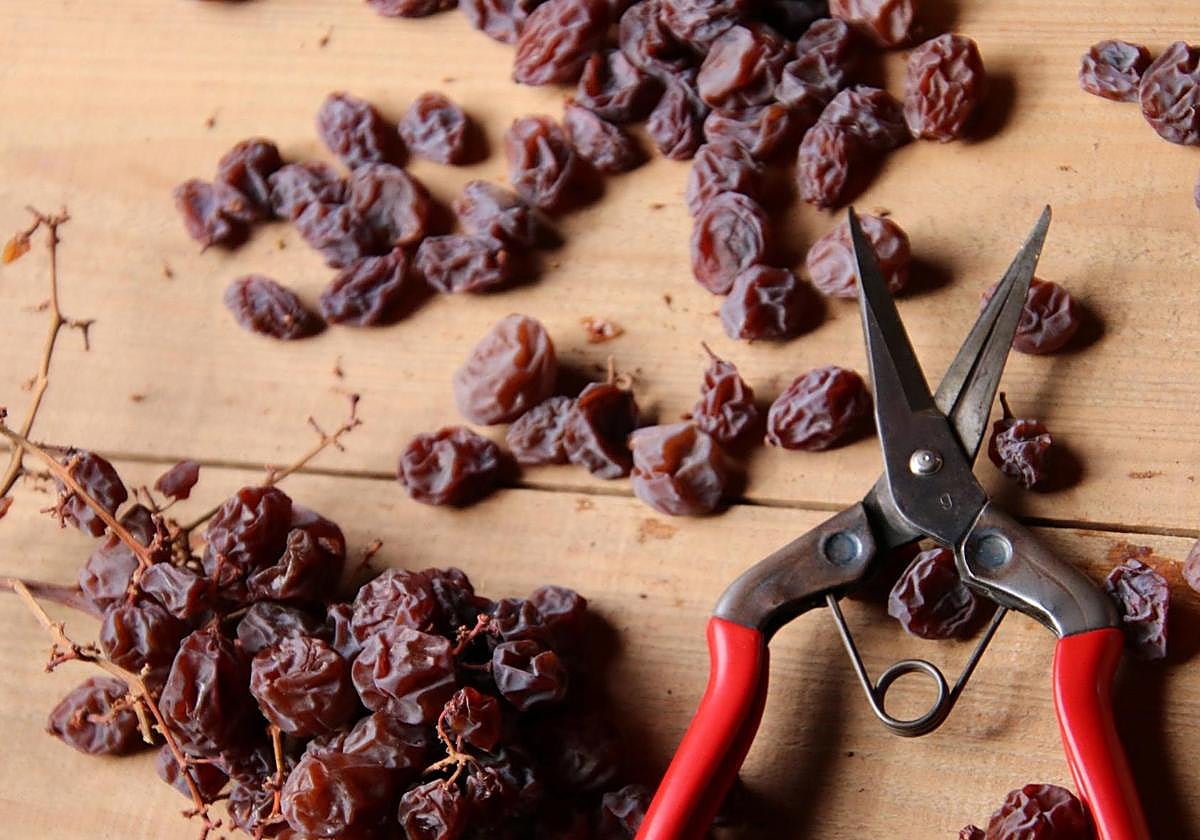
5 Once the raisins have dried in the paseros, they are collected and taken to the 'lagares', farmhouses, where the 'picado' (chopping) phase begins. One by one they are cut from their bunches with small scissors. In the past, it was a task mainly entrusted to women, although today this isn't always the case. There are also bunches that do not go through this process, instead they are sold in boxes. They are usually selected for their size and shape so that they look better in traditional containers, known as 'chatos' or 'catites'. They are sold by size, in which there are up to five categories: Extra, first, second, third and a fourth that is usually discarded, where the Muscatel raisins are classified from largest to smallest. Due to its size, the smallest raisins can be utilised for homemade wine production.
6 A nutritional study carried out by the Regulatory Council and financed by the Malaga Provincial Council in 2018 highlighted the health benefits of Malaga raisins. They contain folic acid, vitamins B1, B3 and K, potassium, boron, calcium and phosphorus. Additionally, they contain phytosterols that block the absorption of intestinal cholesterol, lowering bad cholesterol without modifying the levels of good cholesterol. In short, the Malaga raisin stands out for containing energy-boosting properties (ideal for those who do sports). Its moderate consumption improves physical performance and the immune system, and it also reduces fatigue and the risk of cardiovascular diseases.
7 Despite their benefits and international recognition, the demand for Muscatel raisins from Malaga has fallen. Grapes from other countries are being consumed more because they are seedless. Furthermore, production will decrease even more due to the 'milidiu' fungus which has caused the grape vines to become diseased. Estimates suggest that there will be around eighty percent less grapes produced compared to last harvesting season.
![[]](http://static.vocstatic.com/voc26/latest/assets/images/favicon/surinenglish/apple-touch-icon-57x57.png)