
Gender-based violence
More than a thousand people demonstrate in Malaga city against gender-based violence
The mayor, some of his councillors, as well as representatives from other parties and trade unions joined the march
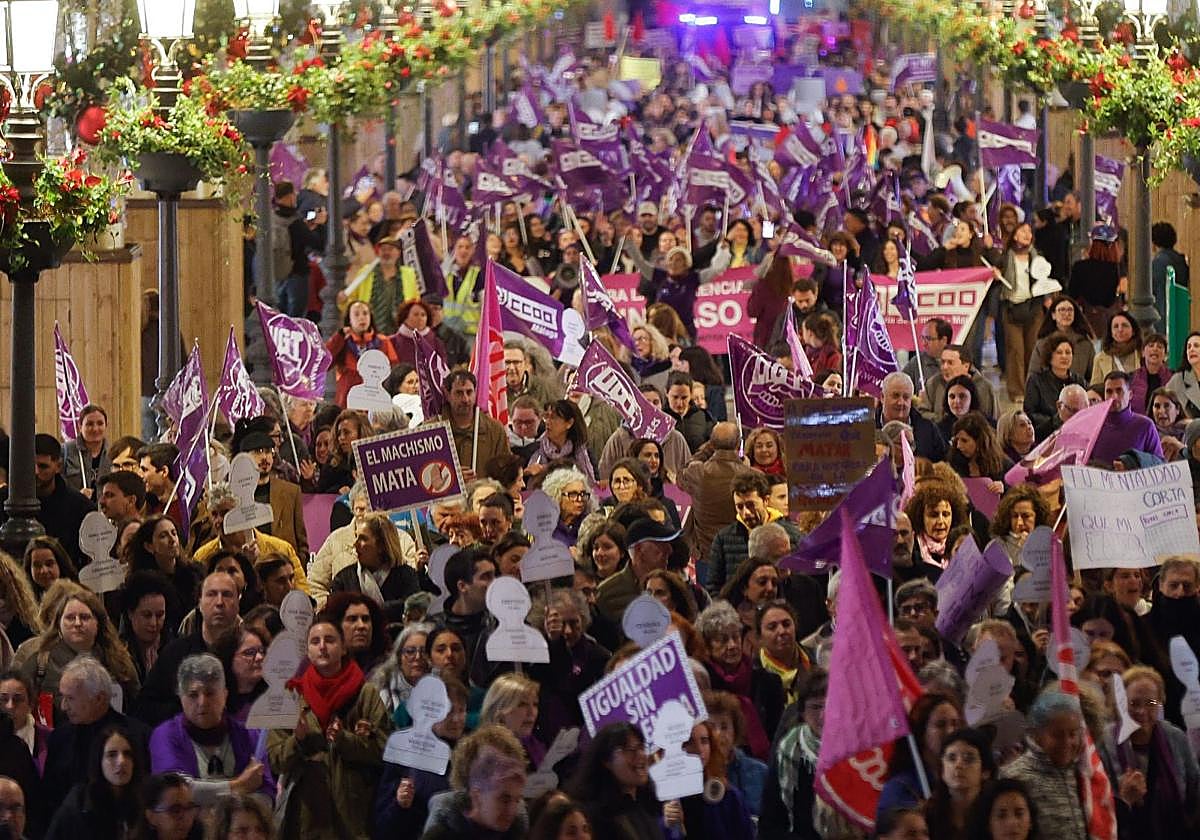

Malaga city centre saw more than 1,000 people march against gender-based violence on Wednesday evening, 25 November (International Day for the Elimination of ... Violence against Women).
This was the number of protesters according to the National Police, but the Violencia Cero platform has put the figure at 3,000 people. They marched from Plaza de la Merced to Plaza de la Constitución, where actress Adelfa Calvo read out the manifesto.
Abiel was among the crowds. She went to the demonstration on her own. "I've been a victim, I've seen it happening around me and I'm a psychologist. I've come here for those three reasons: because I know it first-hand, second-hand and third-hand. For once we can shout without anyone telling us off… We still can't speak freely. Even among ourselves, we feel ashamed to talk about certain things. We still feel guilty," she said.
"They say the murdered women are missing here. But those who are locked away, those who are abused, are missing too," she stated. Abiel was one of those "locked away" years ago and she continues to delve into the wound that is still open. "A part of you breaks and I don't think it will ever be mended: it's like a piece of glass that cracks. You glue it back together, but the cracks are still there. My mother still gets goosebumps every time she hears an ambulance," she explained.
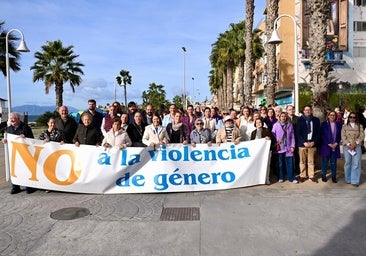
Following the morning's official ceremony, during which representatives from the city council, the provincial authority, the regional and the central governments highlighted the statistics: Malaga is the province with the highest number of gender-based murders this year.
Mayor Francisco de la Torre and two of his councillors, Paco Cantos and Teresa Porras, joined the march. Cantos told SUR: "There is no single reason to explain why Malaga is the province with the highest number of gender-based murders this year. The victims' profiles are very diverse. The only thing they have in common is that they are women. That is precisely what defines gender-based violence: it is the violence women suffer simply because they are women."
Speaking on behalf of Con Málaga, which is standing in the general election under the banner of Frente Amplio, Toni Morillas delivered an election message: "The key to preventing Abascal (leader of the Vox party) from becoming deputy prime minister in 2023 was the feminist mobilisation against the risk of regression. Today's mobilisation foreshadows the one that will take place on Sunday at the ballot box."
Speaking on behalf of the PSOE, Desiré Cortés and Yolanda Florido lashed out at "the denialist party that whitewashes and normalises gender-based violence".
Micaela Jiménez, from Podemos, said: "For a few years, it seemed we were making progress, that the number of women murdered was falling, but now we have reached a standstill and we have come to accept that there are between 40 and 50 [in Spain] a year."
While the authorities were meeting on Wednesday morning at the Malaga Museum and residents were preparing to take to the streets, two more women were murdered, bringing the total number of femicides in Spain so far this year to 49. Such is the voracity of patriarchy that several crimes can be committed in the time it takes to draft a manifesto and read it out.
"Every year the list gets longer. It's heartbreaking."
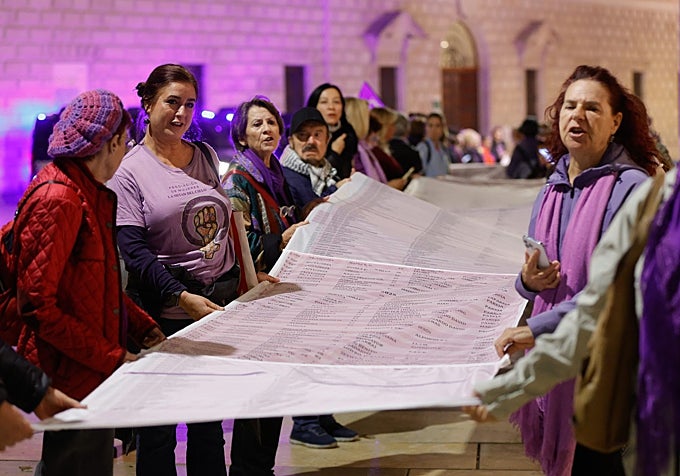
The organisers did not have time to add the names of the most recent victims to the banner listing the nearly 1,400 women whose lives have been cut short by gender-based violence.
Around 20 people carried the banner through the streets of Malaga, including Rosa Rodríguez and María del Mar Castro, who reflected aloud: "Every year the list gets longer. It's heartbreaking." Standing nearby, 70-year-old Antonio Tallón stated: "We men need to re-educate ourselves, to change."
Among the first to arrive at Plaza de la Constitución was Rocío Morales, president of the Alas Association, which works with children who are victims of gender-based violence. "The fact that there is so much violence among young people stems from a lack of support and of education on emotional and sexual matters, as well as on equality," she said.
Morales set up the association after her daughter was the victim of a sexual assault and she realised that, in such a situation, families are "completely helpless".
She shared a grim prediction: "Violence will increase, unfortunately, if we do not take action on this, if we do not educate people about equality, about not objectifying women, about the fact that your body is your own and about not trusting anyone who tells you to keep a secret, because there are good secrets, but also very bad ones."
Carmen Martín, chair of the organising platform, then took the floor and explained that her organisation is running a social media campaign against the new forms of misogyny circulating online. "We must work on education to combat violence for future generations," Martín urged.
"We are fed up with gender-based murders and with the authorities failing to take them seriously. We're campaigning on this and only today have the political parties addressed the issue, even though women make up more than 50 per cent of the population and all of us, in one way or another, have experienced violence. They must take this seriously once and for all," she demanded just as the march was about to begin.
Patricia Laguna, from Comisiones Obreras, added: "We are protesting against denial, against economic violence and institutional violence. But also because the authorities are refusing to grant protection orders to victims of gender-based violence, which deprives them of their rights, such as the right to access benefits, meaning that many women are forced to live with their abusers."
Young people are taking action too. Nadia, Carla, Cristina and Teresa, all 15 years old, said: "We wish this day didn't have to exist, but we've come to see if we can bring about change. We're not going to stay silent." Inma, the mother of one of them, added: "These girls need to realise that if you disagree with something, you have to speak out and the only way we can do that is by demonstrating."
Alejandra, Sara and Cristina said: "Why have we come to the demonstration? How could we not come! How on earth can there be people who haven't come! We have to be here. Otherwise, people forget that it's still happening, especially now that some are trying to claim that gender-based violence doesn't exist."
Contents of the manifesto
"It is absolutely unacceptable to see the number of victims rising at an alarming rate while we witness attempts to normalise the structural violence that we women suffer on a daily basis. This accumulation of horror is utterly unbearable. It is particularly painful in our region and especially in our province," Adelfa Calvo said at the end of the march, in Plaza de la Constitución.
The manifesto also said that "the policy on support for women victims of violence has been entrusted to Vox", "a party that denies gender-based violence", which "amounts to rendering the structural inequality women suffer invisible". She also referred to the "budget cuts and reductions in resources" for the fight against gender-based violence.
The manifesto then listed demands, among them "greater resources, funding and involvement of the state security forces in the prevention and protection of women who are victims of gender-based violence", as well as a "thorough review" of the VioGén system, the resolution of the "problems" identified with the electronic tagging devices used to monitor abusers and "compulsory training on equal opportunities and combating gender-based violence in the education and healthcare sectors and among legal bodies who work with victims".
The organisers, speaking through Calvo, called on society as a whole to "get involved in restructuring strategies against gender-based violence". "Let the streets shout out, so that the cry resounds in parliaments, in the courts and in institutions," the manifesto concluded.
