
Health
Malaga residents describe what it's like to get bitten by Mediterranean recluse spider
One of the two women says the bite looked like a gunshot wound and both required several weeks of medical treatment
Irene Quirante
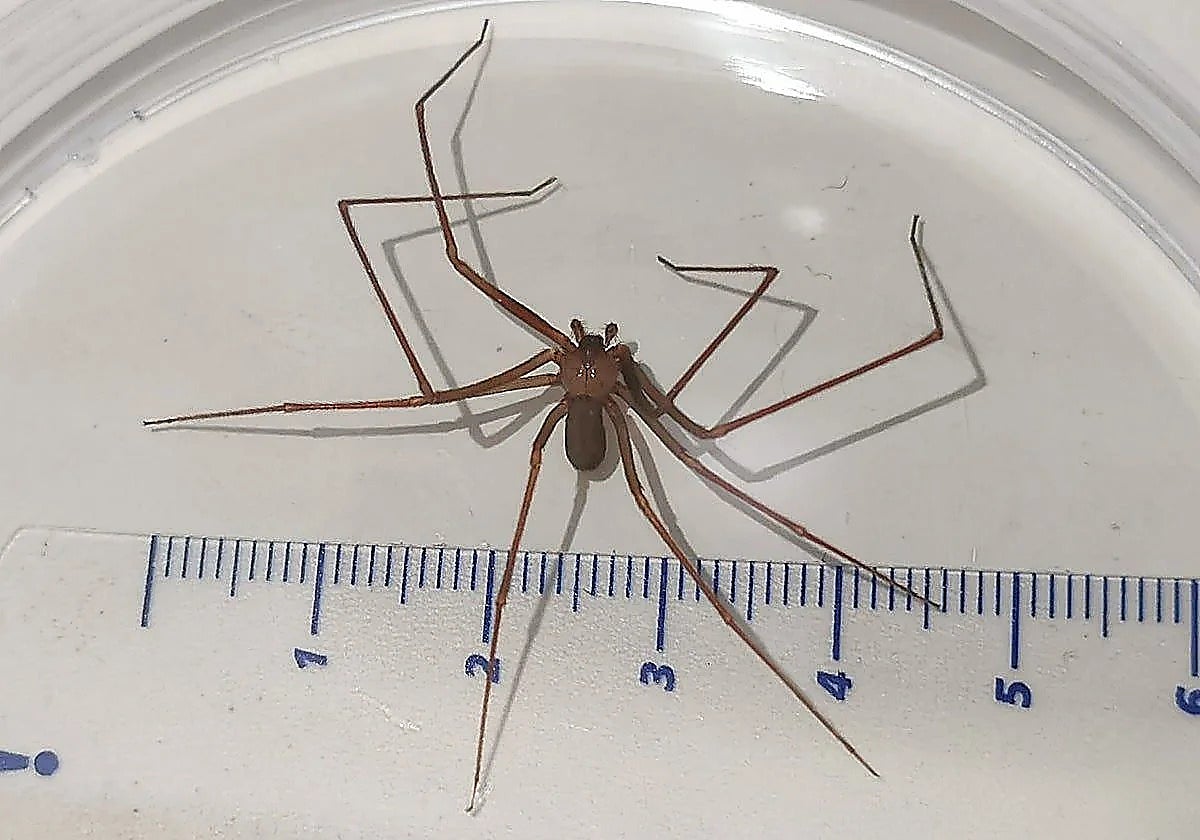
Carmen and Patricia don't know each other, but they share an unusual traumatic bond: both residents of Malaga province suffered the bite of a Mediterranean recluse spider (Loxosceles rufescens) during the summer of 2024. Those days of real anguish and uncertainty left indelible marks, both physical and emotional.
"I had a hole almost five centimetres deep in my leg," Carmen, 27, tells SUR. Patricia, from Estepona, echoes this stark description in the story about her own injury: "It looked like I'd been shot."
Their stories, separated by just a few kilometres within the province, follow the same pattern: extreme pain, erratic medical diagnoses and an exasperatingly slow recovery. Behind both cases was the Mediterranean recluse spider, an elusive arachnid whose venom can destroy human tissue within hours.
For Carmen, the ordeal began on 3 August 2024. At the time, she was temporarily staying at her mother's house while her own home was undergoing renovations. Although she doesn't know the exact moment of the bite, she remembers that her leg suddenly started itching while she was driving. "At first, I didn't think much of it. I just saw that I had a small pimple," she says.
Related story
-
112 incident
Juan Cano
However, what seemed like a simple, harmless skin reaction worsened at an alarming rate. Within hours, she developed severe swelling in her knee and a high fever that wouldn't break. Given the seriousness of her condition, she went to the emergency room. The doctors administered intravenous antibiotics.
The true extent of the injury became clear the next day, when she was referred to her health centre for outpatient treatment. "That's when they realised how serious it was. When I saw the hole, almost five centimetres across, I wanted to die. It was half a centimetre away from hitting the bone."
The definitive diagnosis took some time. It was a dermatologist who, some time later, confirmed that the open wound, which needed to be closed "from the inside out", corresponded exactly to the bite of a Mediterranean recluse spider.
Carmen spent three weeks going for daily treatments and a whole month confined to her home. "I'll never forget that summer. Now, every time I get a pimple, I feel that fear all over again," she says.
Just a few days later, during the first week of August, 50-year-old Patricia began experiencing fever and skin decomposition. She suspects the encounter with the spider occurred on the balcony of her home in Estepona, an area with abundant vegetation. She believes she may have accidentally crushed the spider with her abdomen while taking a nap.
Symptoms
Since she was juggling two jobs at the time, she initially ignored the discomfort in her groin area. However, after three or four days, the skin turned bright red and hardened noticeably and she began experiencing a severe headache accompanied by a 40C fever.
She went to the San Pedro clinic, but the examination was superficial. Due to the tissue's rigidity, she was prescribed a cream and a mild antibiotic, which did not manage to control the infection.
"Two or three days passed and the antibiotic didn't help at all. On the contrary, it got worse. The area burned terribly. In the end, I went to the Marbella hospital and they saw that I had an infection with pus and the beginning of necrosis. If I hadn't taken the very strong antibiotic they prescribed there, I wouldn't be here to tell the tale," Patricia says.
The swelling grew to the size of a large bun. After a shock dose of antibiotics, the infection eventually ruptured the tissue. "It created a gaping hole that looked like a bullet wound. You could see the flesh of my abdomen inside. It was dark and necrotic. Even the nurses were stunned," she says.
Despite the severity, the emergency room report described it as a simple "non-venomous insect bite". This forced Patricia to search for answers on her own online until she matched her symptoms to those of a Mediterranean recluse spider bite.
After 25 days confined to the sofa and a painful suppuration process, the wound closed, leaving a permanent scar. "I've got a scar like I've been shot. I'm going to get a spider tattooed over it," she jokes today.
The cases of Carmen and Patricia highlight the complexity that healthcare professionals face when dealing with loxoscelism in the south of mainland Spain. Because it is not an aggressive species (it only bites when it feels trapped or threatened), patients rarely manage to see or capture the spider for identification.
Furthermore, the initial symptoms often mimic a common bacterial infection, delaying the application of specific treatments. The rapid progression to skin necrosis and the subsequent formation of a deep ulcer requires aggressive pharmacological intervention and prolonged clinical follow-up to prevent further damage to the subcutaneous tissue.
In recent years, similar stories have surfaced in the media, causing alarm. In 2024, the journal of the Spanish society of environmental health published a case in which a spider had attacked a 42-year-old man three times in his home in Vizcaya between May and September 2023.
No cause for concern
Experts, however, are reassuring the Spanish population. Professor of Zoology at Malaga University Raimundo Real says that the sting of the Mediterranean recluse spider is "not at all common" in Spain, as the spider does not usually attack humans nor does it feed on blood, as is the case with other insects. "It must have felt threatened," he told SUR.
Real confirms that this species is one of the most venomous spiders in the Mediterranean and that Malaga is within its habitat, but its presence in the province is uncommon. "It normally feeds on insects. It doesn't attack people spontaneously. If it does, it's because it feels threatened and is acting in self-defence," Real says.
In his opinion, it's not accurate to call it a "bite," since it technically lacks jaws, nor is it exactly a sting, although the term seems more appropriate to the arachnid's characteristics. The attack occurs with "chelicerae, a kind of fang", which it uses to pierce the exoskeleton, injecting its venom and then sucking out the contents of its prey.
Its venom is "proteolytic", meaning it "destroys proteins" and corrodes the flesh in the area surrounding the point where it pierces the skin. "It's not fatal, but it can cause very serious local lesions around the wound that require urgent medical attention. They are potentially dangerous," the professor says.
![[]](http://static.vocstatic.com/voc26/latest/assets/images/favicon/surinenglish/apple-touch-icon-57x57.png)