
Infrastructure
Questions about the functionality of Malaga city's sewage system emerge amid closure of four beaches
Malaga has two large water treatment plants and the city council says that 55 per cent of the network separates stormwater from sewage
-U84046146306zOm-1200x840@Diario%20Sur.jpg)

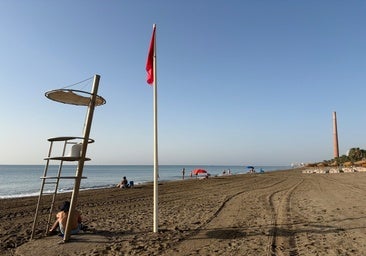
Malaga has seen six of its beaches close in recent days due to discharges from the sewerage system during the storm on Saturday.
According ... to the city council, the main causes are the lack of separate sewerage networks (rainwater and sewage should not flow through combined sewers, but through separate ones) and blockages caused by the accumulation of wet wipes in the system.
The accumulation of wet wipes flushed down the toilet costs the city council more than two million euros a year in repairs, drain-clearing and cleaning operations.
Related story
-
Chus Heredia
Test results have allowed two of the six beaches closed to bathers to reopen. Red flags continue flying at Guadalmar-San Julián, La Misericordia, Sacaba and San Andrés, although they likely to reopen on Wednesday.
The incident in the middle of the peak summer season, however, has sparked a political row and raised many questions in recent days. Does the city's sewerage system actually work?
Sanitation and infrastructure
As a general rule, all major coastal towns treat their wastewater in accordance with European standards.
The remaining issue concerns the municipalities of Cártama and Alhaurín el Grande, which face fines from the EU every six months. The fine is set to rise due to a court ruling overturning the Norte treatment plant, which was to serve future residential developments in Malaga.
Public water company Emasa manages 2,000 kilometres of sewerage network, 666 kilometres of stormwater drains and 40 kilometres of culverted streams, which account for a large part of the blockage problem when it rains, as was the case last Saturday.
In addition, the city has two large wastewater treatment plants (WWTWs): the Guadalhorce plant and the Peñón del Cuervo plant (there is another small, less significant facility in Olías).
The former has the capacity to serve a population of 1.28 million inhabitants. The second has a capacity of around four times less. The first point to note is that the plants have sufficient capacity and margin. That said, the one at Guadalhorce is currently undergoing expansion.
Wastewater treatment plants are responsible for returning treated wastewater to the environment in a manner that meets health and safety standards. They are also responsible for ensuring a range of other processes relating to recycling, the environment and the circular economy.
Technological advances and stricter regulations have turned these facilities into little less than biorefineries for producing fertilisers, recovering phosphorus, removing nitrogen, etc.
Over the course of its 33-year history, the Guadalhorce plant has undergone continuous improvements. Odour issues have been a constant challenge and the focus has been on projects such as those relating to the thermal and mechanical drying of sludge. Now, there is even a project to incorporate AI to anticipate events using climatic and chemical data.
The city's two wastewater treatment plants incorporate tertiary treatment. This means that, in addition to all processes such as grit removal, sedimentation, etc., technology and physico-chemical processes produce effluent (the resulting water) of a quality suitable for reuse.
At present, recycled water is sent to the Axarquía area for irrigation. There is a pilot project for watering gardens in Peñón del Cuervo, used to cool the Campanillas combined-cycle power station and irrigate golf courses. Its use is set to extend to gardens and green spaces in Churriana and Torremolinos.
Here is another key fact: the treated water is of very high quality. There are even projects to use it for the natural recharge of aquifers. This water discharges into the sea via points in the river and subsea outfalls located some distance from the coast.
The treatment phase, therefore, is already in place in the city. The improvements still to be made relate to the transport of that wastewater to the treatment works: the sewerage system.
Wastewater flows out of buildings and travels through pipes to the main sewer, which runs parallel to the coast. From there, it flows to treatment plants. This requires various pumping and pressure systems, to put it simply.
According to councillor for sustainability Penélope Gómez, the incidents in recent days are not due to a fault or malfunction in the sewerage infrastructure, but rather to a routine and unavoidable relief mechanism in response to a very high volume of water within a short period of time.
Gómez pointed out that 55 per cent of the municipality's sewerage networks separate rainwater and sewage. In Barcelona, Seville and Madrid, the proportion of separate sewerage systems is less than five per cent.
Improvements currently under way
Gómez stated that the city council is planning to extend this separation of the network to areas such as Churriana, El Palo, the city centre and Cajón de Dos Hermanas, alongside the construction of a 400-metre-long stormwater tank at the end of the Carretería collector.
By regulation, Malaga's sewerage network is designed to handle 15mm over the course of a whole day. As the rain fell within a period of less than an hour, the pumping stations along the network running parallel to the beaches were unable to channel the entire flow to the treatment works.
The activation of the overflow channels into the sea prevented the water from overwhelming the system and causing flooding in the city.
![[]](http://static.vocstatic.com/voc26/latest/assets/images/favicon/surinenglish/apple-touch-icon-57x57.png)