
Environment
Costa del Sol doubles invasive Asian seaweed removal efforts
Municipalities in the province have requested state aid and activated protocols to remove tonnes of this species that pollutes and hinders fishing
Chus Heredia
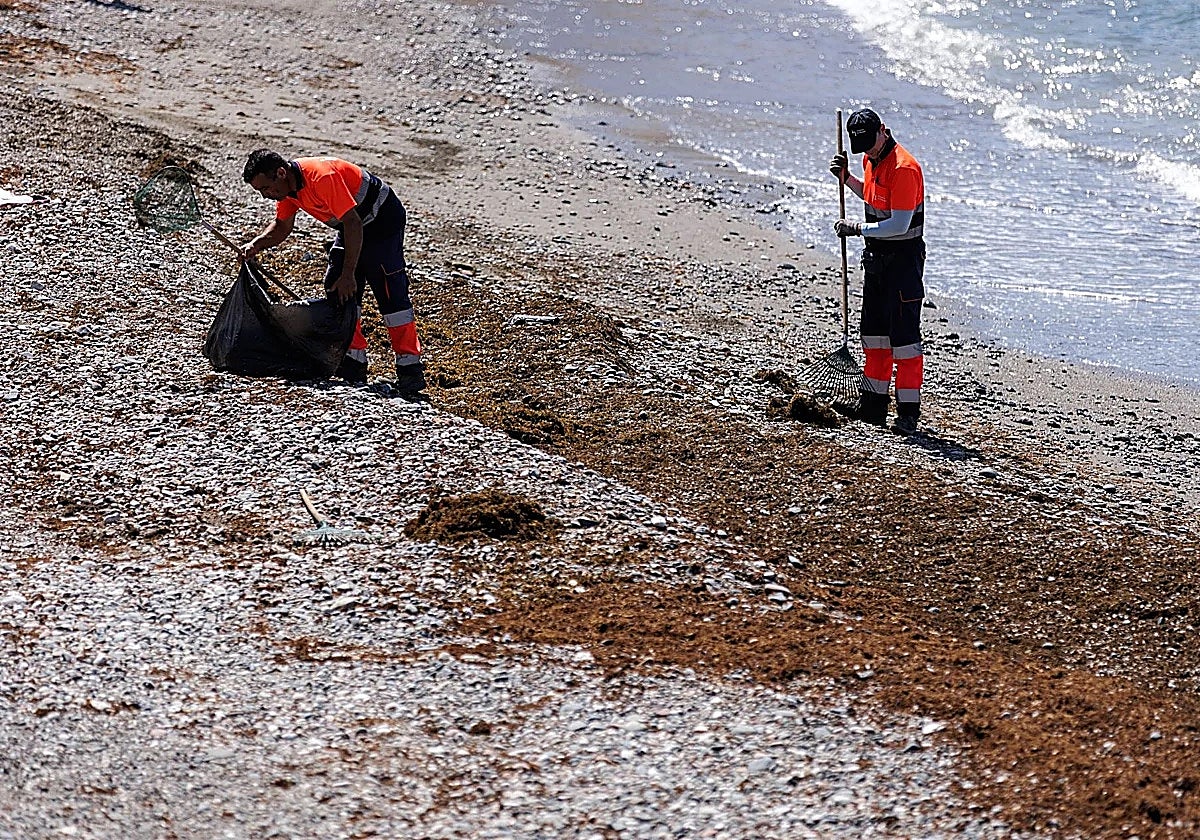
Asian seaweed (Rugulopteryx okamurae) has invaded the Andalusian coast, demanding record removal efforts and forcing local authorities to activate extraordinary budgets and daily machinery.
Originally from the Northwest Pacific, the species has gone from being a localised problem to a genuine environmental and economic emergency on the Spanish coastline.
Recent years have shown uncontrolled expansion that is driving maintenance costs to historic levels. Many municipalities along the Malaga province coast are requesting aid from the central government.
The volume of biomass accumulating on the beaches is showing an alarming increase. In Malaga, the western Costa del Sol is bearing the brunt of the pressure.
Marbella removed up to 374 tonnes in a single day during a severe storm. In Mijas, the town hall removed 2,221 tonnes between April and August last year, which cost it over 500,000 euros. Benalmádena collected 400 tonnes in nine months. According to a town hall statement, Estepona removed more than 450 tonnes in a single year.
Estepona Mayor José María García Urbano is urgently demanding state aid and a coordinated plan with adequate funding, hoping that the Ministry of Ecological Transition will activate a specific funding package for the most affected area of Spain.
The invasion reached Malaga city later than the western part of the province because its seabed is predominantly sandy, hindering the plant's colonisation. However, it now poses a serious problem in the Pedregalejo, El Palo, La Térmica, Sacaba Beach and Baños del Carmen areas.
Since May, the Limasam municipal cleaning company has removed almost 40,000 kilos of seaweed, primarily in the eastern part of the city.
"Until this year, we managed the seaweed deposit routinely. Given the current massive influx, however, Limasam has been forced to activate additional services. Between four and eight workers and one or two tractors are assigned almost exclusively to this task daily. The cleaning service's assessment is that the amount of seaweed has doubled compared to previous years," Limasam sources said.
According to chairman of Costa del Sol coastal sciences Francisco Franco, the difficulty in confronting the plague lies in the invisible nature of its invasion.
"It's the opposite of what happens with American sargassum, which floats, so you know where it is. You can collect it with nets before it reaches the shore. It's easy to prevent. Even so, in the Caribbean, it's impossible to swim in the sea. The difference is that the Asian sargassum doesn't float. It has a slightly higher density than water. When it detaches from the rocks, it leaves a residue on the sand, which is highly mobile. We do a dive and find it one day in Río Verde, Marbella and the next day it's 100 kilometres away. This makes it very difficult to carry out preventative work," Franco said.
Winds and currents dictate the behaviour of the species. The westerly wind is what causes the upwelling of deep waters and carries the large masses that grow in the Gulf of Cadiz.
"Because it's a very thin algae, it's easily torn from the rocks and the currents carry and distribute it throughout the Alboran Sea. On the other hand, the easterly wind tears the algae from the shore in smaller quantities, causing intense influxes on east-facing beaches, like the incident at La Rada in Estepona," Franco said.
As an early containment alternative, oceanaria.es has developed a predictive algorithm using artificial intelligence (AI) that analyses currents and predicts where the algae will reach five days in advance, making it easier for municipalities to efficiently organise their cleaning teams.
The impact of this algae goes far beyond foul odours and decay in the sand. As it decomposes, it releases leachate and harmful chemical compounds. Furthermore, it secretes bitter-tasting toxic compounds and has very high levels of sulphur and nitrogen, preventing local wildlife from consuming it.
Growing without biological control, it creates dense mats between one and 30 metres deep that block sunlight from reaching native flora and suffocate fish and other marine life in their feeding grounds. This has led to the displacement of fish from their traditional habitats.
In the fishing sector, the algae renders traditional fishing gear unusable and hinders trawling operations. The nets become completely clogged, forcing fishermen to haul them in to clean them and repair damaged tackle.
Back in April, the regional government of Andalucía declared the seaweed crisis a force majeure. This allows it to apply exemptions from the state tax on landfill waste disposal to alleviate the financial burden on local authorities.
The plague is now affecting all five coastal provinces of Andalucía. While the Axarquía area is currently only slightly impacted, the Strait of Gibraltar registers an annual biomass of around 100,000 tonnes of fresh weight.
Access environmental monitoring and nature news
![[]](http://static.vocstatic.com/voc26/latest/assets/images/favicon/surinenglish/apple-touch-icon-57x57.png)