
Environment
Asian seaweed crisis declared 'force majeure' in Andalucía
The species has shown an extraordinary capacity for colonisation since it was identified in 2016 in the area around the Strait of Gibraltar
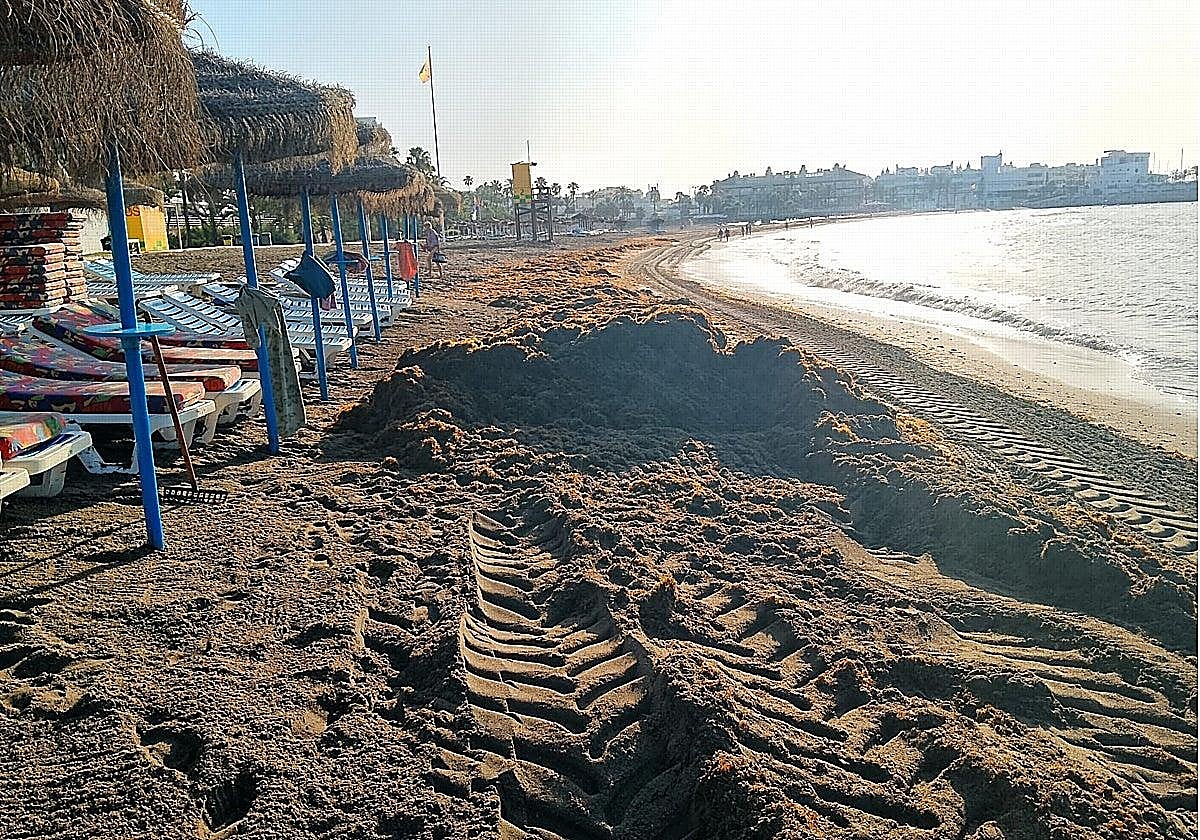
The Andalusian regional government has approved the declaration of force majeure of the invasion of Rugulopterix okamurae, known as Asian seaweed, on the Andalusian coastline.
The agreement will make it possible to apply the exemption from the state tax on the deposit of waste in landfills, with the aim of alleviating the economic pressure on coastal municipalities in the face of this exceptional environmental phenomenon, the Junta said in a press release.
The seaweed which originates in the Pacific Ocean, was identified for the first time in 2016 in the area around the Strait of Gibraltar, having been brought in by tides from the coast of Ceuta. Since then, the species has shown an "extraordinary" capacity for colonisation, expanding rapidly both eastwards and westwards on both sides of the Strait.
Uncontrolled expansion
The seaweed's invasive behaviour is characterised by "disproportionate and unprecedented" productivity and biomass, far outstripping native and other non-native species, to the extent that they now occupy a large part of the Andalusian coastline.
This uncontrolled expansion, together with the scientific evidence that, at least in the medium term, its eradication and the restoration of ecosystems to their previous state is not viable, led to its inclusion in the Spanish Catalogue of Invasive Alien Species in 2020 and its consideration as a species of concern by the European Union in 2022.
At present, the distribution of Rugulopterix okamurae reaches al five coastal provinces of Andalucía: Cadiz, Huelva, Malaga, Granada and Almeria, with the pressure being "especially intense" in Cadiz and in the western part of Malaga. Huelva, despite having less favourable conditions, is not immune to its expansion.
Granada is "widely affected", while Almeria has a significant presence, especially in areas such as Aguadulce, Roquetas de Mar and the Cabo de Gata-Níjar natural park.
Serious consequences
The consequences of this invasion are multiple and particularly serious. In terms of fishing, for example, it makes traditional fishing gear and in many cases, trawling operations "considerably" more difficult, preventing fish from accessing the nets. As a result, the fishing community is forced to hoist the nets to remove the accumulated biomass and subsequently to repair their gear, with the consequent increase in costs and loss of profitability.
On beaches, the massive accumulation of seaweed causes health problems, bad smells and leachates from fermentation and putrefaction, with negative effects on the environment, the landscape and consequent damage to the tourism sector and related activities.
Numerous municipalities have requested extraordinary aid from the authorities.
In the area of the Strait of Gibraltar, it is estimated, even at a conservative estimate, an annual biomass of around 100,000 tonnes of fresh weight, which reaches different coastal municipalities depending on the winds.
Algeciras, Barbate, Conil, La Línea de la Concepción and Tarifa in Cádiz, as well as Estepona and Marbella in Malaga, are under "extraordinary pressure" due to the constant need to remove the seaweed, the growth of which is "incessant and uncontrolled".
In Rota (Cadiz), the volume transported to landfill doubled from 2022 to 2023, tripled in 2024 and increased eightfold in 2025; in Algeciras in 2024 three times more was removed than in 2023 and five times more in 2025; while Tarifa has managed more than 11,000 tonnes in a single summer, quadrupling previous records. In Marbella "hundreds of tonnes have been removed in a single day".
Many town halls have requested extraordinary aid from the authorities, recognising the insufficiency of municipal resources to meet the high costs associated with the collection, transport and treatment of this waste. The removal of this waste generates a massive volume of waste, unpredictable in frequency and magnitude, which requires urgent, repeated and very costly actions.
According to the Junta de Andalucía composting the seaweed is "technically complex" and the industrial uses available are still in their infancy, so the only viable option at present is to manage it as waste and deposit it in landfill.
This management entails the application of the state tax of 30 euros per tonne, established in Law 7/2022, which entails a very significant economic burden for local authorities. However, the law does provide for exemption from the tax in situations of force majeure, extreme necessity or catastrophe, when the delivery of waste is ordered by the authorities.
In this way, the aim is to avoid an "unfair" economic penalty for the municipalities affected, taking into account the "unforeseeable and unavoidable" nature of the phenomenon, the lack of a responsible party and the unavoidable need to act for reasons of public health and environmental protection. The declaration of force majeure will be terminated once a solution for the problem is found.
![[]](http://static.vocstatic.com/voc26/latest/assets/images/favicon/surinenglish/apple-touch-icon-57x57.png)