
Costa del Sol
Marbella has removed an average of 1,500 tonnes of seaweed per month this year
In six months, the town is on track to double the figure recorded throughout the whole of 2025 and the council said the increase is "alarming"

Marbella
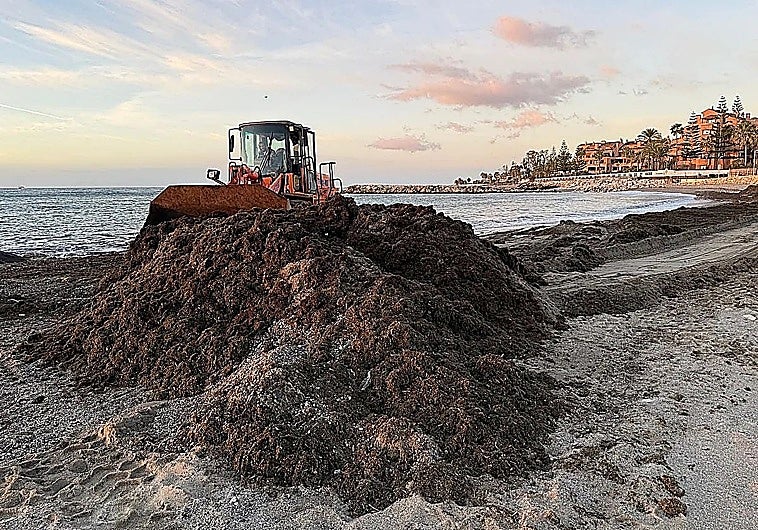
In 2025, Marbella removed 5,300 tonnes of the dreaded Asian seaweed, and so far in 2026 the figure is already close to doubling. As ... of 24 June, the local council had removed 9,110 tonnes of the invasive species Rugulopterix okamurae from the beaches, giving an average of over 1,500 tonnes per month.
In June, up until San Juan, the town hall collected 2,006 tonnes, on course to break the record for the month with the highest amount of Asian seaweed washed up along the 27-kilometre coastline of the province’s second-largest municipality – a record previously held by February, with 2,416 tonnes. March saw 1,392 tonnes wash up on the town’s shores, ahead of January (1,280), May (1,136) and April, which, with 880 tonnes, was the most "favourable" month for Marbella's coastline.
This situation, caused by this algae – which is native to the Pacific and has demonstrated an extraordinary ability to colonise since it was first detected in the Strait of Gibraltar in 2016 – is costing the local authority more than one million euros, according to figures provided by beaches councillor Diego López. The councillor said that the situation “has worsened alarmingly”.
Alone in the face of the emergency
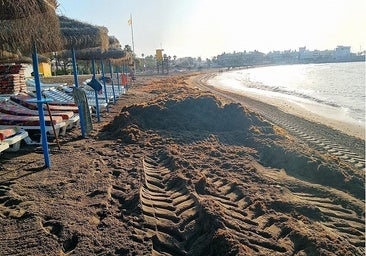
At the last full council meeting on Friday, a motion was tabled calling on the Spanish government to take a greater role in tackling the spread of the invasive Asian algae. “We still have no state funding, we still have no national plan and we continue to face an environmental emergency affecting the entire Andalusian coastline on our own,” said López, pointing out that the town hall has raised this issue in the plenary session on six occasions in recent years.
The initiative, which was approved by the council, calls on the central government to fund the extraordinary costs incurred by local authorities, to approve a national plan to tackle this invasive species, to promote scientific research and to provide specialised vessels to remove the algae at sea before it reaches the coast, thereby reducing both the environmental impact and the clean-up costs.
According to the Andalusian regional government, the invasive behaviour of Rugulopterix okamurae is characterised by "excessive and unprecedented" productivity and biomass, far exceeding that of native species and other non-native species. Its uncontrolled spread, coupled with scientific evidence that, at least in the medium term, neither its eradication nor the restoration of affected ecosystems to their previous state is feasible, led to its inclusion in the Spanish catalogue of invasive alien species in 2020 and its designation as a species of concern by the European Union in 2022.
Marbella & San Pedro hub: View up-to-date local news for Marbella and San Pedro
![[]](http://static.vocstatic.com/voc26/latest/assets/images/favicon/surinenglish/apple-touch-icon-57x57.png)