
People
Young Spaniard beats childhood cancer to become European and world canoeing champion
"When I'm in a canoe, I feel as though I have no limits," Nico Adega says, just before taking part in the AECC event in Malaga this Thursday to mark World Cancer Research Day
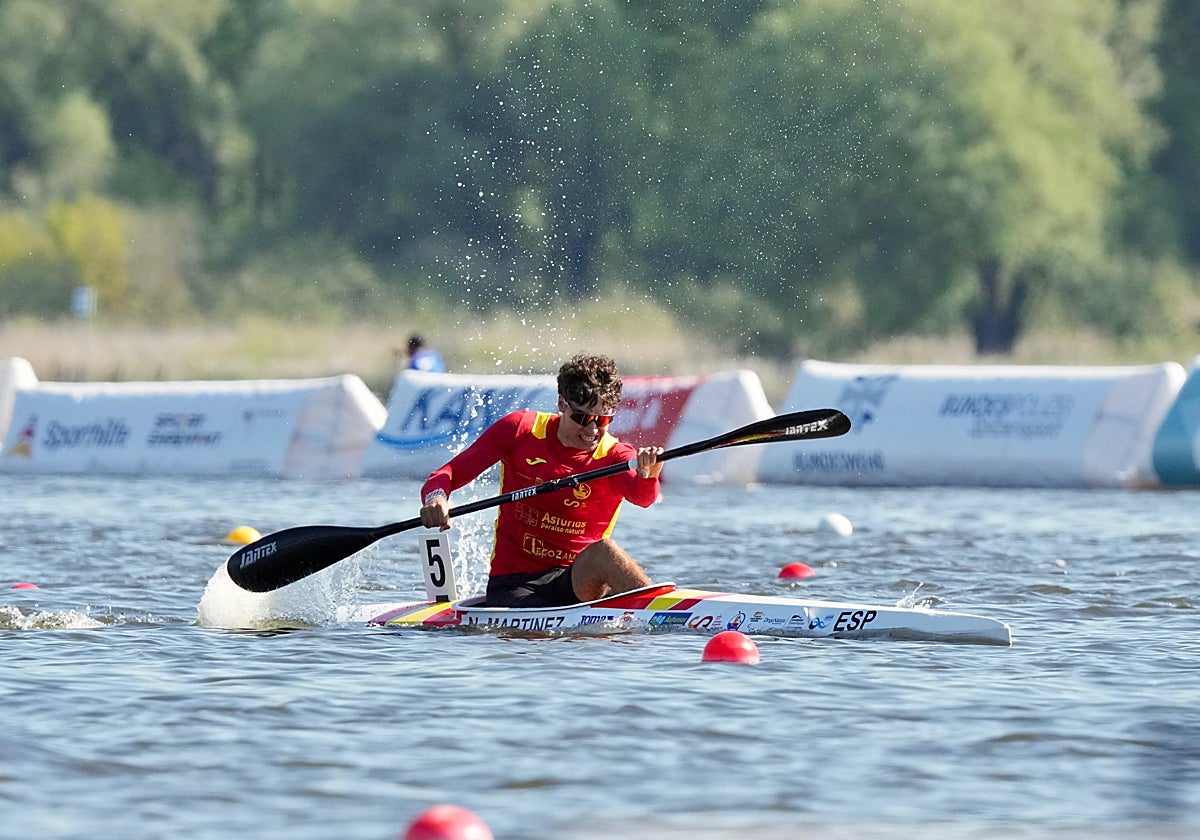

Twenty-year-old Nicolás Martínez Adega, known as Nico Adega (@nico.adega on Instagram), was born in Lugo. His story is one of resilience and ... he wants to share it with the world to give others hope.
At the age of seven, he was diagnosed with osteosarcoma. To recover, he underwent 20 cycles of chemotherapy, 34 sessions of immunotherapy, a surgery to remove part of his right leg and a further 14 procedures to fit him with several prosthetics.
After much searching, he fell in love with adapted canoeing. Adega is now the European and world champion in the KL3 marathon paracanoe event and is preparing to compete at the 2028 Paralympic Games in Los Angeles.
Related story
-
People
José Antonio Sau
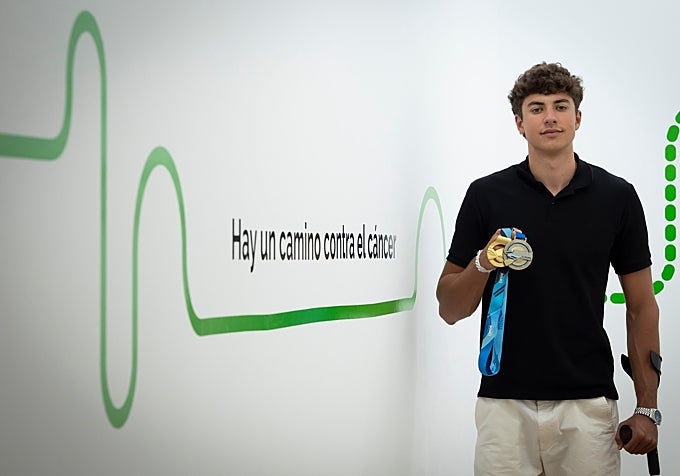
Adega is taking part this Thursday in an event AECC (Spanish association against cancer) has organised to mark World Cancer Research Day.
"I was very active, I used to do all sorts of things and then suddenly, when I was seven, I was diagnosed with osteosarcoma: a type of cancer that is also considered a rare disease. I had it in my knee, which is where it most commonly occurs. I was at a football training session. My mum saw me limping and took me to the paediatrician," Adega tells SUR.
From the paediatrician, he was referred to an orthopaedic surgeon and, following an emergency MRI scan, the family had to come to terms with the news: he had high-grade osteosarcoma in his right knee.
Hospital stay and physical challenges
"I spent practically two years in hospital," Adega explains. He has already had four prosthetic replacements. The latest one involved fitting a "mega-prosthesis" that extends "from the middle of the tibia to the hip".
"They didn't have to amputate it, as it's an internal prosthesis. My leg has normal skin on the outside. It's just that on the inside, instead of bone, I have a prosthesis," he says.
They removed half of his tibia and femur. "Ever since then, I've had a difference in leg length, because when they had to remove the tumour, they took away one and a half of the four quadriceps muscles, as well as the growth plate. That creates an imbalance between my legs. At the moment, the difference in length is five centimetres," Adega says.
He was diagnosed in December 2013 and underwent surgery on 9 June 2014. He had to undergo further surgery to correct the asymmetry between his lower limbs, as his left leg grew normally but his right did not.
The first of these prostheses only lasted him three years. "When I left hospital, they told me I couldn't run, jump or play football," Adega says. Advice he didn’t follow.
On crutches
He now uses a crutch to walk in the street, because he has had muscle weakness in his leg since his last surgery, although he manages to walk without it at home.
Adega thought it was all over when they discharged him. "When they replaced my prosthesis, I realised that the Nico I was now was no longer the same as before," he states.
That was when he started looking into different sports. He tried swimming and cycling on a stationary bike, but didn't get hooked. For five years, every time he would go to the doctor, he would ask his mother to enquire whether he could take up various sports, ranging from judo to table tennis.
The doctor would always say "no", but when Adega was 13, he received the green light to be active. That's when canoeing came into his life.
Since the start, he has been training at the Club Fluvial de Lugo. At first, he competed in the conventional discipline. "I spent more time in the water than in the canoe. You can imagine what winters are like in Galicia, so every time you fall in, it's a proper pain, but I got hooked because I realised I was just like everyone else," Adega says.
It was this sense of belonging and equality that got him hooked on the sport. When he played basketball with his brother and friends, he was much slower and felt left behind.
International success and Paralympic dreams
After two years in canoeing, someone told him about paracanoeing or adapted canoeing. "I took it up and achieved good results straight away: Galician champion, Spanish champion and I have the chance to join the CGTD, Galicia's sports training centre, where I'd be adapting to a high-performance routine of training and studying," Adega explains.
At the age of 16, the young athlete took part in his first international championship, in Portugal, where he competed against Europe's best in the senior category. He finished eighth.
"When the season ends, I have to go to Seville so that I can balance the degree I wanted to study with my sporting commitments. I'm studying Computer Engineering, specialising in Software Engineering, there in Seville. This is my sixth year away from home," Adega says.
He joined the national team and was given the chance to try his hand at the marathon: "I'd never competed before, but I thought I might be quite good at it."
He qualified for the World Championships in Hungary, which he won. This year, he competed in the European Marathon Championships, where he came first. "Without the researchers, I certainly wouldn't have been here or won these medals," Adega says.
He has competed in other events, in the 200-metre category, but his forte is the marathon, where he has enjoyed his greatest successes (KL3 marathon paracanoe).
"My aim now is to try to qualify for the Paralympic Games and bring a medal back to Spain," the young athlete says.
According to Adega, when faced with illness, there are two options: "One, carry on and trust that everything will turn out all right in the end, or let yourself be brought down, which will be worse. If you're in a bad frame of mind, your body's defences drop and that will mean the treatment won't work as well. At the age of seven, I had to learn that health is the most important thing and that, if you don't have it, you can't do anything with your life," he states.
"Sport has changed my life. It has allowed me to feel just like everyone else. When I'm in a canoe, I feel as though I have no limits."
![[]](http://static.vocstatic.com/voc26/latest/assets/images/favicon/surinenglish/apple-touch-icon-57x57.png)