
Health
Malaga dermatologists debunk dangerous 'solar callus' social media myth
Hospital El Clínico has detected a large increase in melanoma cases, almost 200 in 2025, although early detection allows for curbing the most aggressive skin cancer
José Antonio Sau
Dermatologists at the El Clínico hospital in Malaga have declared war on the hoaxes spreading like wildfire on social media. One of these is the "solar callus" or "sun callus" myth, which claims that exposing oneself to the sun from the beginning of summer without sun cream helps the skin develop a protective barrier.
Dermatologists warn that this myth increases the risk of skin cancer.
Rosa Castillo, coordinator of the melanoma unit at the hospital, firmly states: "Simply acquiring melanin, developing a tan, doesn't protect you from the mutations caused by ultraviolet radiation. Furthermore, sun damage is cumulative, meaning the skin has a memory. In the long run, that skin has suffered a series of damages and has a higher risk of developing skin cancer."
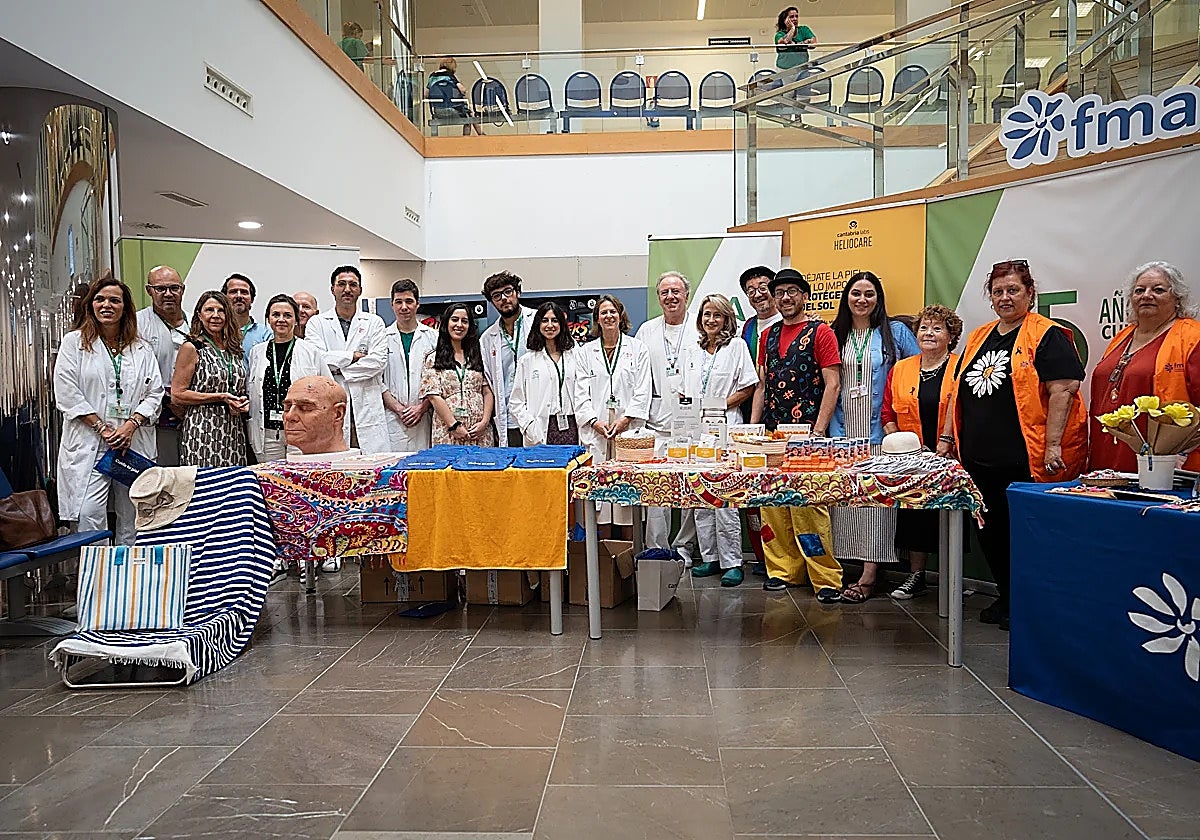
Hospital Clínico has officially presented the Euromelanoma 2026 campaign of the healthy skin association, with which it aims to help young people discern myth from truth.
Experts say that "sunburns during childhood and adolescence and burns that 'turn red' and develop blisters double the risk of having melanoma".
Sun cream
There are other myths, such as the one about sun cream being carcinogenic. "That is, that they cause cancer or that they are endocrine disruptors or pollutants," Dr Castillo says.
"This is not the case. Backed by the scientific community, we know that all these products are properly tested and, when used correctly, are completely safe and protect us against skin cancer," she states. It is also untrue that using sun cream reduces vitamin D levels.
"We often remember to apply sun cream when summer arrives, but we live in Malaga, in the Costa del Sol, and here we have to take a series of measures throughout the year, not only when going to the beach or the pool," Dr Castillo says.
Melanoma on the rise
The campaign highlights the increase of melanoma cases. Analysis of data from the hospital registry shows a progressive increase in the number of melanomas diagnosed over the last three years: 146 cases in 2023, 181 in 2024 and around 200 in 2025.
The most relevant finding is the sustained increase of so-called melanomas in situ (confined exclusively to the epidermis that have not invaded deep layers), with 34 in 2023, 46 in 2024 and 57 in 2025 (which represents more than 29 per cent of the total).
Invasive melanomas, meanwhile, accounted for 112 cases in 2023, 135 in 2024 and 138 in 2025.
A key clinical indicator, the Breslow thickness, which measures tumour thickness, has maintained a stable median of around 0.5 millimetre throughout the three-year period. This minimal thickness of just half a millimetre confirms that the hospital is intercepting lesions at very early stages, resulting in an excellent prognosis and much less aggressive treatments.
Thanks to the implementation of advanced techniques and a greater culture of prevention, diagnoses in hyper-early stages broke records last year, allowing for the effective treatment of the most aggressive skin tumour.
Dr Castillo highlights the importance of early diagnosis: "it means going from not saving lives to saving them".
It's not just about promoting primary prevention, but also secondary prevention. "Today, thanks to teledermatology, as soon as a patient detects a suspicious lesion or a GP suspects a lesion during a routine check-up, we quickly receive that image and within 24 hours the patient is here in a skin cancer unit, where they can be offered treatment and follow-up," Dr Castillo states.
Tanning
Tanning, as such, is harmful. "Tanning is really an increase in melanin, which is actually a defence mechanism against solar radiation, but just because the skin defends itself doesn't mean it's actually protected," Dr Castillo explains.
She asks young people to think and reject the idea that being tanned "is totally healthy and has no repercussions throughout life".
Dermatologist Eliseo Martínez reminds us of the ABCDE rule for skin lesions. A stands for asymmetry (benign lesions should be symmetrical). "A benign mole has this rounded shape," he says.
B stands for borders. "The borders of a benign mole are usually regular, while the borders of a malignant lesion are usually irregular," he states.
The C refers to colour. "Benign moles usually have a single color. If they have two or more colors, it doesn't necessarily mean they are malignant, but it does require a specialist to examine them," he states.
Then there's the D, for diameter. "These are moles that, when they are larger or growing, starting at six millimetres, require more attention," he adds.
Perhaps the most important is "E, for evolution". "A mole that changes and causes symptoms, a mole that is different from the rest, is a lesion that needs to be checked," Dr Martínez says.
More tips
"We know we need to protect ourselves, but sometimes we don't do it diligently enough. When we buy sun cream, they often promise very high sun protection factors, but those levels are only achieved under very specific conditions," doctors say.
Sun cream should be applied at least every two hours and the sun should be avoided "during peak hours of the day".
Review public health, medical care and clinical news
![[]](http://static.vocstatic.com/voc26/latest/assets/images/favicon/surinenglish/apple-touch-icon-57x57.png)