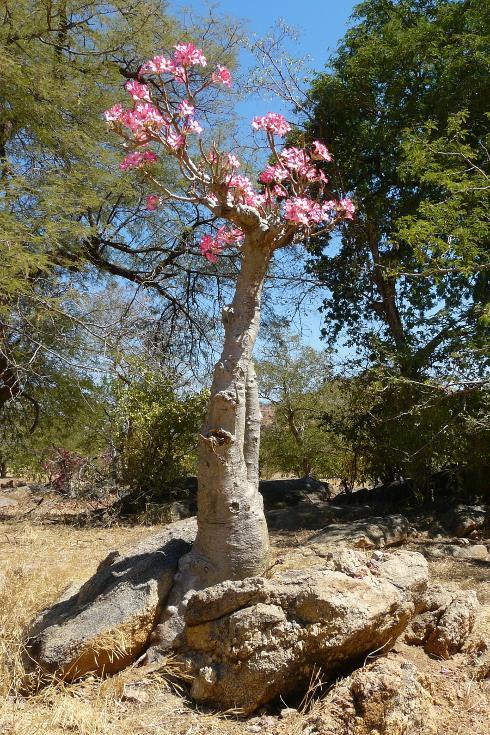
Adenium obesum
This succulent bush or small tree is native to arid parts of the world such as Sudan, Yemen, Socotra and Namibia
Denise Bush
Viernes, 5 de octubre 2018, 08:45
Adenium obesum is a member of the Apocynaceae (dogbane) family and, as with its cousin oleander, all parts of it are poisonous.
Adenium obesum is a stunning and easy-to-care-for plant and common names include mock azalea, impala lily, dwarf bottle tree and desert rose. The flowers are similar to a lily or an azalea: large and trumpet-shaped in red, pink, white or yellow or colour combinations. The blooms are long lasting and in ideal situations the desert rose will come into flower twice a year, in spring and in early autumn.
Getting ahead
-
Gardening hints for october
-
In October in Spain the soil is still warm and there is the promise of rain which makes this the best time to sow hardy annuals such as larkspur, poppies, calendula and nigella directly in to the ground. In mild areas it is even worth the risk of sowing the less hardy ones to ensure large, healthy plants in the spring which will provide even more flowers.
-
If sowing directly into garden soil, make sure it is raked to a fine tilth and all weeds removed. The flower seeds can be scattered thinly for a natural look or sprinkle in shallow drills before covering them with a fine layer of soil. Water them carefully with a watering can with a fine rose fitted. On very cold nights it may be prudent to cover the area with a piece of horticultural fleece as added insurance.
The bright green leaves are oval and arranged in a spiral around the stems; they are generally evergreen but in cooler areas may drop. The main stem or trunk (caudex) gives the plant the 'obese' or 'bottle' description. From seedling size it rapidly swells to store water and, once the plant is mature, can withstand long periods of drought.
A. Obesum has many subspecies, all of which are popular with Bonsai fans. Once the root system has developed, it is often repotted into a shallow dish with most of the root system exposed to give the appearance of a very old tree.
To prevent the trunk from rotting, it is best to water it only when the soil has dried out and not to water at all when it is dormant during the winter. As the desert rose is not cold or frost hardy it will need protection or can be brought indoors and placed in a draught free position with plenty of natural light.
In a free-draining soil, preferably a special mix for cacti, and placed in full sun, the desert rose will grow into a bush or small tree. It can be trimmed in the spring or at the end of the summer and the cuttings propagated. It can also be grown from seed.
When repotting use a strong ceramic or earthenware pot (the roots may burst through thin plastic) about three centimetres larger than the base of the plant and replace all the compost.