
Fire in Almeria
British tourists rescued in Almeria fire: ‘They begged us to save them because they wanted to see their children again’
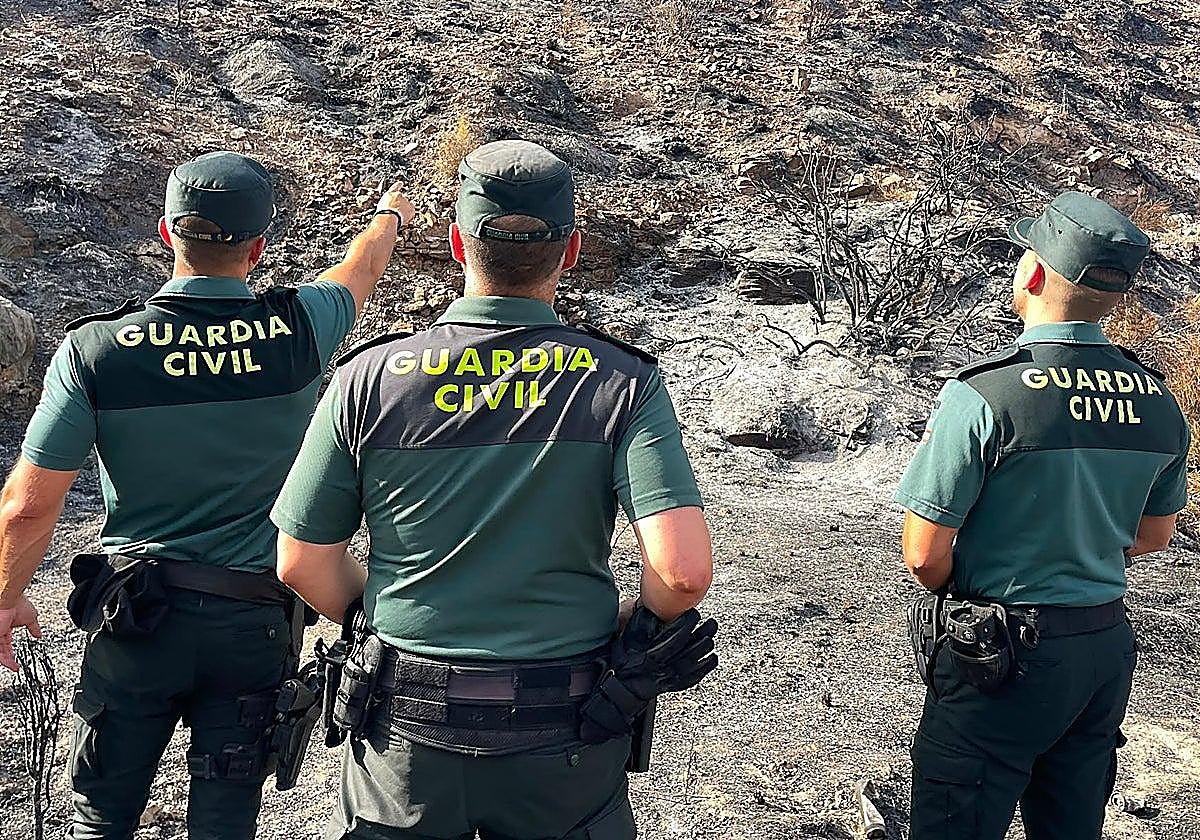
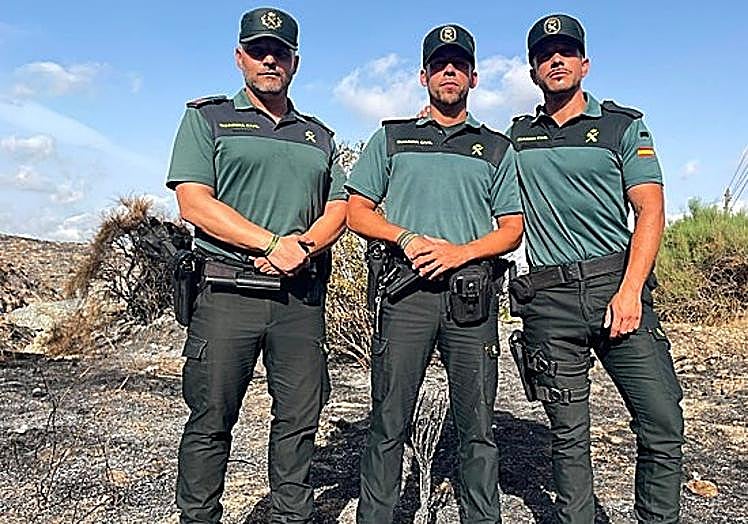
Civil Guard Sergeant Pedro Garre and officers Rafael Zea and Manuel Moyano rescued the couple, with 40 per cent burns, from the bottom of a ravine in the Bédar area

Nerea Escámez
Almería
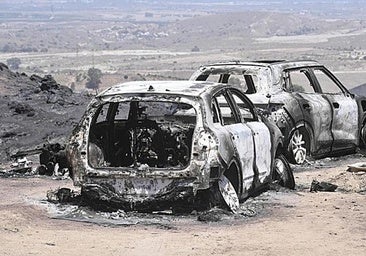
It was half past eleven on Thursday night. The mountainous terrain of Bédar was ablaze. The flames had devoured everything in their path, and silence - ... broken only by the crackling of the embers - enveloped every ravine.
Stealthily, Sergeant Pedro Garre from Zurgena made his way down the slopes alongside Guardia Civil officers Rafael Zea and Manuel Moyano, both stationed in Vera. Following the evacuation instructions, they set out in search of possible victims and the injured, and, conducting a search in complete darkness, began to shout down a ravine: "Is anyone there? Guardia Civil!"
There were no answers. Just silence. Until they heard a faint sound that they initially mistook for the echo of their own voices. “It sounded quite far away; from where we were, it was impossible to pinpoint its source because of the considerable distance and, moreover, the darkness,” Garre tells Almeria newspaper IDEAL as he surveyed the scorched ground at an affected site some distance from the exact rescue location, which is inaccessible due to the extent of the damage to the terrain.
They continued to comb through this stretch of the Bédar ravine until they reached the top of a hill. There, they kept shouting, searching for any glimmer of hope.
Related story
-
Miguel Cárceles and Nerea Escámez
They needed to find people who were still alive. Voices answered from closer by; "They were no longer just an echo," they say.
On reaching a wall along the riverbed, they could make out cries for help in a foreign language. It was two British tourists lying among the embers. The scene was hellish. Their bodies were covered in severe burns and they could barely move. Amid the ashes, the green uniforms offered a glimmer of hope.
“No one could have imagined that there were people still alive there, but our hearts told us we had to be there. Now we look at the ravine and ask ourselves: ‘How on earth did we manage to get down there?’” says Manuel, still shaken by the rescue.
“They didn’t speak a word of Spanish,” says the sergeant, who, however, did not find the language barrier to be a problem. Officer Rafael Zea communicated perfectly in English. The first encounter between the rescuers and the victims perfectly summed up a desperate situation: they said “Please, save us, we need water, we’re going to die, we won’t make it,” says the Guardia Civil officer who interacted with the couple.
“We were coming down a very steep section and hadn’t brought any bottles of water with us. When we saw how dehydrated they were and that the first thing they asked for was water, some of our colleagues who were with us decided to climb back up the hill to fetch water and come back down, despite the difficult terrain,” says the Guardia Civil officer.
“Giving them water was a priority because that was what they were asking for most.” After clarifying any medical concerns with the relevant staff, they kept them alive sip by sip.
The tourists from the United Kingdom, around 47 and 51, were in Almeria on holiday.
“They told us they had three children in England and wanted to see them again, that they weren’t sure if they were going to survive” - that hope may well have kept them alive, as their condition was far from compatible with survival.
“We kept telling them that yes, they were going to survive, that they’d been very lucky given the devastation surrounding the Rambla,” says Zea, still shaken by the experience, “We just told them to think about their children and not that they were going to die,” he said starkly.
Those Guardia Civil officers kept the injured conscious to prevent them from falling asleep. They spoke to them every five minutes.
“They did the same with each other; they wanted to make sure they were all right,” explains Moyano.
The voices sounded more like a desperate attempt to stay alive than a proper response to the questions being asked.
“She kept asking me how long it would be before we could get out of there, and I just kept saying, ‘Ten minutes’,” he says. A reply that was repeated for around three hours - the time it took for the fire brigade to evacuate them using the appropriate equipment from the bottom of the ravine.
They had no idea of the extent of their injuries. “They might have had a broken bone or internal injuries,” says Moyano, who watches his colleagues recount that experience, his eyes betraying the exhaustion of those hellish days.
“I had to press myself against the wall with the person on top of me so that they had something soft to rest against. At that moment, in fact, as we were on a hillside, rocks were falling due to the heat; a rock weighing about 35 kilos fell right next to us.”
Sergeant Garre and officer Zea decided to move to a central spot: “As a means of survival, when they saw a rock fall - and despite their condition - they sat up to tell us, ‘Get us out of here, rocks are falling on us’; that’s what struck me the most - the fight for life,” he recounts with a heavy heart, “They helped us with their sheer willpower so that we could evacuate them, always taking great care.”
Psychological value
The presence of the Guardia Civil alongside the injured tourists was that ray of light they needed in the darkness, a feeling that was further enhanced by the application of psychological support - a crucial aspect when fear takes hold of the injured who have experienced such a catastrophic situation. Indeed, the state of distress experienced by the British tourists was soothed by the expertise of that group of Guardia Civil officers:
“We were their hope on that dark hillside; they told us all their worries, and the bond we formed at that moment was incredible – something that cannot be put into words,” says the officer, still moved by that rescue.
When help reached the very bottom of the ravine, it was time to climb back up. Once they were on the stretcher, they had to be carried up so they could be rushed to hospital.
“The woman kept stroking me with her finger despite the severity of her injuries; I’d step away for a second and then she'd call me back - she didn’t want to lose sight of me,” he explains.
The paramedics set off for Torrecárdenas University Hospital with the two people seriously injured by burns, who were then transferred to the burns unit at the Virgen del Rocío Hospital in Seville.
Back in Bédar, this group of Guardia Civil officers were left with the satisfaction that they had done their duty and had done everything possible to get them out of there.
“At that moment, we knew nothing of their condition; we knew they were in a serious state and feared the worst,” reflects Garre, “The rest was in the hands of the doctors.”
Experience
The rescue and evacuation operations meant the officers had to work longer hours but finally it was time to head home.
“It’s when you wake up that you say, ‘Goodness me, what’s happened’,” says Rafael. “Even now, days later, we still haven’t fully realised just how immense the effort we put in was,” he adds.
Neither he nor Manuel have ever experienced a situation like this before, unlike Sergeant Pedro Garre, who was there during the floods in Almeria and Murcia in 2012.
“You’re always afraid, because that’s what keeps you safe, but during the fire itself, the moment I felt it most was when we were in the car - you could see the trees engulfed in flames; the car could have overturned,” he explains.
Standing near a plot of land reduced to ashes, Guardia Civil officer Manuel Moyano stares straight ahead; everything is desolate, yet he is in no doubt: “The satisfaction I feel right now is that when those people saw us arrive, what they saw was a Guardia Civil uniform,” he explains.
It has been etched in their hearts even before they entered the academy; it is "the spirit of the Guardia Civil", he says.
At his side, Rafael Zea remains hopeful that they will be able to get in touch with the injured as soon as they are out of danger: “They’ll pull through and we’ll see them again,” say the men, who will never forget the faces of those British tourists.
![[]](http://static.vocstatic.com/voc26/latest/assets/images/favicon/surinenglish/apple-touch-icon-57x57.png)